


Here is the text of the Title IX law:
“No person in the United States shall, on the basis of sex, be excluded from participation in, be denied the benefits of, or be subjected to discrimination under any education program or activity receiving Federal financial assistance.”
Congress passed it in 1972, and President Nixon signed it into law that June. Not a word has changed since.
My oldest son is a college freshman this fall. He moved into a dorm governed by those same 37 words. He moved into a rulebook that Washington has rewritten so often that a student can enroll under one version and graduate under another.
This piece is about the gap between the words and the rulebook, and the actions, or inactions, this gap has allowed.
What the law intended
Title IX was written to open doors. Rep. Patsy Mink of Hawaii, the first woman of color elected to Congress, had been turned away by medical schools because she was a woman. She, Rep. Edith Green, and Sen. Birch Bayh pushed the law through to stop schools that took federal money from shutting women out. In 2002, Congress renamed it the Patsy T. Mink Equal Opportunity in Education Act.
It worked. Women now earn most bachelor’s degrees in this country. Girls’ sports grew from an afterthought into the part of Title IX most Americans know.
The law itself never mentions sports or sexual assault. Both came later, as people asked what “subjected to discrimination” means in practice.
How sexual violence became a Title IX issue
In 1977, a group of Yale students sued their university. They argued that sexual harassment by professors was sex discrimination, because it kept women from getting the same education as men (Alexander v. Yale). The courts never ruled for them on the merits. The argument held anyway, and it became the foundation of the campus protections students rely on today.
In 1998 and 1999, the Supreme Court decided two cases about when a student can sue a school for money. In Gebser v. Lago Vista, it said the school must have had actual knowledge of the harassment and responded with deliberate indifference. In Davis v. Monroe County, it said peer harassment must be “severe, pervasive, and objectively offensive.”
That’s a high bar, and the Court set it high on purpose. It was deciding when a school should pay damages, which is a different question from when a school should step in to help a student.
Five swings in one childhood
For years, federal guidance kept those two questions apart. The bar for suing stayed high. The bar for a school’s duty to respond stayed lower. Then the swings began.
2011. The Obama administration told schools to use the “more likely than not” standard of proof in sexual misconduct cases.
2017. The Trump administration rescinded that guidance and let schools use the tougher “clear and convincing” standard.
2020. The DeVos rule took effect, the first binding regulation on campus sexual misconduct.
2024. The Biden administration replaced it. Courts blocked the new rule in many states almost immediately.
2025. In January, a federal court struck down the 2024 rule nationwide, and schools went back to the 2020 version.
On September 28, Education Secretary Linda McMahon formally reinstated the 2020 rule. It took effect immediately, with no public comment period (Chalkbeat explained).
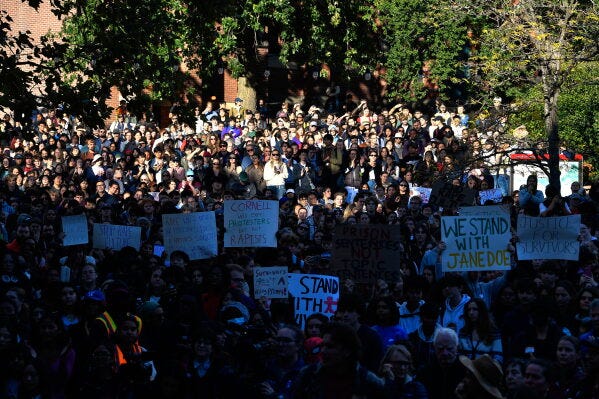
So the latest move didn’t change what’s happening on campuses this semester. It locked it in. The 2020 rules were in force when Cornell investigated and held hearings in Jane Doe’s case, the one everyone has been reading about for the past three weeks.
How the bar moved
The most important thing about the 2020 rule is easy to miss. It took the standard the Supreme Court built for money-damage lawsuits and made it the standard for whether a school has to act at all (Congressional Research Service).
The test for when a school owes a victim money became the test for when a school owes her help.
Today, here’s what that looks like for a student:
The harassment has to be severe, pervasive, and objectively offensive. Sexual assault still counts. The months of harassment before or after may not.
A college’s duty to act starts when an official with authority knows. Telling a professor or a coach may not be enough.
A formal complaint starts the formal process. A student has to file one.
Colleges must hold live hearings, where each side’s adviser cross-examines the other.
Schools choose their standard of proof, “more likely than not” or the stricter “clear and convincing.”
Some places aren’t covered. Incidents in study-abroad programs fall outside it, and off-campus conduct counts only where the school has control.
There are no explicit protections for LGBTQ students. The 2024 rule covered gender identity and sexual orientation. This one drops that language.
Lambda Legal said the rule “lets schools look away until harm becomes severe and pervasive, and forces survivors through re-traumatizing courtroom-style cross-examination just to be heard” (Lambda Legal’s statement).
What enforcement looks like now
A rule is only as strict as the office that enforces it.
In 2025, the Education Department’s Office for Civil Rights closed seven of its 12 regional offices (The 19th reported). Of the 7,072 complaints it resolved between March and September 2025, it dismissed 6,353, about 90% (GAO findings, via The Arc). A Senate HELP Committee report found it reached zero sexual-violence resolution agreements with schools in 2025, with 334 cases pending.
In January, the same office opened 18 new investigations involving transgender athletes (Fisher Phillips summarized).
When she announced the September rule, McMahon promised to “hold accountable any school or college that violates the rights, privacy, or athletic opportunities of our women and girls.”
Shiwali Patel of the National Women’s Law Center responded: “While the administration is unlawfully eroding protections for trans students under the guise of ‘protecting women and girls,’ they are systematically weakening the very laws that keep students safe and schools accountable” (NWLC’s statement).
Safety comes before belonging
The most recent national survey of 33 universities found that 25.9% of undergraduate women experienced nonconsensual sexual contact by force or incapacitation during college. Among transgender, genderqueer, and nonbinary undergraduates, the figure was 23.1% (AAU Campus Climate Survey).
Then there’s the trust gap. Sixty-six percent of all students believe their school would take a report seriously. Among students who have been victimized, that drops to 45% (RAINN’s campus statistics). The students who know the system best trust it least.
That gap costs people their education. Research links sexual assault to lower grades, withdrawing from classes, and leaving school (University of Kentucky research). In one study, 14.3% of women raped during their first semester finished it with a GPA below 2.5.
Patsy Mink wanted a fair shot to access education. A student who doesn’t feel safe in their dorm is still technically enrolled, but may not stay long.
A floor that doesn’t swing
If the federal rulebook flips every few years, students can’t count on it. Colleges can.
Federal rules set a floor. Schools can write stronger protections into their own codes of conduct, and states can require them. California already requires trauma-informed policies that cover off-campus conduct, whatever Washington decides. New York requires campus climate surveys every two years.
Cornell has now partnered with New York State Police on assault investigations and added a case manager for survivors (AP via OPB). Those steps came after a lawsuit and three weeks of national headlines. They belong in every college’s handbook before the next lawsuit, with no headlines needed.
Tarana Burke wrote in her Time essay that the administration’s decision “only adds to the helplessness so many survivors feel.” A university that sets its own higher floor is telling its students they don’t have to wait for the next election to feel safe.
What I told my son
When the Cornell story broke, my son and I talked about it. He said talk of it was all over campus, and that it all seemed unfathomable to his circle of friends. We discussed what consent means, and that someone too drunk or high can’t give it.
I reminded him that we are the helpers. Anyone who sends a message like that in a group chat is one person, but everyone who reads it and stays quiet shapes the culture too. If he sees something wrong, he should say something and do something, even when it costs him.
He’ll spend four years on a campus governed by 37 words and whatever rulebook Washington hands his school next. I’d like his school’s promise to every student to last longer than that.
Education for all requires safety for all.
If this helped you understand what changed, share it with a parent who has a kid on campus.
Slade Wentworth | The Dad Briefs covers the civic, political, and quietly human stories that shape family life in America, with recipes along the way.