


Charrie Stambaugh became a U.S. citizen in the 1990s. She earned degrees from Purdue and Indiana University, married, raised kids, started a photography business, and voted in every election she could.
This spring, a Facebook post told Indiana voters to check their registration. Stambaugh looked hers up and found her registration had been canceled. She registered again and got a letter from the Johnson County Clerk’s Office requiring her to prove her citizenship to keep her right to vote.

Indiana’s check ran on old motor-vehicle records. On Friday, the Supreme Court cleared the way for a much bigger version, built on Homeland Security files and Social Security data covering nearly every American.
The ruling
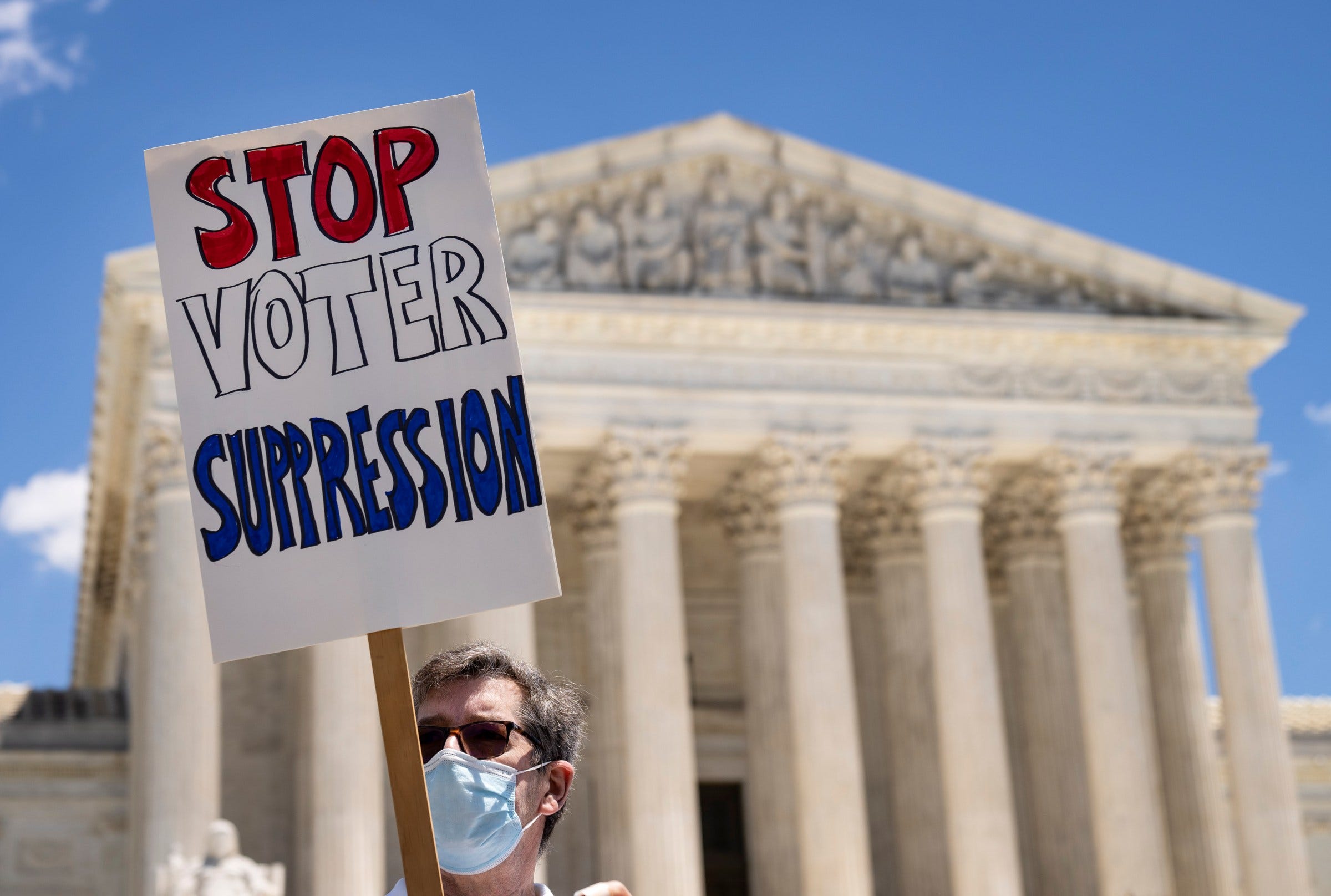
In an unsigned 6-3 order, the Court let the Trump administration restart the modified SAVE system. States can upload their entire voter rolls and have DHS flag anyone it thinks isn’t a citizen.
Justice Ketanji Brown Jackson wrote the dissent, joined by Justices Sotomayor and Kagan. She argued that burdening even a few lawful voters outweighs a harm to the government that doesn’t exist.
In June, a federal judge found that agencies had haphazardly combined private data on millions of Americans, including citizenship data they knew was unreliable. That system is back on.
Voluntary on paper
No law requires your state to use SAVE, and the ruling doesn’t either. The Court said Washington must answer when a state asks it to check a voter’s citizenship. Each state decides whether to ask.
Maine’s secretary of state, Shenna Bellows, refuses to use it. She said after the ruling that it “does not force states to change the way we run our elections.”
The executive branch is pressuring states
In July, the Department of Homeland Security attached new grant conditions to more than $1 billion in homeland security funding. A state that takes the money must run every registered voter through SAVE within 120 days. Until it does, FEMA holds back 20 percent of the award. DHS Secretary Markwayne Mullin said states that want a grant need their voter lists “scrubbed.” Congress never wrote that requirement.
The Justice Department is pushing too. It has sued 30 states and D.C. for full voter files, including driver’s license and Social Security numbers. According to the Brennan Center’s DOJ tracker, the department has said it will run whatever it collects through SAVE. A March executive order also tells DHS to build state-by-state citizenship lists from federal data, a project NPR reports the ruling helps clear.
Rightfully, the courts keep saying no. On September 22, a federal judge in Seattle tossed DOJ’s Washington lawsuit, the department’s 25th straight loss. No judge has ruled in its favor, and a federal appeals court has also rejected its Michigan case. DOJ has appealed many of the other losses.
The losses cross party lines. In Colorado, a George W. Bush appointee dismissed the case with prejudice, meaning it can’t be refiled. He found DOJ gave no valid reason for needing the rolls and that federal law doesn’t entitle the department to unredacted voter files. In California, a federal judge called the demand for data on 23 million voters “unprecedented and illegal.”
What DOJ can’t win in court, some states hand over anyway. At least 16 Republican-led states have given or promised their full voter lists. A state can turn down SAVE and still have every voter screened once its file sits in Washington.
A temporary order with a long reach
The order is a stay. It lasts while a federal appeals court in D.C. hears the case, and through any trip back to the Supreme Court.
Federal law bars systematic purges in the 90 days before a federal election, and that window opened August 5. On paper, that shields the midterms. Given how this administration treats the law, I wouldn’t bet my ballot on paper.
After November, that protection ends. The administration can restart bulk SAVE screening of state voter rolls, and purges can begin, with a runway straight to 2028. Until then, election officials can use the system to check individual voters.
The Court is also set to decide RNC v. Mi Familia Vota, which asks whether states can remove suspected noncitizens inside that 90-day window. If the RNC wins, states could purge anyone SAVE flags right up to Election Day.
A lawsuit led by Florida
Some states didn’t need a push. In 2025, Florida led Ohio, Indiana and Iowa in a lawsuit against DHS. It ended in a 20-year settlement guaranteeing the four states bulk uploads and Social Security number searches. Florida’s secretary of state said the deal would improve SAVE “for decades”.
When the D.C. judge blocked SAVE in June, a federal judge in Florida ordered access restored for those four states anyway. For most of the summer, two federal courts disagreed about whether the system could run at all. Four states kept using it.
The errors and the fraud
Texas ran all 18 million of its voters through SAVE, and the system flagged 2,724 as potential noncitizens. County officials gave each of them 30 days to prove citizenship and removed anyone who didn’t respond in time. About 20 percent of those flagged were later found to be citizens and reinstated. The state referred 117 cases for investigation. That’s 117 names out of 18 million.
In one Missouri county, half of the voters initially flagged as noncitizens have been confirmed as citizens. Utah spent more than a year and a quarter-million dollars reviewing its entire voter roll and found 27 confirmed noncitizens among 2 million voters.
Iowa shows the gap between a flag and a finding. Before the 2024 election, the state flagged more than 2,100 registered voters as possible noncitizens using transportation records. After checking SAVE, it confirmed 277 were noncitizens, and 35 had cast ballots that were counted. Louisiana identified about 400 potential noncitizens among nearly 3 million voters and found 83 who had voted in at least one election since the 1980s.
The errors start in the data. Social Security didn’t record citizenship systematically until 1978. The agency relies mostly on people reporting their own naturalization in person, so its records lag for naturalized citizens. About half of Americans don’t have a passport, which is the backup record that clears many flags.
The errors in SAVE are significant. The voter fraud it claims to find is NOT.
Know your state’s deadline
When a state flags you, state law sets the clock. Federal law doesn’t set a deadline for citizenship challenges, so the rules range from a month to no warning at all. Here’s what the states with specific rules or active programs require.
Arizona:
35 days. The county recorder mails a notice. If you don’t prove citizenship within 35 days, your registration is canceled and your name goes to the county attorney and attorney general.
Texas:
30 days. If you don’t submit proof by the 30th day after the notice is mailed, the registrar cancels your registration.
Indiana:
30 days, plus a hearing. You must provide proof within 30 days of receiving the notice or your registration is canceled. If you can’t produce documents, you can appeal to the county election board, which must hold a hearing.
Mississippi:
30 days. The registrar sends notice by mail and may call or email. You have 30 days to provide proof and stay in pending verification status until you do.
Utah:
30 days. A flagged voter has 30 days to provide proof or is removed.
Florida:
30 days, plus a hearing. You get notice, then 30 days to respond, with the right to request a hearing.
Virginia:
14 days. The registrar mails a notice, and you have 14 days to submit a sworn statement of citizenship or your registration is canceled.
Georgia:
Three days’ notice. If registrars question your eligibility, they must give you at least three days’ written notice of a hearing. You can appeal to superior court within 10 days of the decision.
Ohio:
Removed first. Counties cancel flagged registrations within five business days and send notice afterward. You can request a hearing within 30 days. The law is being challenged in court.
Kansas:
Removed first, for motor-vehicle flags. Voters flagged by motor-vehicle records are removed within five business days, then notified. Under a 2026 SAVE law, counties must notify voters flagged by SAVE before cancellation.
Iowa:
No deadline specified. A 2025 law creates an “unconfirmed” status for voters reported as noncitizens. You confirm your status by providing evidence of citizenship.
South Carolina:
No notice required. The state can purge voters based on public safety databases, and officials don’t have to notify you.
Missouri:
Varies by county. During its SAVE rollout, the state told counties to temporarily mark flagged voters as unable to vote.
Note: Mississippi’s 2026 law says a voter can’t be removed “solely based on a SAVE match,” and cancellation can happen only after a failure to respond or confirmation of ineligibility, never within 90 days of a federal election. A Republican legislature passed that line, and every state could adopt it.
If your state isn’t listed, it handles citizenship questions through its general challenge and removal process. Your county or state election office can tell you the timeline.
What you can do
Check your registration every week until November, then every month after that. Vote.org’s registration lookup also lists your state’s deadlines. The biggest purge risk comes after the election.
Help your parents, naturalized relatives and neighbors do the same. Look up their registrations with them.
Open every letter from your election office. In Virginia you get 14 days. In Georgia, three days’ notice of a hearing. In Ohio and South Carolina, you might get no warning at all.
If you’ve been removed, call the Election Protection hotline at 866-OUR-VOTE for help getting it corrected, and ask for a provisional ballot. If your state offers same-day registration, use it.
Call your county election office, whether a supervisor of elections, a county clerk, a recorder or a registrar runs it. In most states, that office makes the final decision on removing a voter. Ask for three promises: nobody gets removed on a SAVE flag alone, a human checks every flag against state and naturalization records, and the office publishes how many flagged voters turned out to be citizens.
Call your secretary of state and tell them to stay out of SAVE, including the grant conditions that require it.
Ask your state legislators to adopt the same rule upheld in Mississippi: no removal based solely on a SAVE match.
Show up in public. Speak during public comment at county commission meetings. File a public records request for your county’s SAVE flag results. Texas published its numbers, which is how we know how many of the voters it flagged were citizens.
Charrie Stambaugh found out because a stranger posted a reminder on Facebook. Be that reminder for someone.
Be kind, feed your mind, and protect our votes.
Sources
Court rulings and federal actions
Supreme Court of the United States, DHS v. League of Women Voters, No. 26A308, order and dissent (Sept. 25, 2026)
U.S. Department of Homeland Security, “DHS Requires States to Adopt Common-Sense Election Security Measures Before Receiving Federal Funds” (July 10, 2026)
Florida Department of State, “Secretary of State Cord Byrd announces landmark agreement with DHS” (2025)
Texas Secretary of State, “Texas Secretary of State Refers 117 Cases for Investigation of Noncitizen Voting” (Sept. 15, 2026)
SCOTUSblog, Republican National Committee v. Mi Familia Vota (No. 25-1017)
Reporting
Indiana Capital Chronicle, “Longtime citizen flagged, voter registration revoked in proof-of-citizenship ordeal” (July 2, 2026)
Votebeat, “Judge blocks Trump administration’s overhaul of SAVE database” (June 22, 2026)
Votebeat, “Supreme Court rules in favor of Trump’s SAVE system, but impact on 2026 election will be limited” (Sept. 25, 2026)
Votebeat, “Court rules against Trump Department of Justice in voter roll fight with Michigan” (June 2026)
NPR/OPB, “The Supreme Court revives a controversial data system for citizenship checks” (Sept. 25, 2026)
NPR, “The Supreme Court revives the controversial SAVE data system” (Sept. 25, 2026)
PBS NewsHour/AP, “Supreme Court lets Trump administration use revamped federal voter eligibility database for now” (Sept. 25, 2026)
Washington State Standard, “Trump administration’s WA voter roll lawsuit dismissed” (Sept. 22, 2026)
Democracy Docket, “Trump DOJ now 0 for 20 after judge dismisses Colorado voter roll lawsuit ‘with prejudice’” (Aug. 4, 2026)
Democracy Docket, “Trump admin will make states purge rolls or lose election security funding, DHS says”
Democracy Docket, “Voting rights groups sue to block Ohio law that purges voters without warning” (Feb. 13, 2026)
CBS News, “Judge tosses Justice Department lawsuit seeking Oregon voter rolls” (Jan. 27, 2026)
Ballotpedia News, “Federal district judges issue conflicting rulings on states’ use of expanded SAVE system” (July 18, 2026)
ProPublica/Texas Tribune, “A federal tool to check voter citizenship keeps making mistakes” (Feb. 2026)
Texas Tribune/Votebeat, “Ruling that blocks use of SAVE system won’t help flagged voters” (June 29, 2026)
KSL NewsRadio, “New audit finds ‘small handful’ of noncitizens on Utah voter rolls”
When In Your State, “Iowa moves to purge non-citizens from voter rolls using federal records” (March 17, 2026)
PolitiFact, “Is a DHS tool kicking naturalized citizens off voter rolls?” (Feb. 20, 2026)
Ohio Capital Journal, “Voting rights groups sue Ohio over law cancelling registrations without notice” (Feb. 17, 2026)
Magnolia Tribune, “New Mississippi laws aimed at curbing illegal immigration could face challenges from ACLU” (April 15, 2026)
Research and analysis
Brennan Center for Justice, “Tracker of Justice Department Requests for Voter Information”
Brennan Center for Justice, “States Already Enacting Harmful SAVE Act Policies, Requiring Proof of Citizenship to Vote” (June 3, 2026)
Center for American Progress, “The SAVE Act May Be Stalled in Congress, But State Versions Are Being Advanced All Across the Country” (June 30, 2026)
State laws
Arizona: A.R.S. § 16-165
Texas: Tex. Elec. Code § 16.0332
Indiana: Ind. Code § 3-7-38.2-7.3
Mississippi: SB 2588 (SHIELD Act, 2026)
Florida: Fla. Stat. § 98.075
Virginia: Va. Code § 24.2-427
Georgia: O.C.G.A. § 21-2-228
Voter resources
This is such a blatant attack on our voting rights! We all need to be contacting our Representatives and Senators. Thank you, Dad Briefs!