


At about 3:30 on the afternoon of Friday, November 13, the Federal Aviation Administration stopped every flight in the country from taking off. Roughly 3,500 planes already in the air landed safely. Traffic resumed at 8:15 that night.
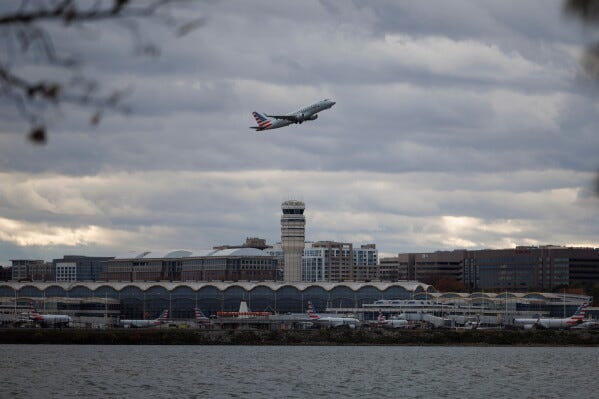
By Sunday, airlines had canceled more flights than Southwest did during its nine-day holiday collapse in December 2022. The flight-tracking app Flighty called it the worst tech-related disruption on record.
That Friday night, Transportation Secretary Sean Duffy raised his funding request from $30 billion to $50 billion.
Congress gave him $12.5 billion for air traffic control sixteen months ago. As of October 31, the FAA had spent about $1 billion of it.
What broke
A router did. According to the FAA’s own account, the contractor L3Harris was installing a new router at a radio site in El Dorado, Arkansas. A second router, swapped in at a radar site in Amarillo, Texas, about three weeks earlier, joined in. Together they flooded the FAA’s telecommunications network with about 1,000 connection attempts every four to five seconds.
The agency’s legacy equipment buckled. Seventeen of the country’s 22 en route air traffic control centers went unstable, and the trouble spread to several approach facilities. The FAA found no sign of a cyberattack.
The installation happened in the middle of a weekday afternoon. Asked why, the FAA said only that it would “reevaluate when we do replacement/maintenance work.” It has since disabled the broadcasting feature on roughly 60 routers of the same type. The router maker told the Wall Street Journal its equipment did not fail. The FAA, L3Harris and the FBI are still investigating the root cause.
The damage was immediate. The FAA counts about 12,462 cancellations that Friday, though it notes not all of them trace to the ground stop. Another 6,700 followed on Saturday. Analysts at Bernstein put the pretax hit to American, Delta, United and Southwest at roughly $345 million. Duffy himself told CNBC the wider economic cost could run into the billions.
One fact matters more than the rest. This failure came from new equipment, installed by the modernization contractor, in the middle of the modernization. Everything the people in charge said next runs into that fact.
Sean Duffy and the big blame game
Duffy spent the weekend on all five Sunday shows. On CNN, he said $12.5 billion “is not nearly enough money” after decades of underinvestment, and that he takes “responsibility for what was given to me by prior administrations.” On NBC, he said he couldn’t apologize for what was passed off to him. On X, he went after Pete Buttigieg by name. A day earlier, he blamed L3Harris and said contractors “take our money and provide really poor service.”
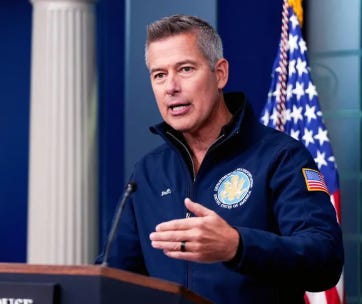
President Trump followed with “Buttigieg ruined the system.” Buttigieg answered that his department reversed a decade of decline in controller staffing.
Here is what Duffy’s department has done with the money it already has.
Committed: About $4.3 billion of the $12.5 billion, or 35%, as of October 31, per FAA data reviewed by POLITICO.
Spent: Just over $1 billion, or about 9%.
Radars: 15 of 612 new radars deployed as of mid-October.
Controller displays: 0 of 435 installed.
Duffy told CNN’s Dana Bash he has “no money in that $12.5 billion” for a new telecom architecture. The law he is describing sets aside $4.75 billion for “telecommunications infrastructure modernization and systems upgrades,” its single largest line. Duffy reads that as money for upgrading the old network. Reasonable people can argue the wording. Nobody can argue that 9% counts as spending it.
The price tag also keeps moving. In 2025, DOT said it needed $20 billion on top of the $12.5 billion. In September 2026, FAA Administrator Bryan Bedford testified that about $10 billion more would do it. Duffy then pitched $30 billion. On the night of the outage, it became $50 billion. No breakdown has been released.
The Government Accountability Office found in September that the FAA has no comprehensive cost estimate for the project. The agency gave auditors a $10.6 billion figure for phase one and could not produce the analysis behind it. GAO director Kevin Walsh said it is “unclear how much support or analysis is behind” the $30 billion and $50 billion requests.
Sen. Chris Van Hollen called the finger-pointing “really rich” given that Congress gave the administration what it asked for. Sen. Susan Collins, a Republican and an appropriator, said she doesn’t “see the justification yet for that much.”
Duffy has his own history with FAA funding. As a congressman in 2019, he voted against a spending bill that carried more than $10.4 billion for the agency. Asked by CNBC whether he regretted it, he didn’t answer. (Large spending bills bundle many items, a point PolitiFact has made about votes like this one.)
The road trip
While his department sat on that money, Duffy found 24 days to film a reality show.
The Great American Road Trip follows Duffy, his wife Rachel Campos-Duffy and their nine children across the country. Bunim/Murray, the company behind The Real World, produced it. It premiered on YouTube on August 19.
Taxpayers didn’t pay for it. A nonprofit called Great American Road Trip Inc. did, and DOT accepted the costs as a gift. The nonprofit is run by Tori Barnes, a former lobbyist for the U.S. Travel Association. Its sponsors, reported by NPR, include Toyota, Boeing, United Airlines, Royal Caribbean and Shell.
DOT oversees auto safety for Toyota. The FAA certifies Boeing’s airplanes and regulates United’s operations. Those companies helped pay for a show starring the man who runs both.
POLITICO reported that one prospective sponsor walked away, describing the arrangement as “paying for access through Tori’s group.”
The watchdog group CREW filed a complaint with DOT’s inspector general on May 11. In June, Sen. Patty Murray and colleagues asked the inspector general to investigate. DOT says career ethics attorneys approved the project and that it was part of Duffy’s official duties for the country’s 250th anniversary. If it was official business, critics ask, why were regulated companies paying for it? The inspector general has published no finding.
JD Vance explains it on Fox
On Monday night, Vice President JD Vance went on Fox’s The Ingraham Angle to talk about the outage. He offered a path forward. Congress could fix air traffic control, he told Laura Ingraham, if Democrats “set aside the ridiculous obsession with men in women’s sports.”
To be precise, Vance did not say transgender athletes caused the outage. He made Democratic cooperation on infrastructure conditional on dropping a culture-war fight that Republicans keep starting. Nothing in the FAA’s account of a flooded router network involves sports, gender or DEI. He brought it up himself, unprompted, in a conversation about routers.
He had tried a version of this before. After the January 2025 midair collision over the Potomac, Vance tied controller shortages to DEI. The head of the controllers’ union answered that certification standards are not based on race or gender.
Then Vance made a second claim. “This is not an expensive problem,” he said, “but we do need to reinvest in rebuilding that infrastructure.”
His own administration had just asked Congress for $50 billion. Added to the $12.5 billion already approved, that comes to $62.5 billion, about $182 for every person in the country.
He said Congress “has not given us a whole lot of resources to work with.” Congress gave them $12.5 billion, and about 91% of it is unspent. Senate Majority Leader John Thune, a Republican, noted that the money “hasn’t been used yet.”
He said the administration has replaced “about 70% of the equipment that needed to be replaced.” That number refers to L3Harris’s project to swap copper lines for fiber, which Duffy describes as 70% complete. It is the same project that was underway when the network went down. On radars, the figure is closer to 2%.
Even Ingraham pushed back, pointing out that his side has been in charge.
Count the official estimates. The vice president says the fix is cheap. The transportation secretary says it costs $50 billion. The FAA administrator told Congress two months ago that $10 billion more would do it. The GAO says nobody at the FAA can document what it costs at all.
The head of the airline industry’s trade group, former New Hampshire Gov. Chris Sununu, added one more data point. More money, he said, would not have prevented Friday’s failure. The people asking for $50 billion still can’t agree on what broke, what fixing it costs, or who is responsible.
They were warned for twenty years
The network that failed is called FAA Telecommunications Infrastructure. Harris Corporation, now L3Harris, won the contract to run it in 2002. The warnings started almost at once, as CBS News documented from the public record.
2006: DOT’s inspector general warned the program was falling behind schedule.
2008: A follow-up audit flagged reliability problems that were already disrupting air traffic control.
2009: A Harris technician’s misconfiguration disrupted 129 FAA facilities.
2023: An FAA-commissioned review called the network obsolete. That July, the FAA listed it among the highest-level safety risks in the national airspace.
2024: The inspector general found the FAA had made 10 “improperly authorized” extensions to the contract, adding 57 months and $1.5 billion without competition. Auditors warned the FAA may be using no-bid extensions “for convenience.”
September 2026: The GAO warned that the FAA’s approach to replacing old equipment could cause disruptions, ground stops included. It found the agency running 11,389 separate project schedules with no integrated master schedule.
Two months later, a router installation under that same contractor caused a nationwide ground stop.
L3Harris kept the work anyway. According to Senate lobbying records cited by CBS, the company has spent $23.9 million on lobbyists since 2020, including $2.51 million this year, and has lobbied Congress on FAA modernization funding every year. In April 2025, it urged House transportation leaders to advance a modernization plan that initially called for $15 billion. On November 14, Duffy said he was “stuck with L3Harris.” His department controls the contract.
The Washington Post reported the same pattern: years of documented risk, and a modernization push that hurried past it.
The son-in-law
On November 3, ten days before the ground stop, Michael Alfonso won Wisconsin’s 7th Congressional District, the seat Duffy once held. Alfonso is 26. He is married to Duffy’s daughter.
His campaign drew money from people with business before Duffy’s department. Wisconsin Watch and ProPublica found at least 25 people who lobbied DOT during Duffy’s tenure gave Alfonso a combined $41,750. Duffy’s own dormant campaign committee sent a reported $1.5 million to Northwoods Future PAC, a super PAC backing Alfonso. (Some outlets put the figure at $1 million.)
On March 31, the political action committee of Air Space Intelligence, an AI aviation company, gave Alfonso $2,500. On June 22, the FAA awarded Air Space Intelligence a 12-year contract worth up to $875.95 million.
Snopes found no evidence the donation influenced the award. The FAA says the company’s tools played no role in the outage. Alfonso’s team said nobody trades an $875 million contract for a $2,500 check. That is probably true. It is also beside the point. The question is why companies seeking favor from DOT keep finding their way to the secretary’s family.
The Bulwark reported another case. The CEO of Covenant Logistics and his wife gave Alfonso $10,000. Weeks later, DOT renewed a regulatory exemption for Covenant for five years.
DOT says Duffy supported his son-in-law only in a personal capacity. No one has shown a quid pro quo. What the record does show is a secretary who takes industry-funded gifts for a reality show, a son-in-law collecting checks from DOT lobbyists, and a department that keeps extending a no-bid contract its own auditors flagged.
Context: the controllers
Staffing did not cause this outage, though it shapes how much margin the system has when something breaks. The FAA recently lowered its full-staffing target from 14,633 certified controllers to 12,563, closing about 2,000 positions on paper. It counted 11,027 certified controllers on September 30. The gap shrank because the goal moved.
Fifty billion dollars and no plan
The $50 billion request has already hit resistance from Republicans. Senate GOP leaders have balked. Rep. Rosa DeLauro, the top Democrat on House Appropriations, called it a “$50 billion ransom without a real plan to deliver.” Marc Scribner of the libertarian Reason Foundation said the administration will “ask for the highest plausible number and take whatever they can get.”
Air traffic control does need serious investment. The network is old, the FAA’s own reviews say so, and the next failure could be worse. That case is real, and it is exactly why this request deserves scrutiny.
Before Congress writes another check, the public is owed some basic answers. A cost estimate the GAO can verify. An explanation for why a contractor with a 20-year record of warnings keeps getting no-bid extensions. A reason a router went into a live national network on a Friday afternoon. A finding from the inspector general on the road trip. And an accounting of the $11 billion already approved and still unspent.
On Friday, 3,500 planes landed safely because thousands of controllers did their jobs under pressure. The people above them spent the weekend blaming a former cabinet secretary, a contractor they chose to keep, Congress, and transgender athletes.
Congress paid for the fix sixteen months ago. The people in charge were busy with other things.
Sources
Slade Wentworth | The Dad Briefs covers the civic, political, and quietly human stories that shape family life in America, with recipes along the way.
Thank you Slade for this explanation. You are the best. And all of the above makes me sick Until when can these people play with our lives and probably sarcaticly laugh behind our backs. I have been here for 48 years. Never would expect an American government to be this corrupt and none of their mates care about THE PEOPLE. Still how we say in Portuguese: a esperança e a ultima que morre. Lets HOPE
Thank you again my friend
Excellent reporting & synthesis