


On April 29, 2026, the Supreme Court of the United States decided Louisiana v. Callais. The vote ran 6–3. Justice Samuel Alito wrote the majority opinion. Kagan, Sotomayor, and Jackson dissented.
Justice Kagan read her dissent aloud from the bench. She has served on the Supreme Court for sixteen years. Justices do not routinely read dissents from the bench. When they do, it means something. She ended without the customary word “respectfully.” She wrote simply: “I dissent.”
She called the majority’s ruling “the latest chapter in the now-completed demolition of the Voting Rights Act.”
That is where we are.
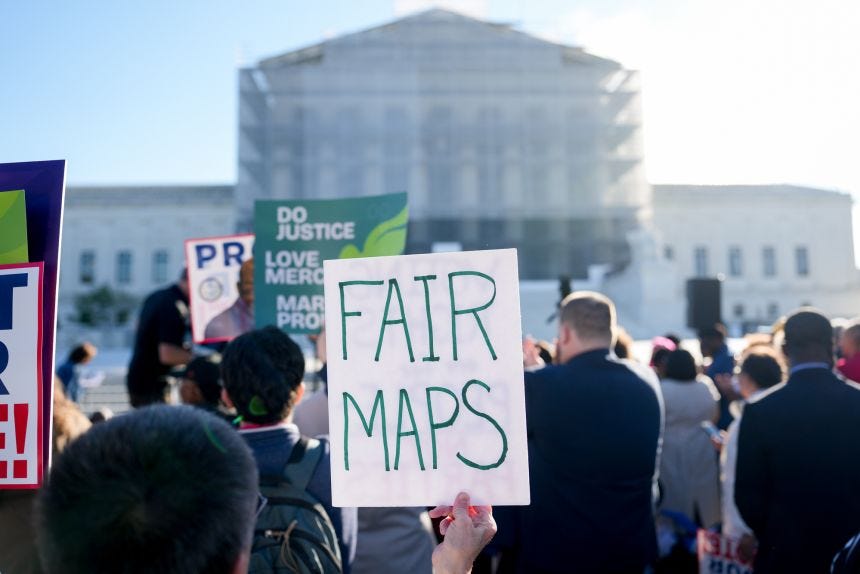
Louisiana v. Callais
To understand Callais, we need about five minutes of background:
Congress passed the Voting Rights Act of 1965 in direct response to the systematic exclusion of Black Americans from the democratic process. Section 2 serves as the law’s nationwide enforcement arm. It prohibits voting practices, including the drawing of district maps, that result in the denial or abridgement of the right to vote on account of race.
The key word is result. Not intent. Result.
Congress wrote that “results test” into the law in 1982, explicitly overriding an earlier Supreme Court ruling that had required proof of intentional discrimination. Congress understood something important: intent is easy to hide. Results are not.
For forty years, that results test worked. Civil rights organizations used it to challenge district maps that cracked Black and brown communities apart — spreading them thin across white-majority districts where their votes got consistently outvoted, and their voices got consistently ignored. When they won those cases, states drew majority-minority districts. Candidates of color won seats. Communities gained representation.
While Callais did not formally repeal Section 2, it did something more durable. It rewrote the rules of proof so that the cases plaintiffs have been winning for forty years now sit structurally nearly impossible to win.
The Louisiana Story
After the 2020 census, Louisiana redrew its congressional map. The state holds six congressional seats. Black residents make up roughly one-third of Louisiana’s population. The new map included one majority-Black district.
A federal judge ruled that the map likely violated Section 2. The Fifth Circuit agreed. Under court order, the Louisiana legislature drew a new map, SB 8, that included a second majority-Black district. In November 2024, voters elected Cleo Fields, a former congressman, to that seat. For the first time in modern history, Louisiana sent two Black members to the U.S. House.
Then a group of voters who described themselves as “non-African American” sued, arguing the new map itself constituted an unconstitutional racial gerrymander. A three-judge district court agreed.
The Supreme Court affirmed, 6–3.
The Court remanded the state to redraw its map. Early voting for the May 16 primary begins this weekend. Cleo Fields’s district may not survive the next election cycle.
The Technical Guts of the Decision
Alito’s majority opinion turns on a precise legal maneuver.
For forty years, the Gingles framework governed Section 2 redistricting cases with three preconditions a plaintiff had to meet to prove vote dilution. The majority did not formally overrule Gingles. It “updated” it. The majority tightened each precondition in ways that make plaintiffs’ burdens dramatically heavier.
Most critically, plaintiffs must now show that racially polarized voting “cannot be explained by partisan affiliation.” In the South, where race and party run deeply correlated, where Black voters vote overwhelmingly Democratic and white voters vote overwhelmingly Republican, proving this is nearly impossible. A state can simply claim its mapmakers drew lines for partisan reasons, not racial ones. Under Rucho v. Common Cause (2019), which held that federal courts cannot police partisan gerrymandering, no federal court can now check either claim.
Alito also requires plaintiffs to produce illustrative maps that satisfy every one of the state’s stated nonracial goals, including its partisan goals toward incumbent protection. Louisiana argued its map needed to shield House Speaker Mike Johnson and Rep. Julia Letlow. Any alternative map that disrupted those incumbents failed the threshold test.
The majority also effectively restores an intent standard on the “totality of circumstances” inquiry, demanding evidence of “present-day intentional racial discrimination.” Congress explicitly rejected this in 1982. The majority just brought it back.
Justice Kagan wrote 48 pages in dissent. Her core argument: “Today’s decision renders Section 2 all but a dead letter.” She accuses the majority of making changes that “eviscerate the law” while maintaining the fiction of preserving it.
Justice Thomas, joined by Justice Gorsuch in concurrence, pushed to go further. He argued that Section 2 “does not regulate districting at all.” The majority declined. The effect differs little.
The Long Arc of Breaking Down the VRA
Callais concludes a project more than a decade in the making.
In 2013, Shelby County v. Holder gutted the Voting Rights Act’s preclearance system — the requirement that states with histories of discrimination get federal approval before changing their voting rules. Chief Justice Roberts wrote that “things have changed dramatically” in the South. Within hours of the ruling, Texas and North Carolina moved to enact new restrictions that had previously been blocked.
In 2019, Rucho v. Common Cause held that partisan gerrymandering falls outside federal court jurisdiction. States could draw maps to benefit their party, and federal courts could not stop them.
In 2021, Alito also wrote Brnovich v. DNC, which narrowed Section 2 as applied to voting procedures. Civil rights advocates recognized it immediately as the template for what was coming in redistricting cases.
In 2023, Allen v. Milligan appeared to reverse course. Roberts and Kavanaugh joined the liberals to require Alabama to draw a second majority-Black district. It looked like a floor. Callais pulled that floor out.
Election law scholar Rick Hasen called Callais “one of the most pernicious and damaging Supreme Court decisions of the last century.” ABC News described it as “Roberts’ signature achievement.” Ari Berman, who has covered voting rights for over a decade, traced Roberts’s effort back to his years as a young lawyer in the Reagan Justice Department in the early 1980s, where he opposed the 1982 amendments that established the results test.
That project ran forty years. It concluded last Wednesday.
The Human Stakes
This abstract legal dispute asks a concrete question: who gets a voice?
When mapmakers crack Black or Latino voters across multiple white-majority districts, those communities consistently lose the everyday levers of representation: a member of Congress with a district office in their neighborhood. A state legislator who shows up at their school board meeting. A city council member who answers the phone about a flooded street.
Fair Fight Action and Black Voters Matter estimate the Callais framework could eventually let Republicans flip up to 19 majority-minority House seats currently held by Democrats. NPR’s analysis found that Republicans could redraw as many as 15 seats currently held by Black members of Congress into white-majority districts. ABC News reported that map changes previously triggering Section 2 scrutiny could affect up to a quarter of the Congressional Black Caucus and roughly a tenth of the Congressional Hispanic Caucus.
Those are projections. What state legislatures actually do determines the pace and reach. But states have already shown their hand. Florida convened a special legislative session within hours of the ruling. Tennessee’s Senator Marsha Blackburn immediately pushed for new maps to target that state’s sole Democratic House member. Mississippi’s governor called lawmakers back to the capital.
The ruling reaches beyond Black voters. LatinoJustice PRLDEF and MALDEF warn that Section 2 enforcement built Latino gains in Texas, Florida, and Arizona over decades — and the ruling now exposes them. The Asian American Legal Defense and Education Fund called the decision a deepening of “long-standing barriers to fair representation.” Native American voting advocates noted that communities used Section 2 as their primary tool to win state legislative representation in states like North Dakota. Those seats now sit structurally at risk.
Hannah Fried of All Voting Is Local said it plainly: this ruling strips away “the right to be heard and for all of our votes to be counted equally.” Not in one state. Across the country.
What Remains
Section 2 is still on the books and available for future restorative federal legislation. Nine states — California, New York, Virginia, Connecticut, Oregon, Washington, Minnesota, New Jersey, and Illinois — have enacted their own Voting Rights Acts. State courts, operating under state constitutions, now offer one of the most important remaining arenas for redistricting challenges.
Rep. Terri Sewell and Sen. Raphael Warnock reintroduced the John R. Lewis Voting Rights Advancement Act in 2025. The bill would restore the preclearance requirement and codify the results test. It has not cleared the Senate filibuster. The current Congress has not improved its prospects.
Civil rights organizations now pivot to state-court litigation and intentional-discrimination claims; cases built around documented evidence of explicit racial intent, the kind of “smoking gun” evidence one attorney noted “people don’t do” anymore precisely because it is illegal.
Rick Hasen, who long resisted the idea, now calls for structural Supreme Court reform. The Brennan Center pushes for 18-year term limits, a binding ethics code, and transparency rules for the shadow docket. Rep. Ayanna Pressley and Sen. Ed Markey lead bills toward Court expansion.
None of these remedies moves fast. None is certain.
The Transformative Justice Coalition — whose founders have fought since before the original Voting Rights Act passed — said what needs saying: “We must speak with our vote in 2026.”
That is not a platitude. It is a precise observation. State legislators draw the maps. Voters elect the attorneys general who enforce discrimination law. In most states, voters elect state supreme court justices too. The ballot box is not a consolation prize. It now serves as the primary mechanism.
The Long View
The Voting Rights Act of 1965 grew from a moment that looked like total defeat. On March 7 of that year, state troopers beat civil rights marchers on the Edmund Pettus Bridge in Selma, Alabama, on national television. That footage changed the political calculus. The law was passed within months.
The people who marched did not fight because they were winning. They fought because they knew what was right.
Louisiana v. Callais lands a serious blow against a law that itself represented a hard-won recovery from a century of state-sanctioned exclusion. It strips away a tool that communities of color have used for forty years to make their voices count.
This is not the end. The courts, the statehouses, the ballot, and the street all remain open.
The work is harder now.
It has been harder before.
The Dad Briefs covers the civic, political, and quietly human stories that shape family life in America — with recipes along the way. Food, Fun, and Fatherly Wisdom. Recipes for Resistance.
Thank you for a clear explanation of the weakening of the Voting Rights Act.
Thank you for explaining this. Such an uphill battle, I feel like we keep going further and further back in time. 😞