


We talk a lot about the culture war.
About who’s winning and who’s losing and who’s to blame. That’s the air attack — the rhetoric, the politicians, the thumbnails, the outrage content. It’s marketing. It’s designed to keep you focused on the argument and away from the operations.
The ground attack looks different. It’s hidden away. It’s a spreadsheet. It’s a 26-year-old former investment banker with a laptop and a federal ID badge, walking into a government agency he knows nothing about, and getting to work.
His name is Justin Fox. He was a DOGE staffer assigned to the National Endowment for the Humanities. His job, by his own description, was to review and flag grants for “DEI” — which would then go up the chain for termination under Trump’s executive order.

There’s just one problem. When he was asked under oath to define the term he was paid to hunt and destroy, he couldn’t do it.
And that tells us everything.
The Method: ChatGPT, a Spreadsheet, and 22 Days
Here’s how DOGE’s ground attack worked at the NEH.
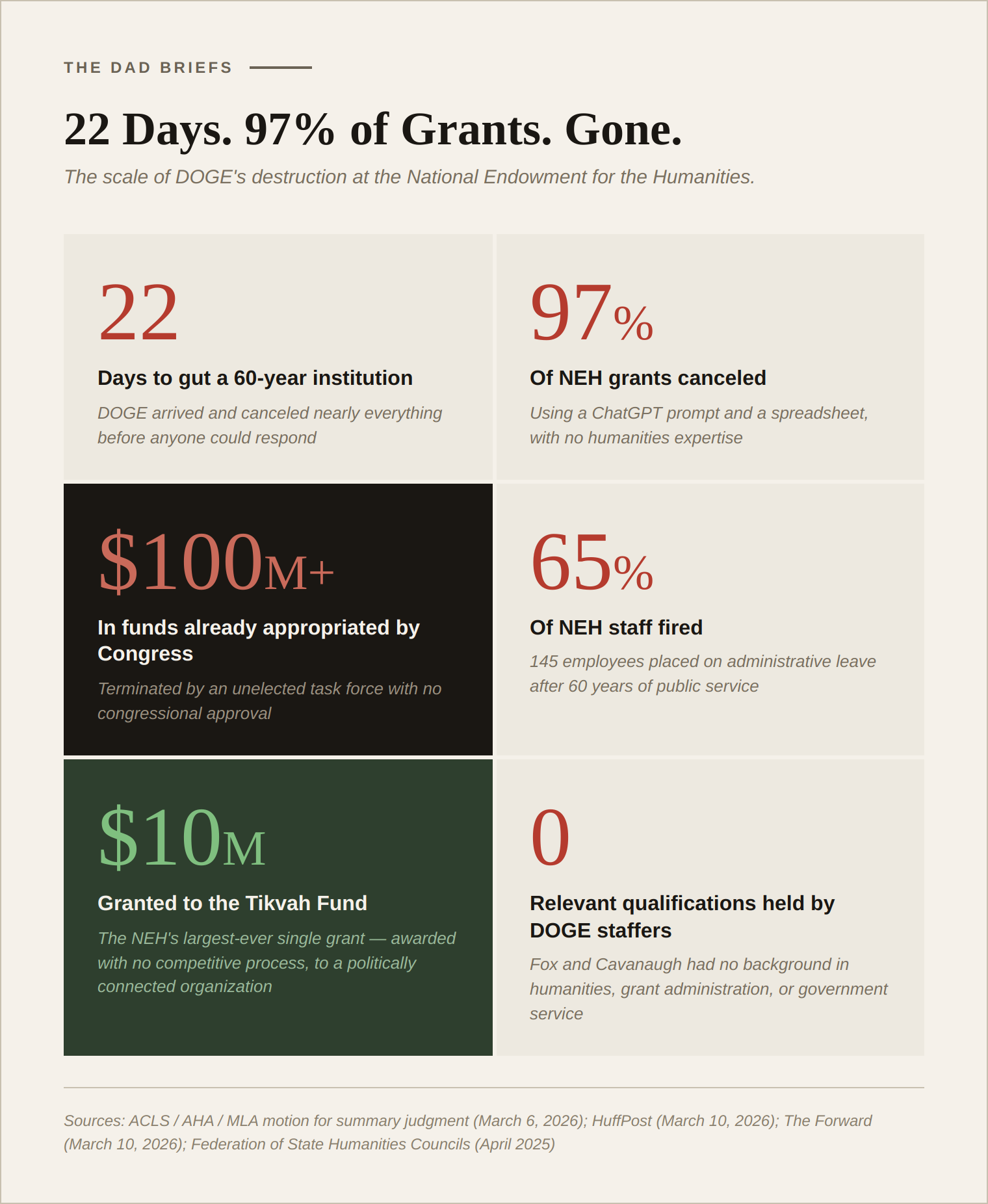
Fox, who — according to the lawsuit — has no background whatsoever in the humanities, grant administration, peer review, or government service, showed up at the NEH in early 2025 alongside his boss, fellow DOGE staffer Nate Cavanaugh. Together, as told in depositions, they entirely controlled which grants lived and which grants died.
Their methodology: they fed NEH grant descriptions into ChatGPT and asked it to answer one question — “Does the following relate at all to DEI?” — in 120 characters or less. ChatGPT’s yes-or-no responses were then entered into a spreadsheet with columns for “DEI Involvement” and “DEI Rationale.” That spreadsheet replaced the list created by actual NEH staff. The grants that came back “Yes” were terminated.
All of this happened in 22 days. In that time, DOGE canceled 97 percent of NEH grants — more than $100 million in funds that had already been appropriated by Congress. Then they fired 65 percent of NEH staff.
Fox and Cavanaugh had no background in the humanities, public or private grant administration, peer review, or government service of any kind before joining the administration. —From the lawsuit filing
The NEH’s acting chair, Michael McDonald, was not in charge. Depositions show he ceded his authority entirely to Fox, at one point writing to him: “As you’ve made clear, it’s your decision on whether to discontinue funding any of the projects on this list.”
McDonald also later testified that he had not known DOGE was using ChatGPT to make these decisions. And when shown a grant about Holocaust history and asked if he considered it DEI, he said no. When asked if he would consider it wasteful, he said no.
It didn’t matter. DOGE cut it anyway.
What Got Killed
Before we talk about the deposition, let’s be specific about what this ChatGPT dragnet actually destroyed. Because the administration wants you to picture a diversity officer with a cushy title. That’s not what was on the list.
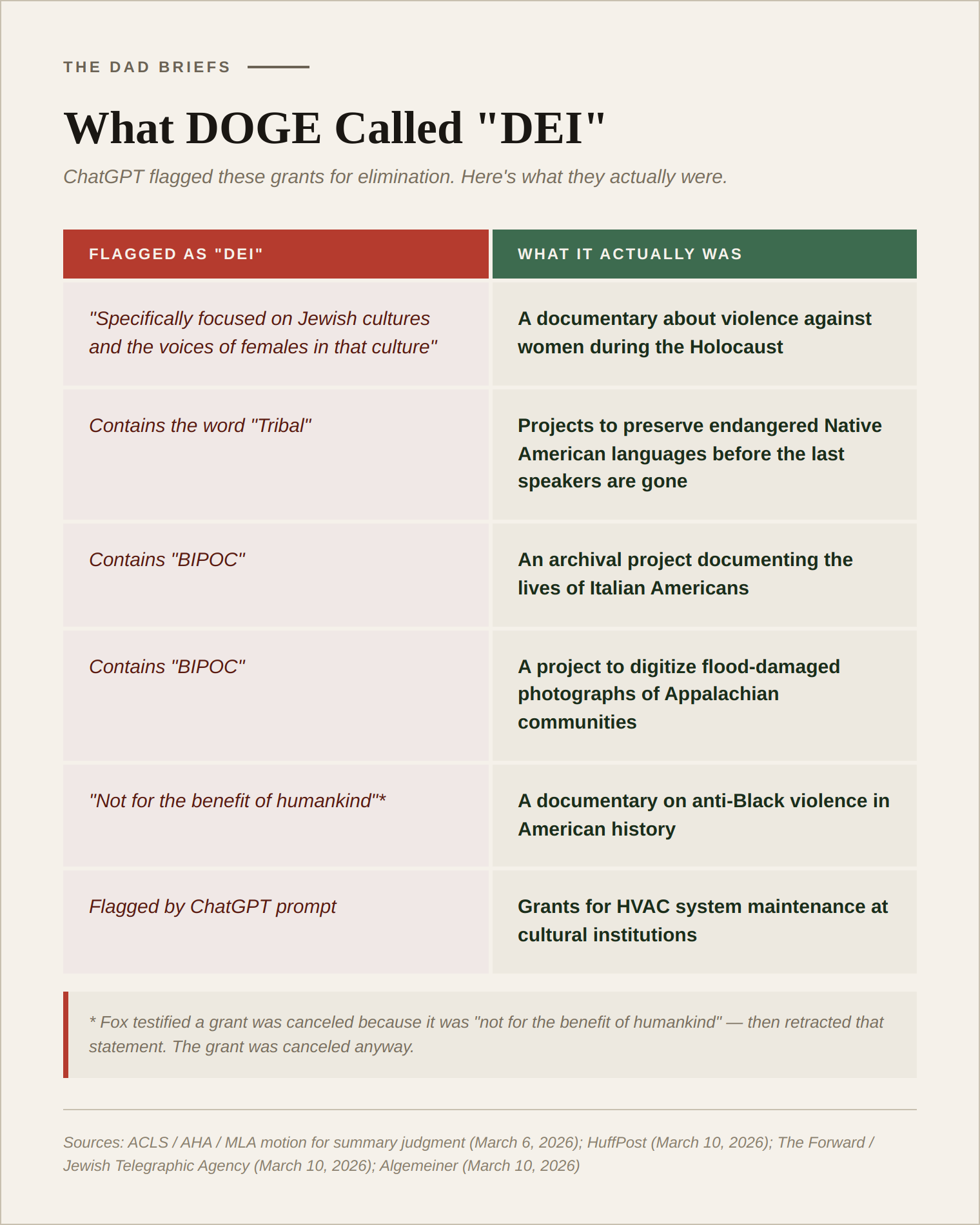
Here is what DOGE flagged as DEI and terminated:
A documentary about Jewish women’s slave labor during the Holocaust. An archival project on the lives of Italian Americans. A project to digitize flood-damaged photograph collections from Appalachian communities. Multiple projects to preserve endangered Native American languages before the last speakers are gone. A documentary on anti-Black violence in American history. A project on U.S.-Japanese relations centered around baseball. Grants for veterans’ humanities programs. Grants for collections management after a natural disaster. Grants for HVAC systems.
HVAC systems.
The lawsuit documents that DOGE flagged grants for having nothing more than the words “BIPOC,” “homosexual,” “LGBTQ,” or “Tribal” somewhere in the description. If ChatGPT saw one of those words, the answer was yes. If the answer was yes, the grant was gone. The actual content — the scholarship, the community, the history being preserved — was irrelevant.
Fox himself testified that a grant about violence against women during the Holocaust was properly classified as DEI because it was, in his words, “specifically focused on Jewish cultures” and the “voices of the females in that culture.”
Jewish history. Women’s voices. Both DEI. Both eliminated.
The Deposition: Two Possibilities, Both Damning
So. Justin Fox. Under oath. Asked to define the term he spent weeks deploying as a weapon against American cultural history.
He couldn’t do it. He pivoted. He deflected to the executive order. He restated the question. He gave answers and then walked them back. At one point he testified that a grant about anti-Black violence in America was canceled “because it was not for the benefit of humankind” — and then retracted that too.
There are only two explanations for what you see in that deposition.
The first is that Fox knew exactly what he was doing and chose not to say it out loud under oath. You don’t define the thing you’re weaponizing, because the moment you define it, you’ve exposed the actual target list. If DEI means “any history involving people who aren’t white,” you do your best not to say it in a federal deposition.
The second is that he genuinely did not know. That he was handed a mandate, a laptop, and a ChatGPT login, and sent into a federal agency to destroy things he couldn’t name, on behalf of a policy he couldn’t explain, in a field he knew nothing about.
At worst, he’s obfuscating. At best, he’s incompetent. In environments where they’re forced to tell the truth, those are the two kinds of people we see working in this administration.
Either way, more than $100 million in American cultural heritage funding was erased in less than a month. The Appalachian photos are degrading. The Native languages are getting closer to extinction. The Holocaust documentary is in limbo. And the man who decided their fate cannot say what he was deciding against.
The Lawsuit — And the Twist
The case was filed on May 1, 2025, by three of the most respected academic organizations in the country: the American Council of Learned Societies, the American Historical Association, and the Modern Language Association. They’ve since been joined by the Authors Guild. On March 6, 2026, the plaintiffs filed a motion for summary judgment in the U.S. District Court for the Southern District of New York.
Their three claims are straightforward and serious. First: DOGE violated the First Amendment by targeting grants based on viewpoint — specifically, by cutting history and scholarship about certain groups while leaving others alone. Second: DOGE violated the Equal Protection Clause of the Fifth Amendment by explicitly targeting descriptions that included the words “BIPOC,” “homosexual,” “LGBTQ,” and “Tribal.” Third: DOGE violated the separation of powers, because it was DOGE — not the NEH chair, and not Congress — that made these funding decisions. An unelected task force, with no statutory authority, decided how $100 million in congressionally appropriated funds would be spent.
That last point is worth pausing on. Congress appropriated this money. DOGE canceled it. No vote. No authorization. No oversight. Just a spreadsheet and a ChatGPT prompt.
But here’s the twist the mainstream coverage has mostly missed:
While DOGE was busy canceling grants for Holocaust history and Appalachian photography as “DEI,” the NEH was quietly doing something else. McDonald asked a staff member to solicit an application from the Tikvah Fund — a politically conservative Jewish cultural organization — for a single-source award. No competitive process. No peer review. The NEH ultimately granted Tikvah $10 million. Its largest-ever single grant.
Depositions also revealed that Adam Wolfson, the NEH’s assistant chair for programs, is married to Dorothea Wolfson — who has worked with Tikvah and directs a program established by a former Tikvah board chair.
So, DEI grants are out. Ten million dollars to a politically connected organization is in. Decided by people with personal ties to the recipient. Using Signal messages that violated the Federal Records Act, so there’d be no paper trail.
That is the real waste, fraud, and abuse.
What This Actually Is
The culture war framing is useful to the people running this operation because it makes you think you’re watching a debate. Reasonable people on two sides, disagreeing about values.
What you’re actually watching is a small number of unqualified people, with no legal authority, systematically destroying 60 years of American cultural investment — using a chatbot — while communicating on disappearing-message apps — and redirecting the money to politically connected recipients.
That’s a cultural shakedown.
And we only know this because scholars and historians and writers filed a lawsuit and fought for discovery. Because depositions happened. Because Justin Fox had to sit in a room and answer questions he couldn’t answer.
The deposition doesn’t just reveal incompetence or bad faith. It reveals the whole architecture. The executive order gave them the mandate. The ChatGPT prompt gave them the cover. The vague, undefinable nature of “DEI” gave them the flexibility to target whatever they wanted. And the speed — 22 days, 97 percent of grants — made sure it was done before anyone could stop it.
They didn’t need to define DEI. That was the point.
The lawsuit is still working its way through the courts. The motion for summary judgment was filed March 6, 2026.
Follow it.
Sources
The lawsuit and motion for summary judgment:
American Council of Learned Societies (ACLS), March 7, 2026; American Historical Association (AHA), March 7, 2026; PR Newswire, March 7, 2026. Motion filed in U.S. District Court for the Southern District of New York, March 6, 2026.
Justin Fox deposition and ChatGPT methodology:
HuffPost, March 10, 2026; Jewish Telegraphic Agency / The Forward, March 10, 2026; Algemeiner, March 10, 2026; The Independent / AOL, March 10, 2026. Full deposition available on the American Historical Association’s YouTube page.
Specific grants canceled:
ACLS/AHA/MLA press release, March 7, 2026; Current.org (public media grants), April 2025; Federation of State Humanities Councils action alert, April 2025.
Tikvah Fund grant and conflict of interest:
The Forward / Jewish Post, March 10, 2026; Jerusalem Post, March 10, 2026.
NEH history and scale:
National Endowment for the Humanities. Founded 1965; over $6 billion in grants to 70,000+ projects across all 50 states over its history.
This post is public. Share it.


