


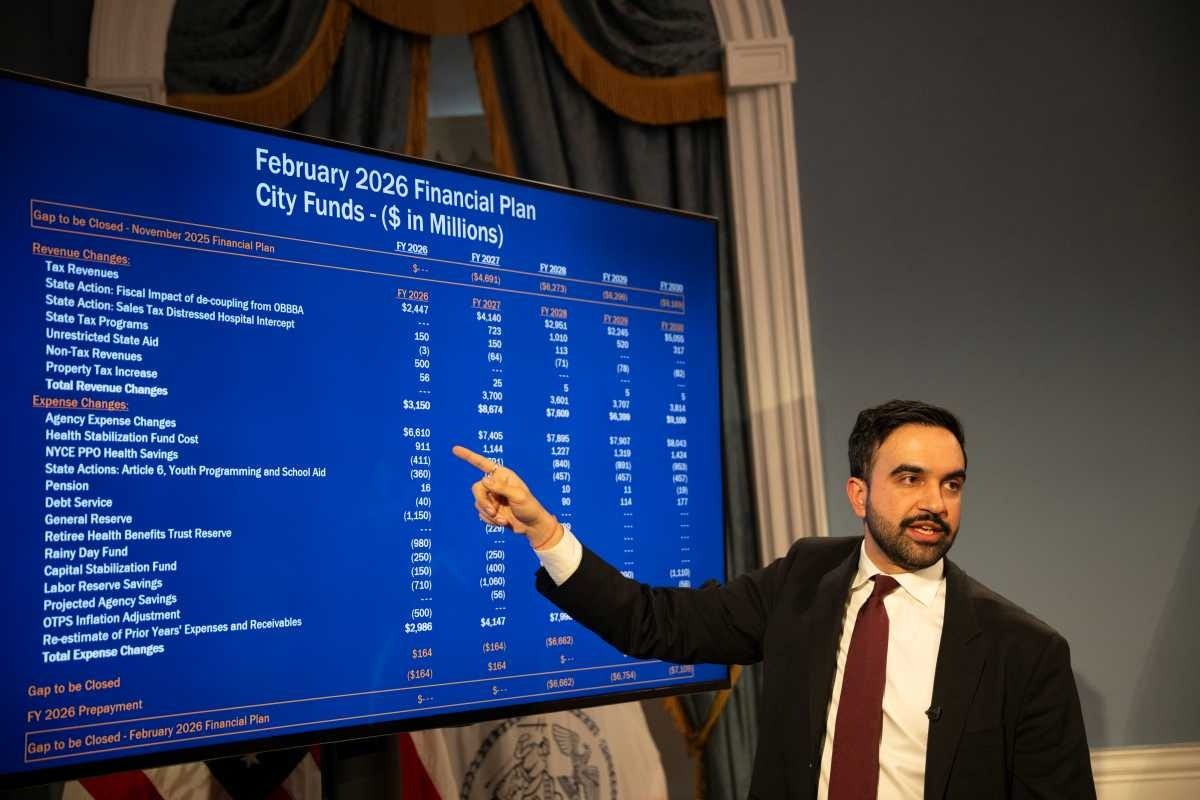
On May 12, New York City Mayor Zohran Mamdani released a $124.7 billion Fiscal Year 2027 executive budget that closes a roughly $12 billion two-year gap without raising property taxes, cutting core services, or drawing down the city’s emergency reserves.
The reaction has been a mix of genuine celebration and significant overclaiming. Both are understandable. Neither is complete.
What Mamdani inherited
The budget hole Mamdani faced when he took office on January 1st was real, well-documented, and not of his making. NYC Comptroller Mark Levine projected in January 2026 a $2.2 billion shortfall in FY2026 and a $10.4 billion gap in FY2027, calling it “the first time since the Great Recession that the City faces a budget shortfall of this magnitude this late in the fiscal year.” His predecessor Brad Lander had flagged in December 2025 that the Adams administration’s pattern of chronic underbudgeting — consistently failing to budget realistic costs for rental assistance, uniformed overtime, shelter, public assistance, special education, and MTA contributions — had left roughly $3.8 billion in unbudgeted FY2026 costs alone.
Critics on the center-right argue the deficit has multiple parents, including City Council-driven entitlement expansions and the state’s unfunded class-size mandate.
These basic, underlying numbers are not seriously disputed by any major independent watchdog.
How the gap was closed
The gap closure rests on four pillars.
The largest single contributor is approximately $8 billion in new state support over two fiscal years, secured through negotiations with Governor Kathy Hochul. The May 12th package alone included $352 million in direct state aid, $3.2 billion in state authorizations (including pension liability restructuring and class-size mandate flexibility), and $500 million in anticipated annual revenue from a new pied-à-terre tax on luxury second homes. This built on roughly $1.5 billion announced in February 2026, $1.2 billion in January for expanded city-funded childcare, and a state takeover of line-of-duty death benefits for first responders worth $202 million to the city annually.
The second pillar is $1.77 billion in agency-level savings identified by “Chief Savings Officers” Mamdani installed across city agencies, working on targets of 1.5 to 2.5 percent. The third is approximately $1.64 billion in FY2027 savings from restructuring pension contributions, effectively spreading current costs over a longer amortization period. And the fourth is new city-side revenue from reducing the Unincorporated Business Tax credit, projected to raise $68 million annually.
No property tax hike. Reserves intact. Comptroller Levine said it had “been a while since we’ve seen a mayor be this conservative on spending” — notable praise from a fellow Democrat.
The Albany relationship
New York City cannot raise personal income taxes, corporate taxes, or most major revenue tools without state legislative approval. Under former Governor Andrew Cuomo, the city was routinely on the losing end of revenue-sharing disputes, and similar progressive revenue proposals had failed in Albany for more than a decade.
Mamdani spent his first months in office both publicly pressuring Hochul through the credible threat of a 9.5% across-the-board property tax hike (widely understood as leverage, and dropped in the final budget) and quietly building the political relationship. He endorsed Hochul’s reelection bid in February 2026, clearing the Democratic gubernatorial primary field and giving himself meaningful leverage going into budget negotiations. NYC-DSA’s “Tax the Rich” campaign mobilized over 1,500 people at an Albany rally in spring 2026. The result was roughly $8 billion over two years and the first pied-à-terre tax in New York State history after more than a decade of failed attempts.
That is a real shift in a structural relationship that has constrained NYC mayors for generations. The mechanics of how it was achieved — political endorsement, public pressure, organized constituent mobilization — are as instructive as the dollar figures.
Falling short of the progressive panacea
Mamdani campaigned on approximately $9 billion in annual progressive revenue: a 2-percentage-point millionaire’s income surcharge projected to raise $4 billion per year, and a state corporate income tax hike to 11.5% projected to raise $5 billion per year. Both were rejected by Hochul, who was direct about it: she would not consider income taxes on NYC residents or corporate taxes on New York businesses. A third proposal — reducing the Pass-Through Entity Tax credit, projected at $1 billion per year — was also rejected in early May.
Of the roughly $9 billion in progressive revenue Mamdani ran on, approximately $568 million, combining the pied-à-terre tax and the UBT credit reduction, made it into this budget. About six cents on every promised dollar, and with important caveats on both.
The pied-à-terre tax is not yet law. As of May 13th, the state budget had not been adopted, and Senate Majority Leader Andrea Stewart-Cousins told reporters she had not been briefed on the tax’s design — the rate structure, valuation methodology, and assessment mechanics remain unsettled. The city projects $500 million in annual receipts; Comptroller Levine’s office estimates realistic collections, accounting for behavioral changes, may land closer to $340 to $380 million.
The pension amortization strategy, which provides $1.64 billion in FY2027 relief, has drawn pointed criticism from Citizens Budget Commission President Andrew Rein: “We’re basically asking people in the mid-2030s to solve the 2027 budget gap, and that’s simply not fair.” The Volcker Alliance notes that stretching pension payments creates debt more expensive than municipal bonds.
The budget as proposed projects approximately a $7 billion deficit in FY2028. Fiscal balance in year one does not mean the structural problem is solved.
Services protected and added
The services side of the budget is where Mamdani’s governing priorities show up most clearly. The executive budget baselined — meaning built into future budgets rather than treated as one-time expenditures — $31.7 million for the city’s library systems, $25 million for Fair Fares (the low-income MetroCard subsidy), $15 million for parks, $15 million for CUNY, and $10 million for cultural affairs. It committed $47.3 million annually for mental health access, $14.3 million for Right to Counsel in housing court, growing to $40 million baselined, and $34.9 million for pedestrian safety infrastructure.
On housing, the five-year capital plan was set at $117.1 billion, with $4 billion in new HPD capital funding for deeply affordable housing and $256 million to restore vacant NYCHA apartments, described by the administration as the largest capital commitment to NYCHA vacant-unit turnover in the city’s history.
One tension worth naming: the budget proposes $519 million in FY2027 savings from the CityFHEPS rental voucher program, framed by the administration as efficiency gains rather than benefit reductions. Housing advocates have protested and litigation is ongoing. That disagreement is real and unresolved.
The bottom line
Zohran Mamdani balanced New York City’s budget without raising property taxes, without slashing services, and without drawing down the city’s reserves. That is factually accurate and significant.
He also secured an $8 billion two-year state aid package and the first pied-à-terre tax in New York State history, demonstrating that the structural relationship between City Hall and Albany is not fixed. That matters for every mayor who comes after him.
The “tax the rich” agenda his campaign centered? Hochul blocked most of it. The structural gap returns in FY2028. Watchdogs are right to flag the reliance on pension amortization and one-time mechanisms. The pied-à-terre tax’s mechanics remain unsettled and dependent on a state budget that has not yet passed.
All of this is true at the same time. The work of civic literacy is holding the real wins and the real limits without needing one of them to disappear. That is what governing looks like in a city of this size and complexity — incremental, contested, structurally constrained, and worth paying close attention to.
Sources
NYC Mayor’s Office
“Mayor Mamdani Details ‘Adams Budget Crisis’” (January 30, 2026) https://www.nyc.gov/mayors-office/news/2026/01/mayor-mamdani-details--adams-budget-crisis-
“Mayor Mamdani, Governor Hochul Announce State’s First Pied-à-Terre Tax” (April 15, 2026) https://www.nyc.gov/mayors-office/news/2026/04/mayor-mamdani--governor-hochul-announce-state-s-first-pied-a-ter
“Mayor Zohran Mamdani Releases $124.7 Billion Executive Budget for Fiscal Year 2027” (May 12, 2026) https://www.nyc.gov/mayors-office/news/2026/05/mayor-zohran-mamdani-releases--124-7-billion-executive-budget-fo
NYC Comptroller — Mark Levine
“Comptroller Levine Projects $2.2 Billion Budget Shortfall in Fiscal Year 2026 and $10.4 Billion in Fiscal Year 2027” (January 2026) https://comptroller.nyc.gov/newsroom/comptroller-levine-projects-2-2-billion-budget-shortfall-in-fiscal-year-2026-and-10-4-billion-in-fiscal-year-2027/
A Stronger Fiscal Framework for New York City https://comptroller.nyc.gov/reports/a-stronger-fiscal-framework-for-new-york-city/
NYC Comptroller — Brad Lander
Annual Report on the State of the City’s Economy and Finances (December 2025) https://comptroller.nyc.gov/newsroom/nyc-comptroller-lander-releases-annual-report-warning-of-fiscal-challenges-amid-federal-cuts-and-adams-administrations-shortsighted-planning/
Measuring New York City’s Budgetary Cushion: How Much is Needed to Weather the Next Fiscal Storm? https://comptroller.nyc.gov/reports/measuring-new-york-citys-budgetary-cushion-how-much-is-needed-to-weather-the-next-fiscal-storm/
NYC Independent Budget Office
Background Paper: New York State Financial Emergency Act for the City of New York (November 2007) https://www.ibo.nyc.ny.us/iboreports/FEAPaper.pdf
News Reporting
“Mamdani proposes $124.7B executive budget — without raiding reserves” (May 12, 2026) https://www.cityandstateny.com/politics/2026/05/mamdani-proposes-1247b-executive-budget-no-gap/413486/
“Mamdani Plugs $12 Billion Budget Hole With Hochul Assist” (May 12, 2026) https://www.thecity.nyc/2026/05/12/124-billion-mamdani-budget-leaves-city-reserves-intact/
“As Mamdani Pulls Budget Rabbit From Hat, Watchdogs Fret Over ‘One-Shots’” (May 12, 2026) https://www.thecity.nyc/2026/05/12/as-mamdani-pulls-budget-rabbit-from-hat-watchdogs-fret-over-one-shots/
“Mayor Mamdani says he has balanced NYC’s budget, will not raise property taxes” (May 12, 2026) https://www.cbsnews.com/newyork/news/nyc-budget-zohran-mamdani-property-taxes/
“Mamdani, Hochul announce $4 billion in budget assistance for NYC” (May 12, 2026) https://www.nbcnewyork.com/news/politics/zohran-mamdani-nyc-budget-deficit-fix/6500886/
“City comptroller looks at Mayor Mamdani’s budget proposal” (May 12, 2026) https://ny1.com/nyc/all-boroughs/inside-city-hall/2026/05/12/city-comptroller-looks-at-mayor-mamdani-s-budget-proposal
“Mamdani Declares Victory As Hochul Helps City Close Budget Gap” (May 12, 2026) https://nysfocus.com/2026/05/12/mamdani-hochul-nyc-budget-deal
“Mamdani Announces Balanced Budget Without Cuts” (May 12, 2026) https://prospect.org/2026/05/12/mamdani-announces-balanced-budget-without-cuts/
“What everyone is missing about Mamdani’s plan to tax Ken Griffin’s $238 million penthouse” (May 7, 2026) https://www.cnn.com/2026/05/07/business/zohran-mamdani-ken-griffin-taxes
“Mayor Mamdani and New Yorkers Want to Tax the Rich. Where Is City Council Speaker Julie Menin?” (March 2026) https://inthesetimes.com/article/zohran-mamdani-julie-menin-kathy-hochul-nyc-tax-rich
“In unusual alliance, Mamdani and Menin press Hochul to reduce a tax credit benefitting millionaires” (April 29, 2026) https://www.yahoo.com/news/articles/unusual-alliance-mamdani-menin-press-184729783.html
“Tax the rich or cut spending? Hochul and Mamdani spar over budgets” (May 6, 2026) https://www.rochesterfirst.com/news/tax-the-rich-or-cut-spending-hochul-and-mamdani-spar-over-budgets/
“54% of New Yorkers back Mamdani’s ‘tax the rich’ plan as Hochul draws the line on new income taxes” https://moneywise.com/news/top-stories/new-york-hochul-mamdani-tax-the-rich-poll
“Mamdani and Hochul propose a NYC wealth tax” https://www.readtangle.com/nyc-wealth-tax-proposal/
“’Beyond insane’: O’Leary blasts Mamdani’s tax-the-rich plan” (May 2026) https://finance.yahoo.com/economy/policy/articles/beyond-insane-o-leary-blasts-132000329.html
Empire Center for Public Policy
“Parsing the Impact of Mamdani’s Tax Hike Plans” https://www.empirecenter.org/publications/parsing-the-impact-of-mamdanis-tax-hike-plans/
“Fiscal Policy, 30 Years After the Crisis” https://www.empirecenter.org/publications/fiscal-policy-30-years-after-the-crisis/
Cato Institute
“Mamdani’s Wishful Thinking on Tax Revenues” https://www.cato.org/blog/mamdanis-wishful-thinking-tax-revenues
Step Two Policy Project
“New York City’s Budget Deficit” https://www.steptwopolicy.org/post/new-york-city-s-budget-deficit https://steptwopolicyproject.substack.com/p/new-york-citys-budget-deficit
The Dad Briefs is produced independently, without party affiliation or partisan funding, and covers the civic, political, and quietly human stories that shape family life in America — with recipes along the way. Food, Fun and Fatherly Wisdom. Recipes for Resistance.
Be kind, and … you know.