


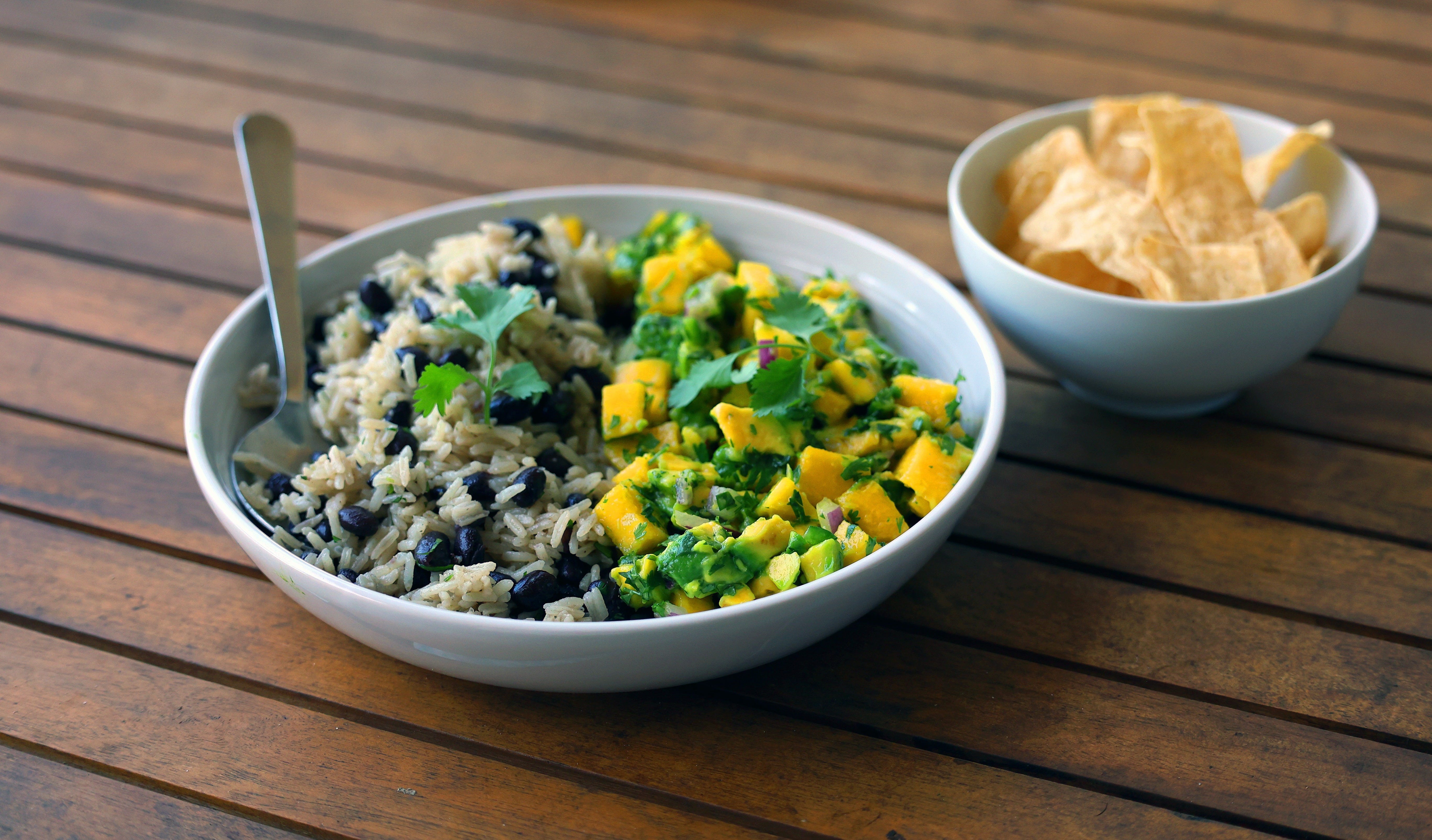
Recipes for Black Beans & Rice and Mango Avocado Salsa are below!
You can stretch beans. Add water and rice, and a pound of dried black beans can feed a family for days at roughly $1.50 a serving. Generations of families have run this math at their own kitchen counters.
But it’s hard to stretch a mango. Fresh fruit and vegetables cost what they cost, spoil when they spoil, and when a grocery budget gets tight, they are the first things families cut. That single fact explains almost everything else in this article.
Cold, hard math at the cash register
Groceries were already expensive, and they keep climbing. Federal economists at USDA project food prices rose another 3.2 percent between April 2025 and April 2026, with fresh produce climbing faster still. Those increases came on top of years of elevated inflation, and prices rarely fall back once a crisis eases.
Right now, roughly one in eight Americans buys groceries with help from SNAP, the Supplemental Nutrition Assistance Program. In fiscal year 2025, that meant about 22.6 million households every month. Working families, seniors on fixed incomes, veterans, children, and people whose paychecks stopped keeping up with the register.
The average benefit works out to about $6.17 per day per person, according to the Center on Budget and Policy Priorities. Six dollars a day supplements a grocery budget. It does not carry one. And on six dollars a day, the mango loses to the beans every time.
Programs help to get fresh food back
Nutrition incentive programs exist in nearly every state, and they target exactly the food that gets cut first.
The model is simple — spend SNAP dollars on fruits and vegetables, and the program matches them, often dollar for dollar. Families take home more fresh food. Local farmers sell more of what they grow. Neighborhood grocers and farmers markets see more business. The Nutrition Incentive Hub’s latest national evaluation found these programs generated more than $62 million in fruit and vegetable purchases between 2024 and 2025, reaching 225,000 families per month.
The best-known is Double Up Food Bucks, started run by the Fair Food Network. It was piloted in 2009 at five farmers’ markets in Detroit. One city, one simple idea: when healthy food is affordable, everyone benefits. Today Double Up operates in nearly 30 states, and it helped shape the federal grant program (the Gus Schumacher Nutrition Incentive Program, if you want the formal name) that now funds similar efforts across the country.
Community solutions scale. Detroit proved it.
In my home state of Florida, and yours, too
Florida runs its own version. Fresh Access Bucks, a program of Feeding Florida, matches SNAP purchases dollar for dollar for fresh, Florida-grown fruits and vegetables. It works at more than 80 farmers markets, farm stands, CSAs, mobile markets, and community grocery stores statewide. No sign-up, no application. If you shop with a SNAP/EBT card at a participating location, the match is automatic.
Spend $10 in SNAP at a participating market, walk away with $10 more for Florida-grown produce. That is the mango problem, solved at the point of sale.
Ordinarily, you could go to freshaccessbucks.com and find a location near you. But because of a gap in state funding, this program has paused operations this month. These programs need our voices to keep their support going.
If you live elsewhere, the Nutrition Incentive Hub can point you to programs in your state.
A structural stretch
SNAP’s structure just changed in a way that puts these gains at risk.
For the program’s entire history, the federal government paid 100 percent of SNAP benefits. The budget reconciliation law signed in July 2025 changed that. Beginning in fiscal year 2028, states with payment error rates above 6 percent must pay a share of benefit costs, between 5 and 15 percent depending on the rate. States also take on a much larger share of administrative costs starting in late 2026.
Error rates sound bad, but the SNAP application requires surprisingly complex paperwork. Simple mistakes, even if states correct them, now put states on the hook for large sums. The Center on Budget and Policy Priorities estimates 27 states face a projected cost shift of more than $100 million per year — per state. State legislatures are deciding right now how to absorb those costs, and options include tightening eligibility, cutting benefits, and making enrollment harder.
Translation: the future of the program that feeds one in eight Americans is being decided in state capitols, this year and next. Wherever you live, that budget fight is worth your attention.
What YOU can do
Move a purchase or two. If you can, shift part of your grocery list to a farmers market or an independent grocer rooted in your community. Food dollars spent locally keep farms in business, support local jobs, and keep money circulating close to home. Summer is peak growing season across most of the country, and here in South Florida, August means avocados and mangoes at their best.
Spread the word. Most eligible families have never heard of nutrition incentive programs. If you know someone shopping with SNAP, tell them about the match. In Florida, we hope Fresh Access Bucks will be available again soon.
Anywhere else, start with Double Up America or the Nutrition Incentive Hub to find a program near you.
Watch your statehouse. The SNAP cost shift lands in state budgets over the next two years. Legislators will hear from plenty of people about it. Make sure some of those people can name what six dollars a day buys.
And make the beans. The recipe from this week’s video, black beans and rice with Florida avocado and mango salsa, feeds four for about two dollars a serving with the fresh stuff included. The cheap part fills you up. The fresh part makes it a more complete meal.
Every family deserves both.
Black Beans and Rice
My wife Carla is Brazilian, and she has made rice and beans her whole life. In this recipe, I take pieces of her process (sautéing onion and garlic and toasting the rice first) and add my own spin (cooking it in broth with cumin and adding the beans directly to the rice instead of serving them separately). She immediately asked me for the recipe because she said it was so good.
That’s the best endorsement I’ll ever know. Please try these. You won’t be disappointed!
Ingredients
1 tablespoon olive oil
1/2 cup onion, finely diced
2 teaspoons minced garlic
1 1/2 cups long grain white rice (uncooked)
3 cups chicken broth
2 15-ounce cans black beans, drained
2 tablespoons lime juice
1/3 cup cilantro leaves, chopped
1 teaspoon ground cumin
Pinch of salt and pepper
Cilantro sprigs and lime wedges for garnish
Instructions
Heat the oil in a large pot over medium heat. Add the onion and cook for 2-3 minutes or until tender. Add the garlic and continue to cook until fragrant.
Add the rice and stir to toast it for 1-2 minutes.
Add chicken broth, cumin, and salt and pepper if desired. Bring the pot to a boil.
Cover the pot and turn the heat down to low. Simmer for 15 minutes or until rice is tender.
Stir the beans into the rice. Cover the pot and let sit off the heat for 3-5 minutes or until beans are warmed through.
Stir in the lime juice and cilantro. Taste and add more salt and pepper if desired.
Serve and garnish with cilantro sprigs and lime wedges. Enjoy!
Mango Avocado Salsa
This is the simplest and best mango avocado salsa you will find. In the video above, I used the tropical avocados you find here in South Florida, which are much bigger than Hass avocados, but the ingredient quantities below are for the more popular Hass variety. Nonetheless, if you can find the sweeter tropical avocados, I recommend giving them a try.
Ingredients
2 ripe mangoes, peeled, pitted, and cut into1/2-inch cubes
2 avocados, peeled, pitted, and cubed
½ cup red onion, diced
¼ cup cilantro, finely chopped
1 clove garlic, grated
1 jalapeño, seeded and minced
Juice of ½ lime
Pinch of salt (optional)
Instructions
In a large mixing bowl, add the mango, avocado, red onion, cilantro, jalapeño, and lime juice.
Toss the ingredients together until they’re fully combined. Taste, add salt if desired, and toss again.
Serve with chips and/or alongside my rice and beans (and any protein). Store leftovers in an airtight container in the fridge. Enjoy!
The Dad Briefs covers the civic, political, and quietly human stories that shape family life in America, with recipes along the way. Food, Fun and Fatherly Wisdom. Recipes for Resistance.
I made an amazing discovery...if I go into my local Wal-Mart just as they're opening in the morning, I can often pick up a whole rotisserie chicken from the day before for $2.50.
That's $2.50 for a fully cooked chicken. That's about half the price of a fresh one that I'd have to cook myself.
Then I'll take it home, stick it in the six quart crock pot, and boil it until it's falling off the bone. I have a straining basket that fits into the slow cooker and holds the chicken, which makes straining and separating the meat a snap.
Strain and pick the meat, pouring the broth back into the crock pot. Chicken soup for days. Or chicken broth for days. And both the meat and chicken freezes quite well.
Can’t you just run for president?
Pretty please with a cherry 🍒 on top?