


QUICK ACTION: Visit the accreditation NPRM’s Federal Register page and click the green “Submit a Public Comment” button on the left side of the page.
Detailed guidance below. Make your voice heard!
There’s a “Grade A” stamp on the egg carton in my refrigerator. I’ve seen it so many times I’ve stopped seeing it.
Like you, I’ve bought countless cartons of eggs, and I’ve never once checked the grader’s credentials. I don’t have to. The egg company doesn’t grade its own eggs. It can’t pick a grader who promises good news, and it can’t fire the grader for handing out a B. Or an F. One standard, applied to everyone, so a dad in a hurry can grab the carton and go.
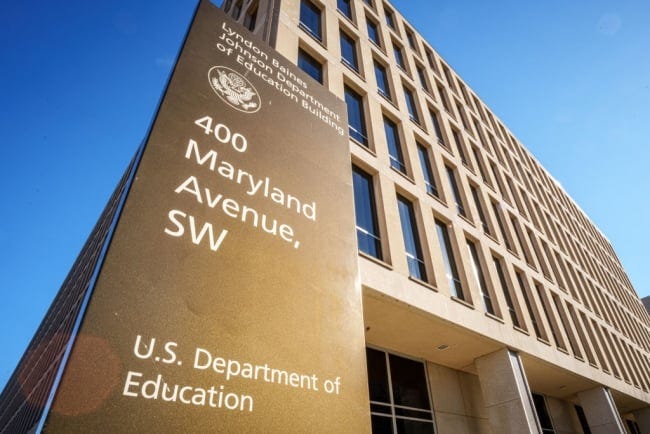
Colleges have a stamp too. It’s called accreditation. Last month the Department of Education proposed rewriting the rules behind it, and the public comment window closes Monday, September 21.
Your voice is needed. Below I’ll show you how to speak up!
Accreditation carries real weight
Most families never think about accreditation when they’re choosing a college, and that’s how it should be. It works like the grade on the carton. A qualified, independent reviewer checks whether a school meets real standards for educational quality, then stands behind the result so students and parents don’t have to investigate every campus themselves.
The stamp carries serious weight. Only accredited schools can receive federal student aid. In fiscal year 2024, that meant $120.8 billion delivered to 9.9 million students. Pell Grants, federal loans, the money that puts college within reach for most American families, all of it flows through schools that hold the stamp.
So the stamp's quality matters.
This proposal would rewrite the rules
On August 20, the Department issues its Notice of Proposed Rulemaking [NPRM], carrying out an executive order President Trump signed in 2025 after calling accreditation his “secret weapon” for reshaping higher education. The administration says the rule promotes innovation and accountability. Read the fine print and three changes deserve your attention.
First, it becomes far easier for a college to drop its accreditor and pick a new one. Under the proposal, a switch is presumed legitimate unless the government can show the school is dodging enforcement. Policy experts call this accreditation shopping. Remember, accreditors are funded by dues from the very colleges they review. When a college can walk away at any time, the business incentive tilts toward leniency. Imagine the egg company shopping for a grader who guarantees an A.
Second, the rule scraps the requirement that a new accreditor operate for two years before seeking federal recognition. Brand-new graders, no track record, overseeing the gateway to billions in aid. The Department admits in its own proposal that it lacks the data to predict how these changes will reshape the market.
Third, the rule would require accreditors to enforce the administration’s interpretations of “academic freedom,” “intellectual diversity,” and civil-rights law. Reviewers who answer to educational standards would now police political ones. Antoinette Flores of New America, who once oversaw accreditation at the Department, calls the overhaul “a political power grab”. The Council for Higher Education Accreditation, hardly a radical outfit, warned the proposal goes “beyond modernization” into undue federal control.
A weakened accreditation hurts all of us
If you want to know what happens when this system fails, ask the students of Corinthian Colleges.
Corinthian ran more than a hundred campuses under names like Everest, Heald, and WyoTech. Its recruiters targeted single parents, veterans, and first-generation students. The company advertised job placement rates it could not back up, and in 2015 federal regulators fined it $30 million for misrepresenting those numbers. It collapsed within months. ITT Tech, another giant with the same playbook, collapsed the following year. Roughly 768,000 borrowers between the two chains were left holding debt for credentials the job market wouldn’t honor. Taxpayers eventually absorbed $5.8 billion in discharged loans for Corinthian students and $3.9 billion more for ITT.
Both chains were fully accredited on the day they declared bankruptcy. Their accreditor, ACICS, kept stamping the carton through every warning sign, until the federal government finally stripped its recognition. Senator Dick Durbin called ACICS a “deadbeat accreditor” that failed as a gatekeeper of taxpayer dollars.
That is what a weak stamp costs. Students’ years, families’ savings, and about $9.7 billion in public money. The proposal on the table right now makes the conditions that produced ACICS easier to recreate, with more accreditors, lower bars to entry, and colleges free to shop among them.
The process needs improvement, but this isn’t it
The current system has flaws. Accreditors rarely pull the stamp from schools with poor student outcomes. Transferring credits between accredited colleges can be maddening. Those problems deserve fixing.
And the Department didn’t write this rule in a back room. A negotiating committee of higher education representatives reached consensus on the text in May. Two things about that process are worth knowing. The Department’s Under Secretary told the committee the administration’s goal was to “upend higher education.” The negotiators representing students and veterans also abstained from the final vote. The two groups the stamp exists to protect declined to put their names on it.
If accreditation needs reform, and it does, the reform should give the watchdog sharper teeth on behalf of students.
This proposal files the teeth down and hands the leash to politics.
Add your voice before Monday!
Federal agencies must read and consider substantive public comments before finalizing a rule, and courts hold them to it. One specific, personal comment carries more weight than a thousand copied form letters.
So here’s your move. It takes ten minutes.
Visit the accreditation NPRM’s Federal Register page and click the green “Submit a Public Comment” button on the left side of the page.
Enter your comment directly into the text box (which allows up to 5,000 characters) or upload a file containing your comment. Uploaded files are not subject to the character limit, and the site accepts common file formats, including PDF and DOCX.
When you are finished, click “Submit Comment” and save the tracking number for your records.
Submit before 11:59 p.m. Eastern on Monday, September 21.
How to structure your public comment
Please make your letter personal! To help you get started, EdTrust and the Lawyers’ Committee for Civil Rights Under Law provide the recommendations below on how you can structure your letter.
Introduce yourself or your organization. Example: “This letter is submitted on behalf of EdTrust, a national nonprofit organization dedicated to advancing policies and practices that dismantle racial and economic barriers in the American education system, in response to the U.S. Department of Education (ED)’s proposed revisions to the regulations that govern accreditation.”
Clearly state your position, the specific provisions of the rule that concern you, and how these provisions would impact you, your institution, or the students you serve. Example: “I oppose the provisions in § 602.17(g) and § 602.23(j) as currently written in the NPRM. Together, these provisions would shield state lawmakers who encroach on academic freedom and institutional governance from accreditor scrutiny. This means that if a partisan state legislature decides to micromanage a university’s curriculum, dismantle tenure, or stack a university board with political operatives — actions that are currently happening and often undermine lawful programs and initiatives designed to uplift under-represented students — the accreditor may be required to look the other way.”
Close with what you want ED to do. Example: “We urge ED to (withdraw XYZ provisions and) not finalize this rule as currently written.”
Quick Cheat Sheet: Review the topics below and choose those that resonate most with you or your organization. Specific provision numbers are listed further below and should be cited in your comment letter!
Where the NPRM Goes Wrong
Guiding Questions
The NPRM Would Weaken Accreditors’ Consumer Protection and Educational Quality Assurance Role
Have you enrolled in an accredited program or institution that provided a poor quality education and/or left you with poor outcomes (e.g., low earnings and high debt)? If so, you can use your experiences to justify the need for strong consumer protections and why ED should withdraw these new provisions.
The NPRM Would Undermine Accreditors’ Role as a Safeguard for Academic Freedom
Has your institution self-censored lawful speech, curricula, or student supports out of fear of this current administration? Have you experienced other instances of federal government overreach that concern you or impact your learning? If so, explain how that experience informs your concerns about partisan interference in higher education and shows why ED should withdraw these new provisions.
The NPRM Would Shield State Partisan Interference From Accreditor Scrutiny
Have state politicians targeted lawful speech, curricula, and student supports at your institution? Have you had other experiences that raise concerns about state partisan overreach into your education? If so, you can cite these experiences to justify your request for ED to withdraw these new provisions.
The NPRM Would Further Codify the Administration’s Anti-Diversity, Equity, and Inclusion Campaign
Has your institution experienced the loss of lawful programs or student supports in response to the federal administration’s campaign against programs that advance diversity, equity, and inclusion? Do you have other concerns about the administration’s continued onslaught against DEI programs and supports? If so, explain how those changes affected you or your campus community and use those experiences to justify why ED should withdraw these new provisions
The NPRM Would Weaken Accreditors’ Consumer Protection and Educational Quality Assurance Role
What’s at stake: Accreditors are charged with ensuring academic quality, evaluating American colleges and universities on factors like student achievement, faculty, and curriculum — the core elements that shape students’ educational experiences. Department-recognized accreditors also determine whether institutions and programs have access to the federal financial aid system, worth more than $100 billion in federal grants, work-study funds, and student loans each year. Taken together, the NPRM’s provisions would weaken accreditors’ role as independent watchdogs that hold institutions accountable and protect students from low-quality programs.
Sanctioned Institutions Could Shop for a New Accreditor
Under the proposed rule, requests to change or have multiple accreditors would be automatically approved unless ED actively intervenes – § 600.11(a)(1)(ii) & § 600.11(b)(1)(ii)
At the same time, ED would eliminate existing safeguards that prohibit institutions from changing or obtaining multiple accreditors if, within the prior two years, their accreditation was withdrawn, revoked, or terminated, or if they were subject to a probation, show-cause, or suspension order – rescissions of language in § 600.11(a) & § 600.11(b)
Untested Accreditors Could Win Federal Recognition
Under the proposed rule, newly created accreditors could apply for federal recognition as soon as they establish accreditation standards and operating procedures and receive an application from at least one institution – § 602.12(a)
While an agency would still need to accredit at least one institution before gaining recognition, the proposal would remove the longstanding requirement that new accreditors have at least two years of experience making accreditation decisions before seeking recognition – rescissions of language in § 602.12(a)
The Department Could Second-Guess Accreditor Enforcement Decisions
The proposed rule would allow ED to maintain an institution’s Title IV eligibility while an adverse accreditation action is under appeal, arbitration, or judicial review – § 602.26(h). However, because the NPRM does not specify when ED would exercise this authority, it would introduce federal discretion and uncertainty into the accreditation process regarding when institutions would face the consequences of adverse actions.
The NPRM Would Undermine Accreditors’ Role as a Safeguard for Academic Freedom
What’s at stake: Accreditors exist as independent entities, separate from federal and state governments, for a reason: to protect higher education from partisan interference. Their role is to ensure that teaching, learning, and research are evaluated by academic experts rather than by changing political priorities or ideological preferences. The NPRM would undermine that independence by effectively turning accreditors into enforcers of the administration’s interpretations of academic freedom, viewpoint neutrality, and the First Amendment.
While these requirements may seem protective on paper, in practice, they give the administration discretion to target whatever it considers ideologically objectionable — a tactic it has already used to take aim at diversity, equity, and inclusion (DEI) programs. Codifying requirements related to “academic freedom” and making them a condition of accreditor recognition would effectively position the federal government as the arbiter of the term.
The ambiguity of these requirements and the threat of severe penalties for noncompliance would also pressure accreditors and institutions to preemptively self-censor lawful speech, curricula, and student supports.
Accreditors & Institutions Would Effectively Need to Comply With the Trump Administration’s Interpretation of Academic Freedom
Accreditors would have to evaluate whether institutions maintain academic freedom protections among their faculty – § 602.17(a)(2)(iii), § 602.17(a)(2)(vii)(A), and § 602.17(a)(2)(vii)(B)
Accreditors would have to evaluate whether institutions maintain policies “regarding the integrity of scholarly activity” – § 602.17(a)(2)(vi)
Accreditors & Institutions Would Effectively Need to Comply With the Trump Administration’s Interpretation of Viewpoint, Ideology, and Intellectual Neutrality
Accreditors would have to evaluate whether institutions have policies “designed to support, promote, and appropriately prioritize intellectual diversity” among faculty, including measures of “student and faculty perceptions on the range of viewpoints and perspectives” (emphasis added) – § 602.17(a)(2)(viii)
Accreditors would have to ensure their decisions are “neutral with respect to viewpoint and ideology that are unrelated to its accrediting policies or standards” – § 602.18(b)(4)
Accreditors & Institutions Would Effectively Need to Comply With the Trump Administration’s Interpretation of the First Amendment
Accreditors could not maintain “standards, policies, and enforcement practices” that impede public institutions from fulfilling their First Amendment obligations – § 602.15(f)
Accreditors would have to evaluate whether public institutions maintain policies that protect First Amendment rights – § 602.17(a)(2)(v)
Accreditors Would Effectively Need to Mirror Enforcement Actions by the Trump Administration
In the preamble of the NPRM, ED notes that its intent “is not to prescribe specific institutional policies or override institutional autonomy.” Yet this provision would conflict with ED’s stated intention by requiring accreditors to “promptly review [their] accreditation or preaccreditation of [an] institution or program” if that institution or program has been subject to an adverse action “by a State agency or Federal agency” (emphasis added) – § 602.28(d)
The NPRM Would Shield State Partisan Interference From Accreditor Scrutiny
What’s at stake: The NPRM would also shield state lawmakers who encroach on academic freedom and institutional governance from accreditor scrutiny. This means that an accreditor would be legally required to overlook partisan efforts to micromanage a university’s curriculum, dismantle tenure, or stack a university board with political operatives — actions that are currently happening and often undermine lawful programs and initiatives designed to uplift under-represented students. Meanwhile, ideologically motivated adverse actions by state agencies against particular institutions or programs would trigger an accreditor review of those institutions or programs.
State Politicians Could Interfere With Accrediting Standards
Accreditors could not maintain standards that “encourage, direct, or otherwise require institutions or programs to violate Federal or State law ....” – § 602.17(g)
State Politicians Could Interfere With Institutional Governance
Accreditors could not review “aspects of institutional governance of public institutions that are established by State law, including the appointment of institutional directors or officers by elected or appointed State officials.” – § 602.23(j)
Accreditors Would Effectively Need to Mirror Enforcement Actions by State Governments
Accreditors would have to “promptly review [their] accreditation or preaccreditation of [an] institution or program” if that institution or program has been subject to an adverse action “by a State agency or Federal agency” (emphasis added) – § 602.28(d)
The NPRM Would Further Codify the Administration’s Anti-DEI Campaign
What’s at stake: The NPRM would give the administration another means to advance its broader anti-diversity, equity, and inclusion agenda; although these requirements are proclaimed as protective, in practice they are poised to exert significant pressure on both accreditors and institutions to interpret and enforce the administration’s legally flawed interpretation of civil rights law — one that has repeatedly treated DEI and race-conscious initiatives as presumptively unlawful, even though many such programs remain lawful and serve important educational purposes.
Accreditors & Institutions Would Effectively Need to Comply With the Trump Administration’s Anti-DEI Interpretation of Civil Rights Law
Accreditors would have to evaluate whether institutions maintain policies that “protect civil rights” among faculty – § 602.17(a)(2)(vii)
Accrediting standards could not “encourage, direct, or otherwise require institutions or programs to violate Federal or State law, including by having policies that provide any preferences on the basis of race” (emphasis added) – § 602.17(g)
Accreditors could not have policies that “require institutions or programs to violate any Federal or State law,” including Title VI of the Civil Rights Act of 1964 and Title IX of the Education Amendments of 1972 – § 602.23(h)
Accreditors would have to conduct a “cost/benefit analysis” of institutions’ student support services to justify their costs – § 602.17(a)(3)(i)
You don’t need a policy degree. You need a stake in whether the stamp means something, and if you’re a parent, a student, or a taxpayer, you have one.
Tell them students deserve a stamp that means something. I would never let the egg company grade its own eggs. I’m not going to watch it happen to my kids’ colleges quietly, either.
Be kind, feed your mind, and use your voice.
Status as of September 17, 2026: this is a proposed rule, open for public comment through September 21. A final rule is expected around November 1, 2026, and would take effect July 1, 2027. I’ll update this piece as it moves.
Sources: Federal Register, “Accreditation, Innovation, and Modernization” (91 FR 53940, Aug. 20, 2026); Federal Student Aid FY2024 Annual Report; U.S. Department of Education press releases; Inside Higher Ed; Higher Ed Dive; New America; Council for Higher Education Accreditation; NPR; Office of Sen. Dick Durbin.
The Dad Briefs covers the civic, political, and quietly human stories that shape family life in America — with recipes along the way.