


Hey Everyone. My full Maine Lobster Roll recipe from episode 1 of The Maine Course is at the bottom of this page. Before you scroll, stick with me for a few minutes, because the story of why that lobster roll costs what it costs is the story of yet another unnecessary economic fight in America.
Another trade war nobody asked for
Last week, trade talks between the United States and Canada collapsed. At midnight, new 50 percent American tariffs took effect on about $20 billion of Canadian goods, covering everything from building materials to liquor, as NBC News reported. Prime Minister Mark Carney called the move “a miscalculation.” By Tuesday, Canada answered with retaliatory tariffs of up to 50 percent on roughly 700 American products, effective September 8, promising to match us, per NPR’s coverage, dollar for dollar.
Remember, this is Canada. Our largest trading partner. The border Maine families cross for hockey tournaments and grocery runs. For thirty years under NAFTA and its successor, most goods moved across that line duty-free. Now trade lawyers are calculating combined rates of 60 percent, as U.S. News details.
None of this was forced on us. This administration started the fight in February 2025, originally justifying it with fentanyl trafficking claims. Customs data showed less than one percent of fentanyl seizures happen at the northern border, per National Fisherman’s reporting. When the Supreme Court struck down the emergency tariffs earlier this year in Learning Resources v. Trump, the administration found new authorities and kept going. A fight with our closest ally, sustained by choice, escalating by choice.
The Maine Course: Fishing for answers
Maine’s lobster economy and Canada’s are one body with a border running through it. About half of Maine’s roughly 90 million-pound harvest crosses into Canada for processing, and three-quarters of that comes right back to American plates, according to Luke’s Lobster’s CEO, who calls the two industries completely intertwined. Maine sends about $200 million of lobster north every year; the state’s top fisheries official warned tariffs on that flow could cripple the fishery, because the only place the added cost can land is the boat price, meaning what lobstermen get paid.
And the squeeze comes from every direction at once. Steel tariffs raise the cost of traps, clips, rings, and hoops, as even Senator Collins acknowledged at an Appropriations hearing. Bait costs more. A lobster caught in Maine can be taxed twice, once entering Canada for processing and again coming home. Commerce Secretary Lutnick assured senators that USMCA-compliant lobster would likely dodge the tariffs, but this week’s escalation is precisely about abandoning that framework.
So the shack charges $38. The market charges $12 to 18 a pound. The lobsterman earns less per pound than at almost any point in seventy-five years. Everyone in the chain is squeezed, and the squeezing was a policy decision.
These aren’t luxury items
Maine imports most of its heating oil, gasoline, and other refined petroleum from across that same border. Winter is coming, as it does every year in Maine, and this one arrives with a trade war attached. Rent and groceries in Maine already run above the national average. A tariff is a tax paid at the register and the fuel truck, and Maine families are positioned to pay it more directly than almost anyone in America.
No crisis demanded this. No emergency at the northern border, no trade imbalance that talks couldn’t address, no problem a 50 percent tax on hockey sticks solves. What Maine got instead was a manufactured fight with the neighbor its economy is built around, and a Senate delegation whose loudest response has been a strongly worded letter.
The tension is the product of decisions, which is worth remembering, because decisions can be unmade.
For now: toast the bun in butter. Pile it high. Enjoy every bite. That part, at least, is still fully in your hands.
Be kind and feed your mind.
Maine Lobster Roll
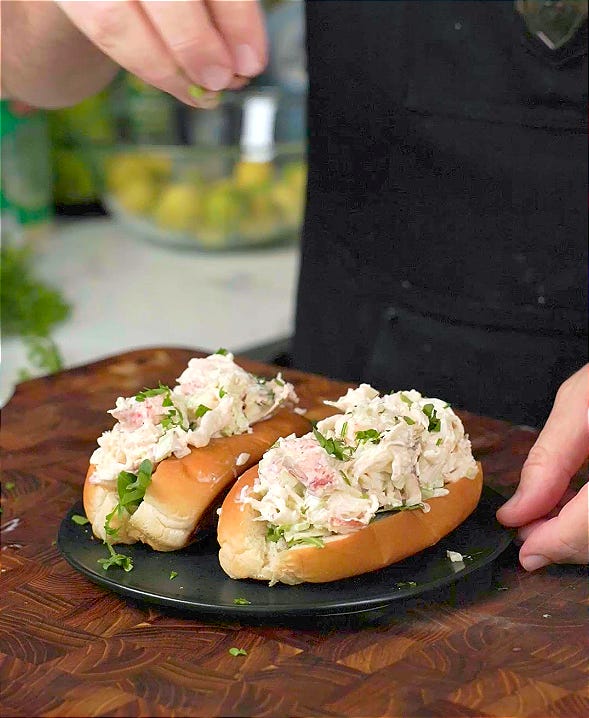
A classic Maine recipe using chilled lobster meat with mayo and diced celery. Served on a toasted top-split hot dog roll with a little greens (I used arugula here). Garnished with chopped parsley and/or chives.
Note that claw and knuckle meat are traditionally used in this roll, but I also add the tail meat if I’m not saving it for another dish.
Ingredients
8 oz Lobster meat, cut or pulled apart into bite-size chunks
2 tbsp Mayonnaise
Pinch of White Pepper
Pinch of Kosher Salt
3 tbsp celery, peeled and diced
2 top-split hot dog rolls
1 tsp soft butter to grill
Green leaf lettuce or arugula
Chopped chives and/or parsley to garnish (optional)
Lemon wedge to garnish (optional)
Directions
Tear lobster meat into bite-size pieces. Add lobster meat, mayonnaise, white pepper, salt, and celery to a large bowl. Mix well and chill in the refrigerator until ready to use.
Spread a layer of butter onto both sides of 2 rolls. Place on a pan or griddle over medium heat & grill each side until golden brown.
Place buns on a plate or serving tray. Add greens to the roll as a base. Divide the lobster mixture evenly between rolls.
Optionally, garnish with chopped parsley and/or chives and a squeeze of fresh lemon.
Serve immediately. (A side of chips goes well with this roll.) Enjoy!
Slade Wentworth | The Dad Briefs covers the civic, political, and quietly human stories that shape family life in America — with recipes along the way.
Suggestions on what citizens can do to stop this nonsense?
I hope none of your recipes call for hockey sticks - I can’t afford em!