


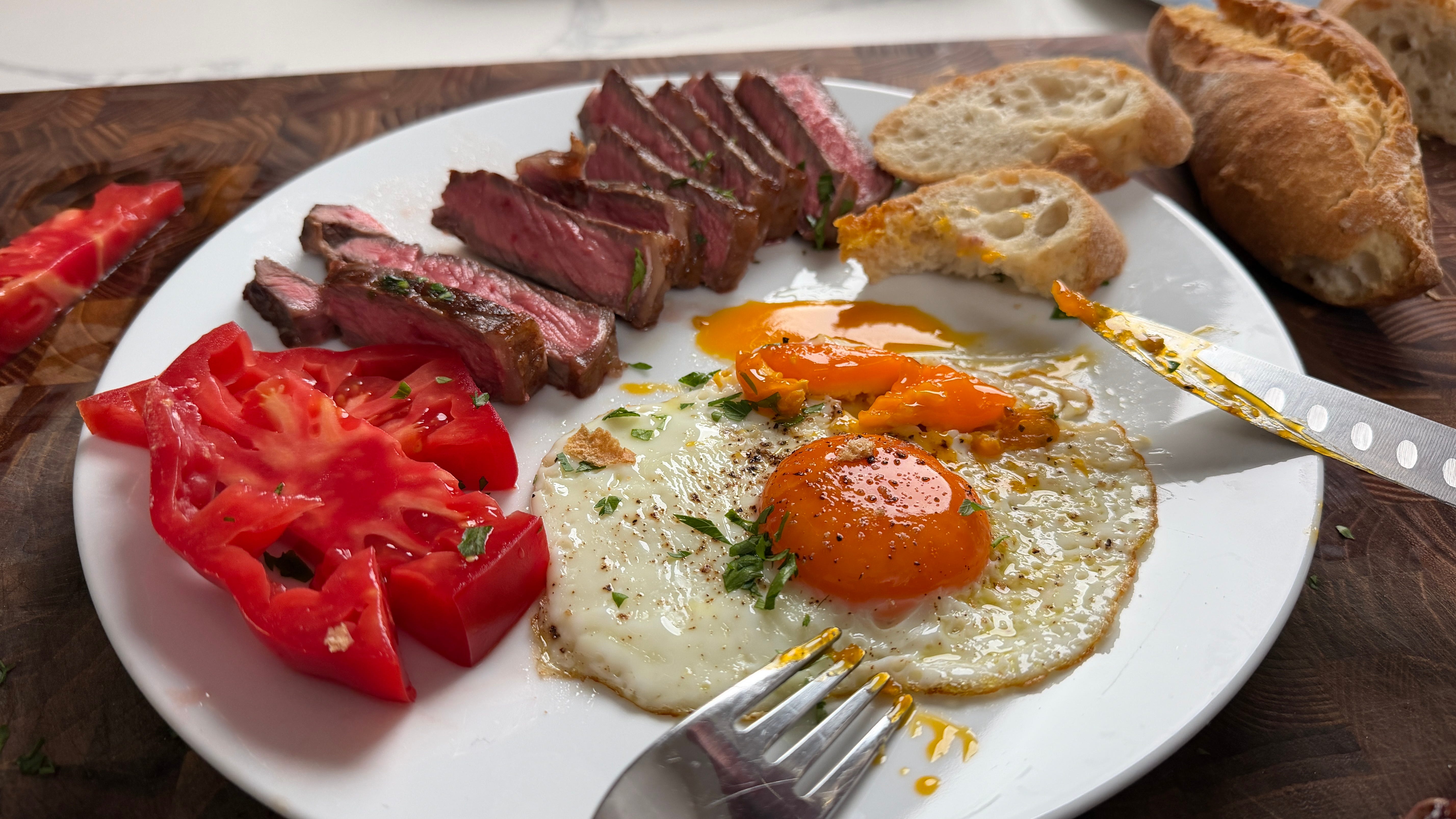
Breakfast for dinner at our house means steak and eggs. This week I priced every item on the plate, then read the court filings behind them.
Three industries. Three cases. One pattern.
The Eggs
In March 2025, a dozen eggs hit a record $6.23. Waffle House added a 50-cent surcharge to every egg. Families cut back. Food banks felt it.
The explanation was bird flu, and bird flu was real. The industry lost tens of millions of laying hens.
On June 29, 2026, the Justice Department and 17 states, Florida among them, sued three of the country’s largest egg producers: Cal-Maine Foods, Versova, and Hickman’s Egg Ranch. The DOJ’s antitrust complaint alleges that from June 2022 to March 2025, the companies coordinated bids on a trading platform that feeds Urner Barry, the benchmark grocers and restaurants use to price billions of eggs.
Prosecutors say the goal was to make demand look stronger than it was. In December 2022, Hickman’s CEO allegedly emailed executives at the other two companies: “Please consider posting strong bids, early and often.”
In March 2025, the companies learned they were under investigation and were told to preserve their documents. Egg price quotes dropped. New York wholesale eggs fell from $8.53 a dozen in late February to $3.86 by April.
Recovering flocks played a part. Critics noticed the timing anyway. Farm Action’s Angela Huffman told NPR the companies “realized they couldn’t get away with it any longer.”
The companies settled the same day the case was filed.
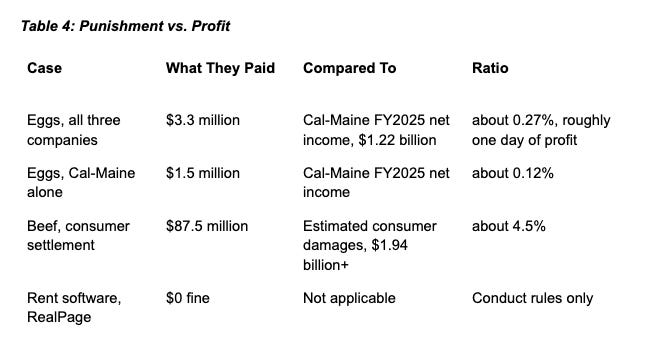
None of them admitted wrongdoing. None paid a fine.
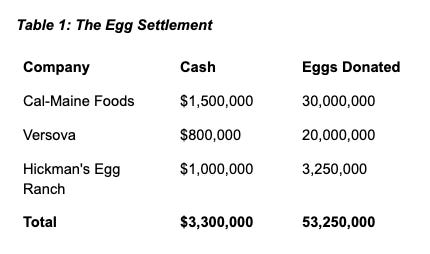
Cal-Maine’s own earnings report shows $1.22 billion in net income for fiscal 2025. That works out to about $3.3 million a day. The entire three-company settlement equals roughly one day of Cal-Maine’s profit.
Cal-Maine has been here before. In 2023, a federal jury found Cal-Maine and other producers liable for conspiring to restrict egg supply from 2004 to 2008.
The Steak
Four companies control more than 80 percent of American beef processing: Tyson, JBS, Cargill, and National Beef.
Ground beef hit a record $7.16 a pound in August. In 2021 it cost under four dollars. Most of today’s price traces to the smallest cattle herd since 1951, after years of drought. The packers say they’ve been losing money on beef.
The lawsuit covers an earlier window. Ranchers, grocers, restaurants, and shoppers allege that from roughly 2014 to 2020, the four packers coordinated to limit supply. Ranchers would get paid less for cattle, shoppers would pay more for beef, and the packers would keep the difference.
On July 16, 2026, a federal judge certified the case as class actions, letting millions of buyers sue together. Plaintiffs’ experts estimate consumer damages above $1.94 billion. The packers deny wrongdoing and are appealing part of the ruling.
Tyson and Cargill already settled with consumers.
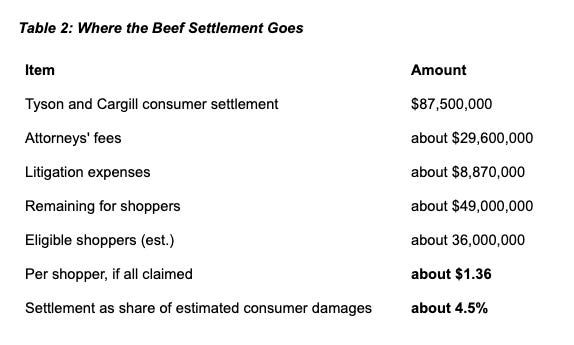
Actual checks will run larger because few people file claims. The claim deadline passed June 30.
The pattern reaches past beef. In 2021, Pilgrim’s Pride pleaded guilty to chicken price-fixing and paid a $107.9 million fine. JBS owns a majority stake in Pilgrim’s. Smithfield, JBS, Seaboard, and Hormel have all paid to settle consumer pork claims.
In November 2025, President Trump directed the Justice Department to investigate meatpackers. Concern about this industry crosses party lines.
The Gas
California drivers pay about $6 a gallon. The war with Iran and the disruption to shipping through the Strait of Hormuz account for most of that.
A lawsuit filed June 22 argues they don’t account for all of it. The class action complaint says Kalibrate, a pricing software company, gave competing chains a shared algorithm to set pump prices. The defendants include 7-Eleven, Circle K, BP, Marathon, Walmart, and Albertsons, and together they run more than 1,700 California stations.
According to the complaint, Kalibrate warned customers that undercutting a rival would trigger a “downward spiral.” A feature called “restoration” allegedly lets nearby stations raise prices together, by a lot, at the same time. Old-school price-fixing needed a back room. The lawsuit says the software became the back room.
The suit cites research finding that the software raised prices about 6 cents a gallon on average, and up to 30 cents where most stations used it. The strongest peer-reviewed evidence comes from a study of German stations. Margins held steady when one of two competing stations adopted pricing software and rose about 28 percent when both did.
California saw this coming. AB 325, a state law that took effect January 1, makes clear that price-fixing through a shared algorithm still counts as price-fixing.
Kalibrate says it disagrees with the allegations and will fight them. Nothing has been proven.
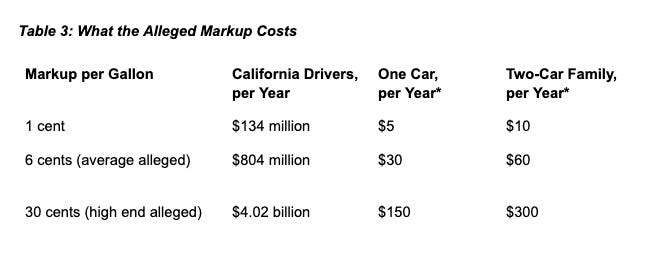
*Assumes about 500 gallons per car per year, roughly 12,000 miles at 24 mpg. Statewide figures use the complaint’s estimate of $134 million per cent.
The closest precedent offers little comfort. In November 2025, the Justice Department settled its algorithmic rent-pricing case against RealPage. The settlement set new limits on how the software works. It carried no fine.
The Pattern
Bird flu. A shrinking herd. A war. The crises were real. Real crises make good cover, and a price you can’t check is a price someone can pad.
I spent years in fraud prevention. The first lesson of that work: when the expected penalty is smaller than the expected gain, you already know what happens next.
A fine smaller than one day’s profit is just another business expense.
Slade Wentworth | The Dad Briefs covers the civic, political, and quietly human stories that shape family life in America, with recipes along the way.
Everyday it's some new thing, showing us how big corporations endlessly screw the consumer. Thank you for explaining this so clearly and concisely
A friend used to have this to say: When times are bad, they raise the price of whiskey. When times are good, they raise the price of whiskey.