


The Trump administration has conditioned us to expect the next bad thing to happen, especially when it comes to our election process. The constant lies are destabilizing to our democracy and making us less safe. Speculation on what it might do next is almost impossible to avoid.
It’s been an era of deceit, manipulation, and bald-faced anti-democracy. Yet a Republican-controlled Congress has left it almost entirely unchecked. They must all be held accountable.
So let’s name names.
The quick-hit list
March 25, 2025: Trump orders Documentary Proof of Citizenship on the federal voter registration form, plus an Election Day deadline for mail ballots. A federal judge blocked the citizenship demand. Another judge permanently blocked most of the order on June 24, 2026, writing that the Constitution “does not grant the President any specific powers over elections.”
March 2025: CISA freezes its election security work and ends funding for the EI-ISAC, the network that warned states about threats. The 2027 budget request would eliminate the program.
April 9, 2025: A presidential memo orders an investigation of Chris Krebs, Trump’s own cyber chief, who called the 2020 election secure.
April 2025: DHS and DOGE turn the SAVE immigration database into a citizenship checker for voter rolls. A judge blocked it. On Sept. 25, 2026, the Supreme Court revived it over a dissent from three justices.
July 15, 2025: Trump says Texas can “pick up five seats” with a redraw. A federal panel found “substantial evidence” of racial gerrymandering, and the Supreme Court let the map stand. Missouri and North Carolina followed. Indiana’s Republican Senate said no.
Aug. 18, 2025: Trump vows to “get rid of MAIL-IN BALLOTS” and voting machines by executive order.
August 2025: DHS names Heather Honey, whose debunked 2020 claims Trump repeated, its deputy assistant secretary for election integrity.
September 2025 onward: DOJ sues 30 states and D.C. for unredacted voter files. Judges have dismissed 26, including eight Trump appointees.
Nov. 9, 2025: Trump pardons 77 people tied to the 2020 fake-elector scheme, including Rudy Giuliani, John Eastman and Mark Meadows. State charges remain.
Jan. 28, 2026: The FBI seizes 656 boxes of Fulton County’s 2020 election records with spy chief Tulsi Gabbard on site. A judge let DOJ keep them.
Feb. 2, 2026: Trump says Republicans “ought to nationalize the voting” in “15 places.”
Feb. 4, 2026: Gabbard’s office confirms it took voting machines from Puerto Rico.
Feb. 11, 2026: The House passes the SAVE America Act, 218-213. It requires Documentary Proof of Citizenship to register and a photo ID to vote in every federal election. It stalled in the Senate.
March 31, 2026: A second order creates federal “citizenship lists” and tells the Postal Service to deliver ballots only to approved voters. A judge blocked it. On Sept. 14, the Supreme Court refused to revive it for November.
July 7, 2026: DOJ letters warn election chiefs in all 50 states they “could be criminally prosecuted.”
August 2026: DOJ announces a record 1,000 federal monitors for Nov. 3.
Sept. 10, 2026: The Census Bureau proposes leaving noncitizens out of the 2030 count that divides House seats, if they lack green cards.
Oct. 22, 2026: DOJ sues to block Alaska from certifying its Senate race if Sen. Dan Sullivan loses to Democrat Mary Peltola. The suit blames a second candidate named Dan Sullivan, whom both a state court and the Alaska Supreme Court kept on the ballot. Trump said he ordered the suit himself: “I’m the one that said ‘do it.’”
Proof of citizenship is a different thing from voter ID
Showing an ID at the polls is old news. Most states already ask for one.
Documentary Proof of Citizenship is a different hurdle, at a different step. Under the SAVE America Act, you’d have to prove you’re a citizen with papers before you could register at all. The bill requires states to turn away any application without it.
Your driver’s license won’t do it. A REAL ID with the gold star proves you’re here lawfully, and green card holders carry the same star. Only five states (Michigan, Minnesota, New York, Vermont and Washington) offer an ID marked for citizens. Everyone else would need a passport or a certified birth certificate. If you register by mail, you’d have to bring those papers to your election office in person.
Now picture who gets stuck. The bride whose birth certificate carries her maiden name. The veteran whose birth certificate burned in a house fire. The grandmother born at home in 1948. The bill tells states to make a process for supplemental documents, but it leaves the details to them, which could mean 50 different sets of rules.
The SAVE America Act also adds a photo ID requirement, and supporters lead with that part because it polls well. The citizenship paperwork at registration is the larger change, and it gets far less attention.
And Congress? The House passed the president’s bill. Senate Republicans kept the filibuster, and appropriators made CISA keep its regional election advisers. Beyond that, the majority has mostly watched.
That’s where we come in
Ultimately, we, the people, are the check and the balance.
The courts have done their part. Twenty-six judges, appointed by presidents of both parties, threw out the voter-roll lawsuits. A judge can only rule on what someone brings to court, though, and every one of those cases started with an election official who said no.
So I want to salute those who protect our elections. They make our checks and balances possible. They keep our elections free and fair and our democracy working.
Look at Nevada. Homeland Security claimed there might be as many as 15,903 noncitizens on the state’s rolls. Nevada’s election officials demanded the data, DHS cut its claim to 185, and the check brought the list to zero. Every flagged voter was a U.S. citizen.
Look at Georgia. Secretary of State Brad Raffensperger, a Republican, refused to hand over his voters’ birthdates and Social Security digits. A federal judge sided with him on Sept. 30.
Look at Utah. Lt. Gov. Deidre Henderson, another Republican, got DOJ’s threat letter and called it “another love letter.”
Look at Tennessee. Voters in Davidson, Williamson and Madison counties said their touchscreens flagged Marsha Blackburn when they pressed Jerri Green. State Coordinator of Elections Mark Goins sent a Republican technician and a Democratic technician to check the machines together. Every vote is counted from the paper ballot. Davidson County brought back the coffee stir sticks. That is what integrity looks like up close.
The salute
Here are the people who run and protect our elections, from the top of the ballot to the folding table.
Secretaries of State and lieutenant governors serve as chief election officers in most states. They sign the “no” letters.
State election directors and coordinators, like Tennessee’s Mark Goins, write the rules and train the counties.
State attorneys general and their election units defend voters in court. They won the voter-roll cases.
County clerks, registrars, auditors and administrators of elections run the day-to-day work. Here in Florida, that’s our 67 Supervisors of Elections.
County election commissions, boards of elections and canvassing boards count, review and certify, usually with both parties at the table.
Voter registration staff process applications, verify eligibility and keep the rolls clean under federal law.
Election IT and cybersecurity staff fill the gap the federal cuts left behind.
Voting machine technicians, often in bipartisan pairs, fix, seal and document every device.
Logic-and-accuracy testers run test ballots through every machine before Election Day, in public.
Ballot designers, proofreaders and printers get every race, name and language right.
Mail ballot processors and signature verifiers check each envelope against the signature on file.
USPS letter carriers and mail handlers carry ballots both ways.
Drop-box couriers and chain-of-custody teams move ballots in pairs, with logs and seals.
Poll workers, election judges, inspectors and precinct clerks open the doors at dawn and close them after the last voter in line.
Greeters, line managers and parking volunteers keep things moving.
Interpreters and accessibility aides make sure every eligible citizen can cast a private ballot.
Poll watchers and observers from both parties see the process for themselves.
Election Protection hotline volunteers and lawyers answer the calls at 866-OUR-VOTE.
Post-election auditors and hand-count teams check the machines against the paper.
Recount officials and certification boards finish the job on deadline, whoever wins.
Judges hear election cases fast and follow the law.
Journalists sit through canvass meetings so we know what happened.
Custodians, principals, pastors and rec center staff unlock gyms, churches and community halls at 6 a.m.
This work takes courage. In the Brennan Center’s 2026 survey, 32 percent of local election officials reported threats, harassment or abuse because of their job. Fifty-two percent worry about their colleagues’ safety. Seventy-five percent said they’ve received no new resources to make up for the federal cuts. Four in ten of the chief local election officials who ran the 2024 election were new since 2020, the highest turnover in at least 25 years.
Some paid a steep price. Ruby Freeman and Shaye Moss, a mother and daughter who counted ballots in Atlanta, were smeared by Rudy Giuliani and won a $148 million judgment. Giuliani is now pardoned. The president’s Justice Department is now asking for the names of the people who worked alongside them.
They stay anyway. Pennsylvania Secretary of State Al Schmidt, a Republican, faced death threats after 2020 and spent years fending off Heather Honey’s lawsuits. She now holds an election integrity title at DHS. Schmidt is still at his post.
Your turn
Nov. 3 is nine days away. Make your plan and vote early if you can. Check your registration, track your mail ballot or find your early voting site.
Then do one more thing. When you hand in your ballot, look the poll worker in the eye and say thank you. Thank the Supervisor of Elections staff, the technician, and the volunteer who will be there past midnight.
They keep the process free and fair. We keep it ours by showing up.
The check and the balance are us.
Vote.
Then thank someone in a lanyard.
The Bookshelf
The U.S. Constitution: A Comprehensive and Annotated Guide for the Modern Reader by Melissa Murray (37 Ink, 2026)
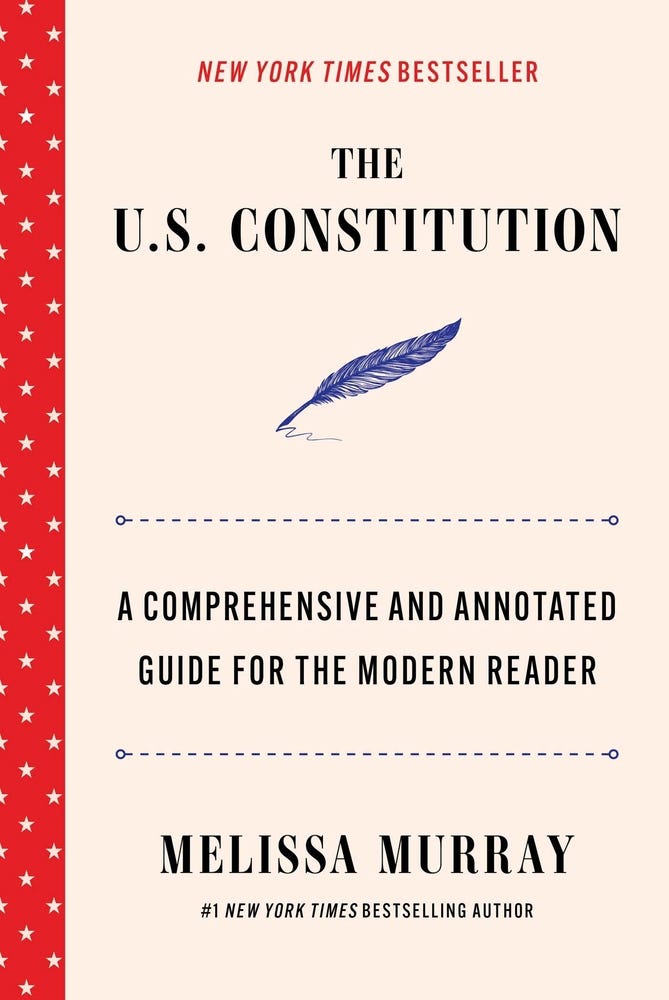
This week’s list keeps running into the same wall. A judge blocked the president’s election order because the Constitution doesn’t give him the power to run our elections. That power sits in Article I, Section 4, which hands the “times, places and manner” of elections to the states and to Congress.
Murray, an NYU law professor and co-host of the Strict Scrutiny podcast, walks through every article and all 27 amendments in order. For each one she explains where it came from and what it means today. Read the Elections Clause, then the 15th, 19th, 24th and 26th Amendments, and you’ll see how hard Americans fought to widen the vote, one amendment at a time.
Her case is that the Constitution belongs to the people, and that’s the same case this week’s Brief makes. You can also buy it through Democracy Forward’s store, where your purchase goes to a group that has been in court defending these rights.
Dad Joke for the Road
My boss asked me why I only get sick on weekdays. I said it must be my weekend immune system.
The Recipe
Slade’s Mac & Cheese

INGREDIENTS
For Mac & Cheese
½ cup butter
¾ cup flour
1 qt whole milk
12 oz sharp cheddar cheese, grated
4 oz Gouda cheese, grated
1 tsp dry mustard
1 tsp ground white pepper
½ tsp ground turmeric
½ tsp salt
½ tsp black pepper
Pinch of ground nutmeg (optional)
1 pound corkscrew pasta, uncooked
For Topping
1 cup panko breadcrumbs
¼ cup grated Parmesan cheese
¼ cup finely chopped fresh parsley (curly or Italian)
4 tbsp butter, melted
Salt and pepper to taste (optional)
DIRECTIONS
In a large pot on the stovetop, cook pasta in water until done. Drain and set aside.
Preheat oven to 425º F.
Make the roux: Return the large pot to the stovetop. Over medium-high heat and using a whisk, melt the butter, then add the flour, stirring until smooth. Gradually add in milk, about 1 cup at a time, stirring until smooth each time. Once all milk is added, the roux should be the consistency of a cream soup.
Add all spices and whisk until fully incorporated. Then add the grated cheeses and whisk until smooth and creamy.
Turn off heat and carefully add in the cooked pasta. Use a spatula to stir until all the pasta is evenly coated with cheese sauce.
Pour the pasta and cheese sauce mixture into a baking dish large enough to hold it all. Level the surface using a spatula.
Make the topping: In a medium mixing bowl, add the breadcrumbs, grated Parmesan cheese, chopped parsley, salt, pepper and melted butter. Stir with a fork until everything is evenly mixed.
Spread the topping onto the pasta and cheese mixture, ensuring an even layer across the entire surface.
Bake for 15 minutes, or until the topping is golden brown.
Remove from the oven and let stand for 15 minutes before serving.
Enjoy!
Slade Wentworth | The Dad Briefs covers the civic, political, and quietly human stories that shape family life in America, with recipes along the way.