


Note: Instructions for entering a substantive public comment are below.
Washington, D.C. has many monuments. The Lincoln Memorial. The Washington Monument. The Vietnam Veterans Memorial. The Jefferson Memorial. Congress has authorized each one, debated them publicly, designed them with restraint, and built them to honor something larger than the person who ordered it.
Donald Trump wants to add one more. He would like it to be the biggest.
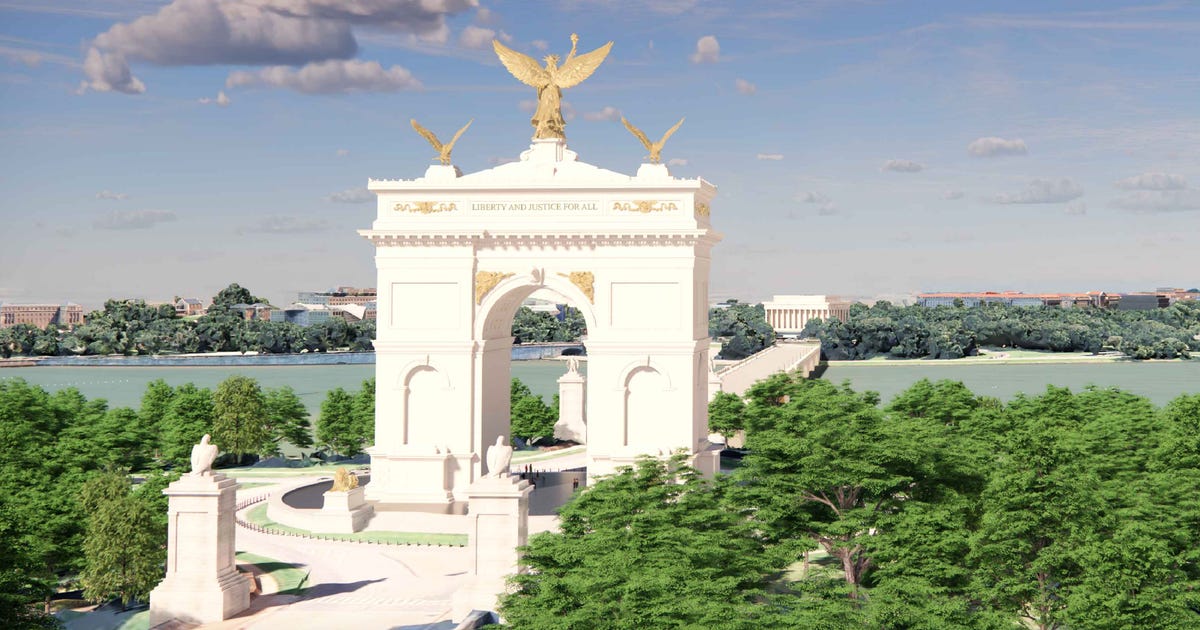
The proposal is a 250-foot gilded arch — taller than the Arc de Triomphe in Paris, more than twice the height of the Lincoln Memorial — at Memorial Circle, the traffic roundabout on the Virginia side of Arlington Memorial Bridge. The design includes a winged figure holding a torch, two gilded eagles, and inscriptions in gold reading “One Nation Under God” and “Liberty and Justice for All.”
When asked who the arch was for, Trump pointed at himself: “Me. It’s going to be beautiful.”
The National Park Service is currently accepting public comments on the project. The deadline is June 15, 2026 — this Monday.
Your comment becomes part of a federal record that the agency must take into account. Here is what you need to know, and how to make your comment count.
The Origin Story
This project goes by several names. The White House calls it the “Independence Arch.” The official NPS review documents call it the “Triumphal Arch.” The press has taken to calling it the “Arc de Trump,” after a CBS correspondent floated the nickname and it stuck.
The idea was seeded in April 2025 by architecture critic Catesby Leigh in an essay for the Claremont Institute arguing Washington is “the only major Western capital without a monumental arch.” Leigh originally envisioned something modest — around 60 feet. Harrison Design architect Nicolas Leo Charbonneau posted a rendering in September 2025. By October 15, Trump was showing 3-D models on his Oval Office desk. After Trump chose the largest option, Leigh himself turned critic, telling the New York Times the result is “way too big for that site.”
The administration’s historical rationale is that Washington has wanted an arch for 200 years. A Congressional Research Service review found no evidence that any previous president sought to build one, and that the 1901 McMillan Plan — which Trump’s team has cited — specifically rejected freestanding triumphal arches in favor of memorial temples. The administration’s legal hook is a 1924–25 authorization for a pair of slender 166-foot columns at the site, never built, meant to symbolize North and South. Historians note those columns were designed to frame the Lincoln Memorial view — not block it.
The NPS Has Jurisdiction
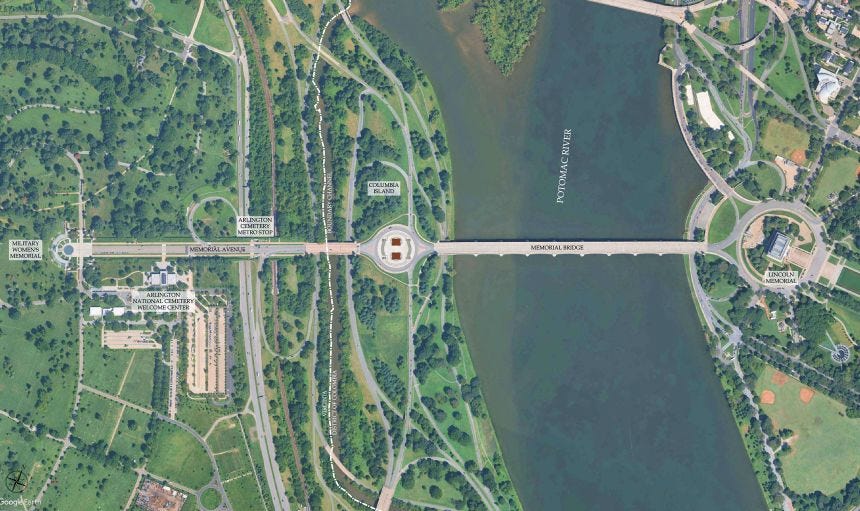
The site — Memorial Circle, Columbia Island, Lady Bird Johnson Park — is federal parkland managed by the National Park Service within the George Washington Memorial Parkway. That triggers Section 106 of the National Historic Preservation Act, which requires any federal agency undertaking a project to assess its effects on properties listed in the National Register of Historic Places and to give the public a meaningful opportunity to comment before a final decision is made.
The NPS completed its Assessment of Effects in June 2026. Its preliminary finding: adverse effect. The report concludes the arch “would alter, directly and indirectly, characteristics of those properties that qualify them for inclusion in the National Register,” diminishing their integrity of setting, design, feeling, and association. The affected properties include the Memorial Avenue Corridor Cultural Landscape, Arlington Memorial Bridge, Arlington House (the Robert E. Lee Memorial), Arlington National Cemetery, the Lincoln Memorial and its cultural landscape, the National Mall Historic District, and potentially the Pentagon. The Area of Potential Effects, per the NPS, covers “the landscapes and structures that form the ceremonial gateway” between Washington and Arlington.
Section 106 is a procedural requirement. An adverse-effect finding does not stop the project. What it does is create a record — and the stronger, more substantive the public comments in that record, the harder it is for the agency to dismiss objections and the more material there is for the courts to work with.
Criticisms, in Detail
The Sightline
Arlington Memorial Bridge was built deliberately low. The axis it sits on — from the steps of the Lincoln Memorial, across the Potomac, directly to Arlington House, the former home of Robert E. Lee — was designed as a symbol of post–Civil War reconciliation between North and South. The arch, placed directly on that axis at Memorial Circle, breaks that sightline permanently. Architectural historian Alison Hoagland told the Commission of Fine Arts that disrupting the view “would disrupt this reconciliation.” Architect and public historian Neil Flanagan described the Potomac as “the border between the North and South … It’s literally crossing the border and trying to heal those wounds.”
The Form
A triumphal arch is not a neutral architectural form. It originates in ancient Rome — the Arch of Titus (81 CE), the Arch of Septimius Severus (203 CE), the Arch of Constantine (312 CE) — built to commemorate military victories and glorify individual emperors. The Arc de Triomphe was ordered by Napoleon in 1806 after Austerlitz to glorify his army. Napoleon never lived to see it finished. Art historian Marisa Anne Bass has described the triumphal arch as a form that “emerged … in ancient Rome to make permanent the status of a conquering emperor as a godlike victor … the point was to commemorate an individual, not a nation.” Sue Mobley of Monument Lab called it “textbook Trump … It has to be the biggest. That’s the authoritarian impulse.”
The words inscribed on this arch — “Liberty and Justice for All,” “One Nation Under God” — are borrowed from democratic and civic tradition. The form they are stamped onto is the architecture of autocratic self-glorification.
The Process
The Commission of Fine Arts — whose members Trump replaced after firing the prior commissioners — approved the design on May 21, 2026. CFA Secretary Thomas Luebke read into the record that of roughly 600 written public comments received, 99.5 percent were in opposition. The National Capital Planning Commission voted 9-1 to advance the project on June 4 while flagging unresolved issues: pedestrian safety, flight-path interference at Reagan National Airport, view obstruction, the Height of Buildings Act, and missing detail on lighting, stormwater, and materials.
On funding: Trump initially claimed the arch was fully privately financed. The National Endowment for the Humanities FY2026 budget documents earmark $2 million in special-initiative funds for the arch and an additional $13 million in matching grants — $15 million in taxpayer money — while the NEH has not yet distributed $65 million Congress separately appropriated for state humanities councils, which are facing layoffs and frozen grants.
On legal authorization: Public Citizen filed suit in February 2026 (Lemmon v. Trump) on behalf of three Vietnam veterans and a retired architectural historian, arguing the project lacks the congressional authorization required by the Commemorative Works Act. The CRS agrees fresh congressional approval is required. The administration relies on the 1924–25 column authorization. Judge Tanya Chutkan declined a preliminary injunction but ordered the NPS to give 14 days’ notice before breaking ground.
On airspace: The FAA conducted a limited feasibility study and found no significant adverse effect, but explicitly noted the review was limited and that a full aeronautical study is required before construction can proceed. The site is less than two miles from Reagan National Airport, under the same north approach corridor as the fatal 2025 American Airlines–Black Hawk midair collision.
The Fight is On
The National Trust for Historic Preservation submitted formal objections documenting conflicts with the McMillan Plan and the Commemorative Works Act. The Society of Architectural Historians issued a detailed June 2 statement refuting the administration’s historical claims. The National Parks Conservation Association noted that Arlington conducts 27 to 30 funeral services every weekday and up to 10 on Saturdays — roughly 6,900 military burials a year — and that the landscape deserves protection.
The elder-led advocacy group Third Act organized a multi-day demonstration at the Lincoln Memorial through Memorial Day weekend under the banner “86 Trump’s Arch,” arguing that democracies do not build memorials to living presidents.
Rep. Don Beyer (D-VA), whose district includes the site and whose family members are buried at Arlington, introduced the Arlington National Cemetery Viewshed Protection Act with roughly 33 co-sponsors to bar federal funds for the arch without congressional approval.
How to File a Substantive Comment
A comment that engages the legal and factual framework becomes part of a record the agency must reckon with, and that litigants can cite. Here is how to make yours count.
Submit here:
Online: NPS PEPC project page — George Washington Memorial Parkway, projectID 136973
Email: ncr_planning@nps.gov
Deadline: June 15, 2026, 11:59 p.m. Mountain Time
These are the only two accepted submission methods. Your comment and identifying information will become part of the public administrative record.
What to say — substantive arguments that carry legal weight:
1. The sightline is irreplaceable. Name specific affected properties — the Lincoln Memorial, Arlington Memorial Bridge, the Memorial Avenue Corridor Cultural Landscape, Arlington House — and explain in your own words how placing a 250-foot structure on the deliberate axis between them destroys the integrity of setting, feeling, and association that gives those properties their National Register significance. Cite the NPS’s own adverse-effect finding and argue that no mitigation in a Programmatic Agreement can restore a permanently obstructed view.
2. Demand real alternatives, not just mitigation. The Section 106 process requires the agency to explore alternatives that genuinely avoid or minimize adverse effects before accepting them. Argue that the Draft Programmatic Agreement is premature and that a legitimate “no-build” alternative and alternative siting locations must be analyzed before any decision document is signed.
3. Raise the NEPA question. Ask whether the NPS has prepared a full Environmental Impact Statement. A project of this scale, height, and documented public controversy warrants an EIS rather than a simpler categorical exclusion, and the Section 106 process must be completed before any NEPA decision document (a Finding of No Significant Impact or Record of Decision) is finalized.
4. Press the authorization gap. Cite the Commemorative Works Act and the CRS finding that no previous president sought to build an arch here, and argue that a 1924–25 column authorization for two 166-foot structures cannot lawfully cover a single 250-foot arch that is fundamentally different in scale, form, and purpose.
5. Name the concrete harms. Pedestrian and traffic safety at a high-speed traffic circle. FAA airspace risk at Reagan National, where the administration’s own feasibility study called itself a “limited review” and required a full aeronautical study before construction. The 1910 Height of Buildings Act, which caps most D.C. construction at 130 feet. Disruption to Arlington’s daily funeral services and the solemn character of the cemetery landscape. Stormwater, tree loss, and landscape disruption in Lady Bird Johnson Park.
6. Be personal if you have standing. If you have visited these sites, attended a funeral at Arlington, are a veteran or a Gold Star family member, or are a resident or commuter who depends on the Memorial Bridge corridor, say so. Particularized injury strengthens the administrative record and, if it comes to it, legal standing.
The comment period closes Monday night. The arch’s opponents have already put 99.5 percent of public comments on the record against it. Add yours, and make it one the agency has to think about.
The forms are open. The deadline is real.
Let’s write the record now.
Be kind, feed your mind, and … you know.
Done!
This is what i submitted, based closely to your suggestions:
"This Monument to Mr. Trump is a further disgrace that he wants to place on our great nation! There are numerous issues with this Trumpian Monument:
1. The sightline is irreplaceable. The Lincoln Memorial, Arlington Memorial Bridge, the Memorial Avenue Corridor Cultural Landscape, Arlington House will be blocked by this monstrosity. Placing a 250-foot structure on the deliberate axis between them destroys the integrity of setting, feeling, and association that gives those properties their National Register significance. The NPS itself has stated that sees an adverse-effect finding and argue that no mitigation in a Programmatic Agreement can restore a permanently obstructed view.
2. If something has to go forward, let it be in keeping with the entire area and memorials surrounding it. We need substantially different and real alternatives, not just mitigation. The Section 106 process requires the agency to explore alternatives that genuinely avoid or minimize adverse effects before accepting them. Argue that the Draft Programmatic Agreement is premature and that a legitimate “no-build” alternative and alternative siting locations must be analyzed before any decision document is signed. Try a 70-foot tall structure as originally envisioned by the designer.
3. Has NEPA been fully evaluated and enforced as it is intended to be for such federal projects? A project of this scale, height, and documented public controversy warrants an EIS rather than a simpler categorical exclusion, and the Section 106 process must be completed before any NEPA decision document (a Finding of No Significant Impact or Record of Decision) is finalized.
4. The Commemorative Works Act and the CRS finding that no previous president sought to build an arch here, and argue that a 1924–25 column authorization for two 166-foot structures cannot lawfully cover a single 250-foot arch that is fundamentally different in scale, form, and purpose.
5. Pedestrian and traffic safety at a high-speed traffic circle. FAA airspace risk at Reagan National, where the administration’s own feasibility study called itself a “limited review” and required a full aeronautical study before construction, should be studied as part of a full NEPA EIS Evaluation . The 1910 Height of Buildings Act, which caps most D.C. construction at 130 feet. Disruption to Arlington’s daily funeral services and the solemn character of the cemetery landscape. Stormwater, tree loss, and landscape disruption in Lady Bird Johnson Park.
You need to stop this monstrosity from moving forward, completely. IF there is enough support to build something there. Consider the above arguments and follow due process to enhance our historic monuments and not overwhelm or over shadow them!!!!!!"
Thank you. This is by far the best and fullest analysis of the history and the reasons for objecting to the arch I've encountered. "F*** Donald Trump" will have no effect as a public comment, but points from this piece are indeed substantive.