


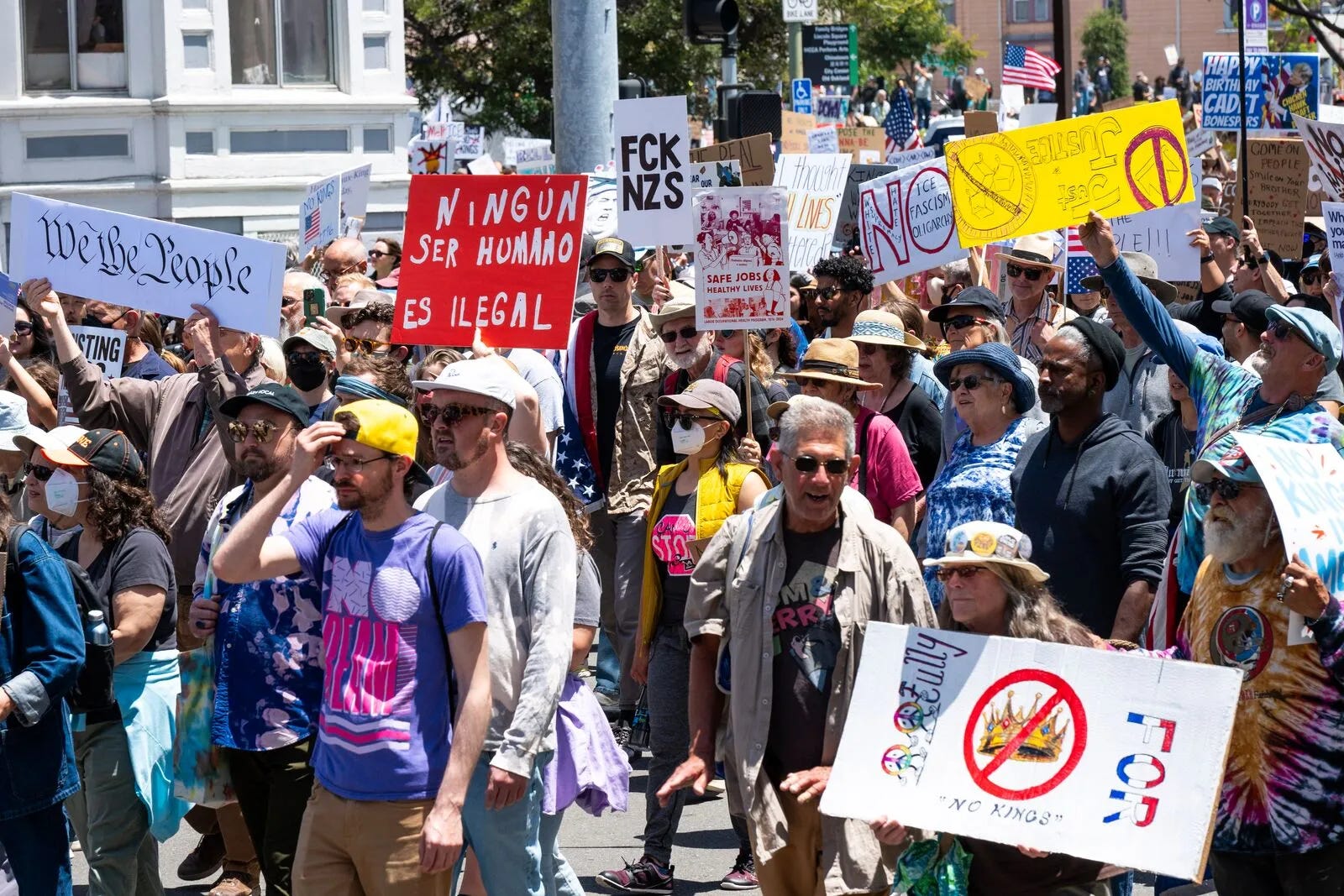
I was driving home from a doctor’s appointment with Carla this morning, and we stopped at a light next to the library. It was our polling place this month. It’s also the four corners where every No Kings rally in our town was held.
It got me thinking about how we showed up for each other over the past two years, how our collective courage changed things, and what happens next.
The swing
The scale still hasn’t sunk in. Democrats flipped nine Republican Senate seats, and Mary Peltola’s win in Alaska, called this week, sealed a 56-44 Senate majority. Kansas elected its first Democratic senator since 1932. In the House, Democrats were on pace for their largest majority since 2008. And according to NBC News, no minority party had flipped both chambers on a single night since 2006.
Those numbers started on street corners. The first No Kings day in June 2025 drew an estimated 4 to 6 million people. October drew roughly 7 million. Organizers counted 8 million in March, a figure not yet independently verified. Our corner was one of thousands.
How we got here
Over the past ten years, MAGA devotees went too far in their support of the destruction of democratic norms and institutions. They backed an obvious grifter and pledged blind fealty to anywhere he took them. Even if their hearts were in the right place, and many were simply tired of Washington’s business as usual, the path they chose again and again was anti-human, anti-dignity, anti-empathy. It ran roughshod over every historical parallel and every sense of basic decency.
This administration has ransacked our country.
Voters noticed. In the NBC News exit poll, 43 percent of midterm voters said opposing Trump was one reason for their vote.
The pendulum
Political scientists have a name for this. Christopher Wlezien calls it thermostatic public opinion. When policy runs too hot in one direction, the public turns the dial the other way. Since 1842, the president’s party has lost House seats in 40 of 43 midterms. A 2024 study by Matt Grossmann and Wlezien tested whether parties pay a price for moving policy hard in their own direction, and found a large midterm penalty for the president’s party on top of everything else.
The thermostat doesn’t take sides. It will turn on us, too.
Now we’ve begun to swing hard to the left, and as the blue wave washes over us, we’ll be tempted to take it too far. Some of that is necessary. We have to release the pain on behalf of everyone who has been victimized by inhumane policy and insane hatred. At the same time, we have to rise above victimhood, through resistance and into leadership. The goal is a democracy renewed into something stronger than it has ever been, stronger than the status quo we lost.
Going far and going too far are different things. Going far means subpoenas and oversight hearings, laws that lower what families pay, protections written to outlast any one administration. Going too far would mean borrowing the tactics we spent a decade fighting: punishing opponents for being opponents, treating a norm as optional the moment it gets inconvenient.
The test is simple. Would we accept this power in the hands of the people we just beat?
It’s a cycle, really. And how fortunate are we to see it through.
Fall in love, fall in line
There will be plenty of infighting and disagreement. There already is.
Bill Clinton put it this way in a 2003 speech: Democrats want to fall in love, and Republicans just fall in line. Political scientists Matt Grossmann and David Hopkins gave that quip a framework in Asymmetric Politics. The Republican Party runs as an ideological movement that prizes purity. The Democratic Party is a coalition of groups who want government to do concrete things. Teachers, nurses, union members, immigrants, small business owners and suburban moms will argue about what comes first. That’s what a coalition is.
The last decade complicates the old line, though. Republicans needed 15 ballots to elect Kevin McCarthy speaker in 2023, then threw him out ten months later, the first time the House has ever removed its speaker. Ezra Klein wrote in 2024 that Democrats fall in line and Republicans fall apart. The unity MAGA showed was loyalty to one man. Discipline around ideas is something else.
Then look at this week. Seven incoming progressives voted against Hakeem Jeffries in caucus. Pramila Jayapal withheld her support until he commits to Medicare for All. Chris Van Hollen challenged Chuck Schumer, and Sen.-elect Peggy Flanagan called for new voices in leadership.
And then the caucus nominated Jeffries 251 to 11, putting him in line to become the first Black speaker of the House. That’s a family argument that ended in a vote. It’s supposed to look like that.
Already, with congressional leadership and legislative priorities, the roots of our resistance keep a wary eye on every move. We’re concerning ourselves with processes we can barely touch, closed-door caucus votes and leadership races, because we know nothing can be outside our reach ever again. Accountability is for every elected leader. We’re not letting anyone off the hook.
That’s a good thing.
The four corners
The light turned green this morning, and we drove through the intersection. No signs. No crowd. A library, a crosswalk, and a few people walking in and out with books.
That’s what we were fighting for. Ordinary days. A building where you can borrow a book or cast a ballot without worrying whether either will still be there.
The pendulum will swing back someday. It always does. Our job is to make sure it swings inside a sturdier house: courts that hold, elections that count, and institutions that protect the people who lose as fiercely as the people who win.
We showed up on those corners because we feared what we might lose.
We’ll keep showing up because we’ve reclaimed our power.
Slade Wentworth | The Dad Briefs covers the civic, political, and quietly human stories that shape family life in America, with recipes along the way.
I've often thought of pendulums as a good analogy of politics. And your 'family argument settled by vote' is excellent. I believe that our country's political pendulum can and must swing to maintain the voice of the people. Smaller oscillations would be better!
https://en.wikipedia.org/wiki/Pendulum
Spreading this info might be helpful too. John Stewart's podcast with Gil Duran.
https://youtu.be/9BL4tcw8MVE?is=E3JWBxRiGleUy4eg