
The Fourth Estate Is Under Threat.
Here’s What That Means for All of Us.
Last Saturday, Brendan Carr — the chairman of the Federal Communications Commission and the nation’s chief broadcast regulator — was at Mar-a-Lago when he picked up his phone and posted a warning directed at every TV broadcaster in America.
“Broadcasters that are running hoaxes and news distortions — also known as the fake news — have a chance now to correct course before their license renewals come up. The law is clear. Broadcasters must operate in the public interest, and they will lose their licenses if they do not.”
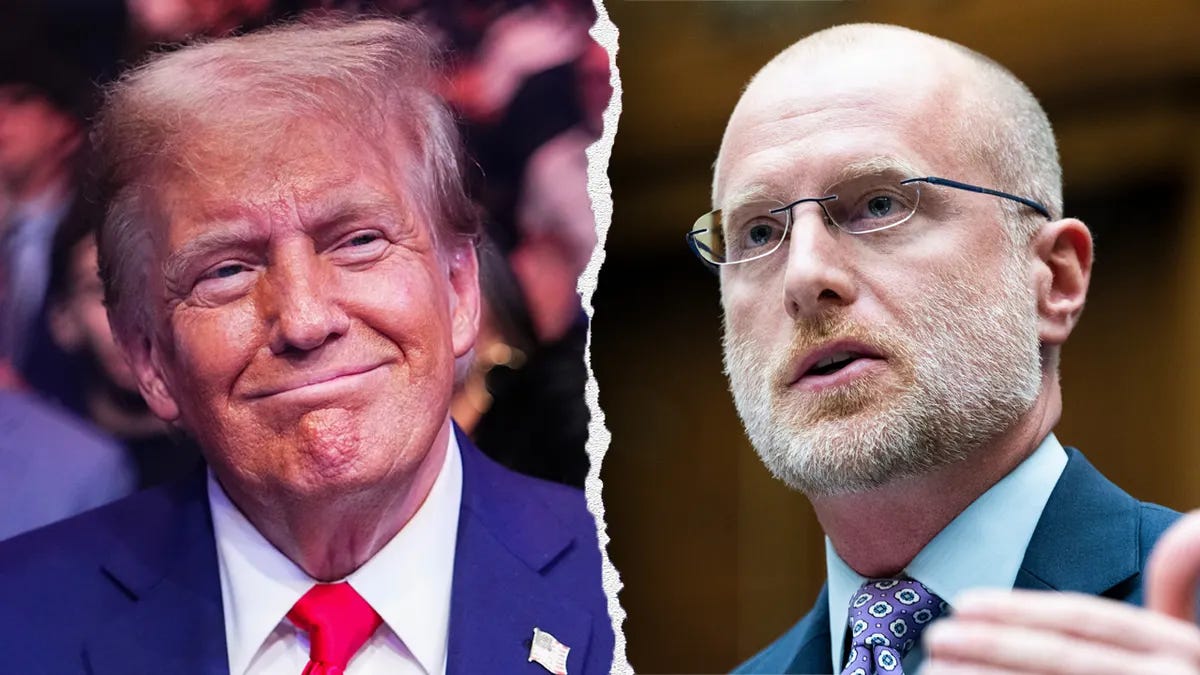
The trigger was a dispute over war reporting. The Wall Street Journal had reported that five U.S. Air Force refueling planes were struck during an Iranian missile strike on the Prince Sultan Air Base in Saudi Arabia. The president called the coverage “intentionally misleading” and accused the Times, the Journal, and other outlets of “terrible reporting.” Carr, at the same resort as the president that day, echoed the complaint with a threat.
The president then endorsed Carr’s warning on Truth Social, calling media organizations “Corrupt and Highly Unpatriotic.” And then Trump went further — suggesting on social media that some journalists should be tried for treason over their coverage of a war.
Let’s be precise about what just happened: the United States government threatened to strip broadcasters of their licenses if their war coverage didn’t align with the president’s account of events. And it did so while the war was still ongoing.
That is not a threat to “fake news.” That is the definition of state-controlled media.
Why is the Press called the “Fourth Estate”
To understand why this moment is so consequential, it helps to understand where the concept of a free press actually comes from — and what it was designed to do.
The term “Fourth Estate” was popularized by the historian Thomas Carlyle, who attributed it to the Irish statesman Edmund Burke. In his book On Heroes and Hero Worship (1840), Carlyle wrote: “Burke said there were Three Estates in Parliament; but, in the Reporters’ Gallery yonder, there sat a Fourth Estate more important far than they all.” The three estates Burke referred to were the Lords Spiritual, the Lords Temporal, and the Commons — essentially the church, the aristocracy, and the people. Burke’s argument, as Carlyle framed it, was radical: the reporters watching from the gallery were more powerful than any of the three official branches of government combined. Not because they held authority, but because they held accountability.
Carlyle connected the press directly to the survival of self-governance: “Printing, which comes necessarily out of Writing, I say often, is equivalent to Democracy: invent Writing, Democracy is inevitable.” He saw the press as instrumental to the birth of democracy — spreading facts, sparking debate, and making revolution against tyranny possible.
This wasn’t romanticism. It was a structural argument about how free societies function. Democracy requires that citizens be informed enough to make consequential decisions — about who governs them, how wars are fought in their name, what their tax dollars are doing, what their government is hiding. No governing body can be expected to operate accountably without knowledge of what it is doing being available to those it governs.
Walter Cronkite put it with characteristic directness: “A democracy ceases to be a democracy if its citizens do not participate in its governance. To participate intelligently, they must know what their government has done, is doing and plans to do in their name… This is the meaning of freedom of press. It is not just important to democracy — it is democracy.”
The First Amendment doesn’t protect the press because journalists are special. It protects the press because you are special. You are the sovereign in this democracy, and the press is the mechanism by which you exercise that sovereignty with informed consent rather than manufactured ignorance.
What Brendan Carr Is Actually Doing — and Why His Limited Legal Power Isn’t the Point
Legal experts and First Amendment advocates were quick to point out that Carr’s specific threat has significant practical limitations. The FCC does not license national networks. It licenses local stations that carry network programming. Cable networks like CNN fall entirely outside the FCC’s authority. The New York Times and Wall Street Journal — the outlets Trump specifically attacked — own no broadcast licenses whatsoever and are entirely beyond the FCC’s reach.
But there is a deeper reason Carr’s threat is largely hollow — and it comes from the one and only time in American history that the FCC actually revoked a television station’s license over content. It is a story most people have never heard. And it is the exact opposite of what Brendan Carr is implying.
The One Precedent — and What It Actually Means
The station was WLBT, Channel 3 in Jackson, Mississippi. It had been on the air for just eighteen years when the FCC did something it had never done to any other station in the country — and has never done since.
WLBT was an NBC affiliate in a city whose population was forty percent Black. Its transgressions were not subtle. In 1955, when Thurgood Marshall — NAACP lawyer and future Supreme Court Justice — appeared on an NBC national broadcast to discuss the implications of Brown v. Board of Education, WLBT cut the network feed and put up a card that read: “Sorry, cable trouble.” The station manager later admitted he had pulled the interview deliberately. His explanation: television networks had become instruments of, in his words, “Negro propaganda.”
That was not an isolated incident. It was policy. The station sold anti-integration literature in the lobby of its downtown studios. It editorialized in favor of segregation. It blacked out network civil rights coverage as a matter of routine. When James Meredith was admitted to the University of Mississippi in 1962, the station manager wrote a deriding editorial that prompted formal complaints to the FCC. The station gave airtime to segregationist politicians while systematically excluding the Black community from any meaningful representation — in a city where nearly half the population was Black.
In 1963, civil rights leader Medgar Evers was finally granted air time after formally requesting the opportunity to respond to Jackson’s mayor. He spoke calmly and eloquently: “Whether Jackson and the state choose change or not, the years of change are upon us. In the racial picture things will never be as they once were. History has reached a turning point.” Three weeks later, he was assassinated in his driveway.
In 1964, the Reverend Everett Parker of the United Church of Christ — joined by NAACP state president Aaron Henry and Rev. R.L.T. Smith — filed a formal petition with the FCC to deny WLBT’s license renewal. They documented the pattern of discrimination, the blacked-out coverage, the editorial hostility, and the systematic exclusion of the Black community from a public airwave they had every right to access.
The FCC’s initial response was as revealing as WLBT’s conduct. The commission ruled that the petitioners had no standing to challenge the license — because they had no economic interest in the station and were not subject to electronic interference from its signal. In other words: ordinary citizens, including the very community the station was supposed to serve, had no legal right to participate in FCC proceedings. The public, as far as the FCC was concerned, did not exist in this process.
The United Church of Christ appealed to the United States Court of Appeals for the District of Columbia. In 1966, the court — in an opinion written by Warren Burger, before he became Chief Justice of the United States — ruled that the public absolutely had the right to participate in FCC hearings. This was a landmark decision that permanently changed communications law. Citizens could now challenge broadcast licenses. The airwaves, Burger wrote, belonged to the public.
It didn’t end there. The FCC, undeterred, renewed WLBT’s license anyway. Twice. The challengers appealed again. Burger wrote a second decision. This time the court took the extraordinary step of ordering the license stripped entirely — the first and only time a federal court has ever done so based on a station’s content and conduct.
In 1969, WLBT became the first television station in American history to lose its broadcast license over what it put on the air. In 1971, control passed to a biracial nonprofit. The new management appointed the first Black general manager of a television station in the American South. The station was rebuilt from the ground up as what its new operators called “a beacon of tolerance.”
A Mississippi Freedom Trail marker now stands outside the building.
Now consider what that precedent actually establishes. The one and only time the FCC’s content authority was invoked to strip a license, it was used to punish a station for suppressing minority voices, distorting coverage of a civil rights movement, and providing a platform for a political establishment’s preferred propaganda — while excluding the community it was supposed to serve.
The power was wielded against state-aligned media. Not for it.
When Brendan Carr invokes the FCC’s “public interest” authority to threaten stations that report facts about a war the president finds inconvenient, he is not following precedent. He is inverting it. He is pointing a legal instrument designed to protect the public from government-friendly distortion and aiming it in the opposite direction entirely.
As one First Amendment scholar noted, the Telecommunications Act of 1996 further restricted the criteria for revoking a license to the point where he described it as “essentially impossible before then” and “totally impossible now” on content grounds.
That’s the legal reality. But Carr’s strategy was never about legality. It was about fear.
Media advocacy groups have been clear about what this approach is actually designed to achieve: not license revocation, but self-censorship. The implicit threat, as public interest communications attorney Andrew Jay Schwartzman described it, is that broadcasters who displease the administration may find the regulatory relief they want — merger approvals, license transfers, spectrum allocations — suddenly much harder to obtain. It is regulatory leverage wielded as a weapon, and it works without a single license ever being revoked.
We have already watched it work. When Carr suggested ABC affiliate owners might face license scrutiny over a Jimmy Kimmel joke, two of the largest broadcast groups in the country pulled the show from their programming within hours. Paramount, seeking merger approval, told the FCC it would install an editorial ombudsman at CBS and eliminate diversity and inclusion practices as conditions of the deal. Defense Secretary Pete Hegseth stood at a Pentagon press briefing and said of CNN — explicitly — that “the sooner David Ellison takes over that network, the better,” referring to the Paramount executive seeking regulatory approval to acquire CNN’s parent company.
The Radio Television Digital News Association’s CEO, Tara Puckey, called it precisely what it is: “What Chair Carr is describing is government control of the press.”
The Broader Pattern: Fourteen Months of Documented Attacks
This week’s threat did not emerge from nowhere. It is the latest escalation in a systematic, documented campaign against independent journalism that began on the first day of Trump’s second term — in fact, before it officially started.
By the numbers, compiled by Poynter’s Press Freedom Watch: 215 anti-media social media posts from Trump in 2025 alone. Seventy-six documented federal actions against journalists. Thirteen lawsuits filed by journalists and media organizations against the administration over press freedom violations.
The scope of what those numbers represent:
Access and accreditation: The Associated Press was banned from the White House press pool in February 2025 after refusing to use the administration’s preferred name for the Gulf of Mexico. In October 2025, the Pentagon introduced new press guidelines requiring reporters to submit material for vetting as a condition of access — conditions that nearly the entire mainstream press corps, including AP, Reuters, NPR, and all major newspapers and broadcasters, refused to accept. They surrendered their Pentagon credentials rather than comply. Their places were filled by pro-Trump outlets and political influencers. Critical journalism was not formally banned. It was rendered structurally unworkable.
Physical threats: There were 170 reports of assaults on journalists in the United States in 2025, 160 of them at the hands of law enforcement, most occurring during immigration enforcement coverage.
Legal intimidation: The FBI raided the home of Washington Post reporter Hannah Natanson on January 14, 2026. Legal observers described it as a rare and deliberately intimidating move, designed to send a message to reporters covering government sources. Jameel Jaffer of Columbia University’s Knight First Amendment Institute called it “intensely concerning” for its chilling effect on legitimate journalistic activity. Trump separately sued the New York Times for fifteen billion dollars. A federal judge threw the case out.
Public broadcasting: FCC Chairman Carr launched investigations into NPR and PBS, explicitly linking them to Congressional efforts to defund both organizations. He reopened complaints against ABC, CBS, and NBC over their 2024 election coverage. He conspicuously declined to reopen the equivalent complaint against Fox News.
International press freedom: Voice of America, Radio Free Europe/Radio Liberty, Radio Free Asia, and other U.S.-funded international outlets — which collectively reached 427 million people every week in countries where independent journalism doesn’t otherwise exist — have been gutted by funding freezes and mass layoffs, going dark in some cases entirely. Nine hours into Trump’s second term, before the congratulatory calls from foreign leaders had finished coming in, he suspended hundreds of millions of dollars in foreign aid earmarked for press freedom support overseas.
Reporters Without Borders has recorded a marked decline for the United States on its World Press Freedom Index, citing political pressure, legal intimidation, and the politicization of regulatory agencies. RSF has explicitly compared the approach to Vladimir Putin’s. Amnesty International has gone further, arguing that this is no longer a media dispute — it is a full-blown human rights crisis.
Why Wartime Press Suppression Is the Most Dangerous Category of All
Everything described above is serious. But the FCC’s threat over war coverage deserves its own category of alarm, for one simple and irreducible reason: governments lie during wars. They have always lied during wars. And a press that is free to challenge those lies is not a nuisance — it is the only mechanism a democracy has to hold its military and its leadership accountable when the stakes are highest.
Consider the historical record. The Pentagon Papers revealed that the government had systematically deceived the public about the scope and trajectory of the Vietnam War. The Abu Ghraib photographs showed what was happening in American detention facilities in Iraq when official briefings said nothing of the kind. The claim that Iraq possessed weapons of mass destruction — repeated with certainty by the most senior officials in government — was wrong, and it took independent journalism years to fully document how wrong it was. The My Lai massacre was covered up by the military. It was a reporter who exposed it.
In every case, the government called that journalism irresponsible, dangerous, or treasonous. In every case, history vindicated the reporters.
Senator Brian Schatz of Hawaii grasped the stakes of this moment immediately: “This is a clear directive to provide positive war coverage or else licenses may not be renewed. This is worse than the comedian stuff, and by a lot. The stakes here are much higher. He’s not talking about late night shows, he’s talking about how a war is covered.”
The Foundation for Individual Rights and Expression was unambiguous: “The First Amendment doesn’t allow the government to censor information about the war it’s waging.”
When Brendan Carr says broadcasters must report the war in a way that meets the government’s definition of the “public interest,” he is describing state-run media. There is no softer way to say it. State-run media is what countries have when they don’t have a free press. It is what Russia has. It is what North Korea has. It is what the United States has never had — and what the First Amendment was written specifically to prevent.
This Is Not About the Media. It’s About You.
I want to be careful here, because I know that trust in the press is genuinely low — and some of that distrust is earned. Journalism has real failures. Sensationalism. Institutional bias. The collapse of local news. The corrosive incentives of engagement-driven media. These are legitimate criticisms, and they deserve serious engagement.
But there is a categorical difference — a difference in kind, not degree — between criticizing journalism and weaponizing federal regulatory power to silence reporting a president finds inconvenient. One is the sign of a healthy, skeptical democracy. The other is how democracies end.
The ACLU’s Brian Hauss made the historical point directly: “Restrictions on press freedom are the canary in the coal mine for democratic backsliding. As the White House thumbs its nose at the First Amendment, it’s instructive to look to countries like Hungary and Russia, where the descent into autocracy began with crackdowns on journalists.”
He is not being hyperbolic. This is documented pattern, observed across multiple countries over multiple decades. The sequence is consistent: first the press is delegitimized (”fake news,” “enemy of the people”); then it is pressured through regulatory and legal threat; then compliant outlets are rewarded and critical ones are punished; then the public, already primed to distrust what it reads, accepts the narrowing of the information it receives. Not because anyone issued a formal censorship order — but because the incentives and the fear did the work quietly, over time.
You don’t have to love the media to understand what losing it means. An informed citizenry cannot exist without independent journalism. Corruption cannot be exposed without reporters who are free to expose it. Wars cannot be questioned without journalists who are free to question them. Elections cannot be meaningful if the information environment surrounding them is controlled by the government holding them.
Joseph Pulitzer believed a newspaper “should always fight for progress and reform; never tolerate injustice or corruption; always fight demagogues of all parties… always oppose privileged classes and public plunderers; never lack sympathy with the poor; always remain devoted to the public welfare.” That is not a left-wing agenda. That is a democratic one. And it is one that requires a press free enough to actually do it.
When a government tells you the only trustworthy information comes from the government, that is the moment — precisely that moment — when you should trust the government least.
What You Can Do Right Now
Support independent journalism financially. Subscribe to a local newspaper. Support investigative outlets. Contribute to public broadcasters. They cannot do this work without resources, and the industry is under severe financial pressure independent of any political threat.
Use media literacy tools. Ground News, AllSides, and similar platforms help you understand the media landscape — identifying bias, factuality ratings, and ownership structures so you can evaluate what you’re reading rather than outsourcing that judgment to an algorithm or a politician.
Contact your representatives. The FCC chairman is a presidential appointee, but Congress has oversight authority over the FCC and can hold hearings, pass legislation, and make clear that using a federal regulatory body to coerce news coverage is unacceptable.
Share credible war reporting. When you see coverage of the Iran conflict that is sourced, fact-checked, and corrected when wrong — share it. The label “fake news” derives its power from repetition, not evidence. Counter it with specificity.
Remember the precedent. The one time the FCC revoked a TV license over content, it did so to protect a community whose voices were being suppressed by a broadcaster serving a segregationist political establishment. The power was designed to hold media accountable to the public — not to hold the public accountable to the government’s preferred narrative. Brendan Carr knows that. He’s counting on you not to.
The reporters in the gallery didn’t become the Fourth Estate because someone handed them that title. They earned it by showing up, asking uncomfortable questions, publishing inconvenient facts, and refusing to look away — even when the government told them to.
That work has never been more important, or more endangered, than it is right now.
Be kind, and you know.
Sources: Washington Post, NPR, CNN, CBS News, NBC News, Al Jazeera, The Hill, Axios, Poynter Institute, WAN-IFRA, Columbia Journalism Review, Committee to Protect Journalists, Reporters Without Borders, American Civil Liberties Union, Foundation for Individual Rights and Expression, Brennan Center for Justice, National Archives, Mississippi Encyclopedia, Yale Journal on Regulation, Democracy Now!, Lapham’s Quarterly, FactCheck.org, The 19th News, Votebeat.


Thank you such a thorough discussion of the meaning of the 4th State, the history of the only time the FCC revoked a stations license, and steps to take to help bolster free press in the US. Keep up the good work!