


He wasn’t supposed to do that.
King Charles III arrived in Washington on April 28th as a guest, a ceremonial symbol of the “special relationship” between Britain and the United States, here to mark the 250th anniversary of American independence with warmth and pageantry and a state dinner. He was supposed to be decorative. He was supposed to behave.
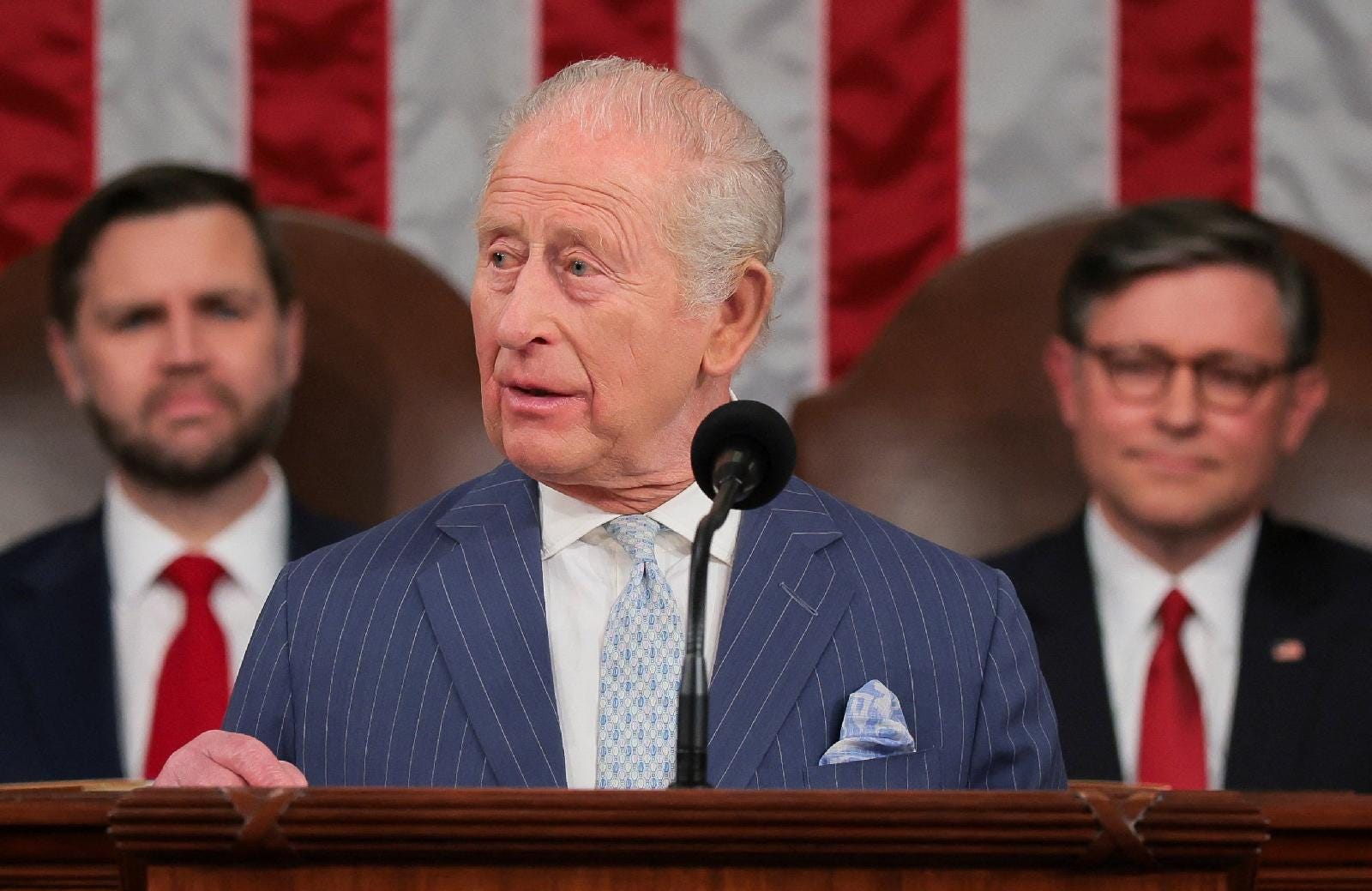
Instead, he stood at the podium of a joint session of Congress, with JD Vance seated three feet behind him and Mike Johnson presiding over the chamber, and delivered thirty of the most pointed minutes in recent American political memory. Without ever raising his voice, without naming a name, and without breaking diplomatic decorum.
That is a skill. A particular kind of genius, in fact.
Here are ten things the King said that Congress, and the rest of us, needed to hear.
1. Executive power has limits. He cited the receipts.
Charles traced the principle of limited government all the way back to 1215 and the Magna Carta, noting that it “is cited in at least 160 Supreme Court cases since 1789, not least as the foundation of the principle that executive power is subject to checks and balances.” He said this in the building where those checks and balances are supposed to live. He said it to the people elected to enforce them.
2. This democracy is not a one man show.
Standing before a Congress that has largely yielded its institutional authority to a singular executive will, Charles reminded the room of the animating principle of their own founding: governance happens “not by the will of one, but by the deliberation of many, representing the living mosaic of the United States.” He didn’t editorialize. He didn’t have to.
3. Ukraine deserves an unambiguous answer.
While this administration has muddied the waters around American support for Kyiv, the King was clear. He invoked the post-9/11 unity of NATO’s first Article 5 invocation, the shoulder-to-shoulder history of two World Wars, and then said plainly: “that same unyielding resolve is needed for the defence of Ukraine and her most courageous people.” This was a calm yet unyielding call to action.
4. NATO is a valuable alliance.
The Trump era has treated the Atlantic alliance like a protection racket: pay your share or we walk. Charles treated it like what it actually is: a foundational architecture of Western security built on shared values and mutual commitment. He called it part of Henry Kissinger’s vision of “an Atlantic partnership based on twin pillars: Europe and America,” and said that partnership is “more important today than it has ever been.” He then warned, with characteristic British understatement, against the “clarion calls to become ever more inward-looking.”
5. Judges matter.
Among the shared values he named as the very foundation of democratic prosperity: “the rule of law, the certainty of stable and accessible rules, an independent judiciary resolving disputes and delivering impartial justice.” This, in a political moment defined by a president who has called federal judges “radical left lunatics,” defied court orders, and treated judicial review as an inconvenience. Charles didn’t comment on any of that. He simply named what a functioning democracy requires, and let the contrast do the work.
6. The environment is a national security issue.
The administration has systematically dismantled environmental protections, gutted the EPA, and opened protected federal lands to extraction. Charles stood before their Congress and said: “we ignore at our peril the fact that these natural systems (in other words, nature’s own economy) provide the foundation for our prosperity and our national security.” He called nature “our most precious and irreplaceable asset.” He said our generation must decide how to address “the collapse of critical natural systems.” He said this to their faces.
7. Diversity is a source of strength.
The current administration has waged a systematic campaign against diversity, equity, and inclusion across federal institutions, universities, and corporations. The King described what gives democratic nations their collective strength: “our vibrant, diverse and free societies.” He called the United States “the living mosaic” of its people, and said his deepest hope is that we continue “to value all people, of all faiths, and of none.” Different words. Same address.
8. Allies are not adversaries. Duh.
This administration has treated European partners with contempt, threatened trade wars against allies, and reserved its warmest diplomatic energy for autocrats. Charles came as a representative of the closest ally America has, and made the case for what that relationship is actually built on, not sentiment or nostalgia, but shared democratic values and interdependent security. He asked Congress to honor what eighty years of partnership has built, rather than discard it.
9. The Founding Fathers were “imaginative rebels with a cause.”
He said this with obvious warmth. He also said it in the same breath as invoking the principles they carried forward: common law, Magna Carta, the separation of powers, the rights of the individual against the overreach of the state. The implication was unmistakable: those principles are not decorations. They are the inheritance. They are what the rebellion was for.
10. The world is watching what America does, not what it says.
He closed by referencing President Abraham Lincoln’s Gettysburg Address, that the world will little note what we say here, but will never forget what we do. Then he turned it directly on the nation: “America’s words carry weight and meaning, as they have since Independence. The actions of this great nation matter even more.”
King Charles III is a constitutional monarch. He is, by definition, bound to remain above politics. He came here as a symbol and left as something considerably more interesting: a mirror, held up at close range, reflecting back to a joint session of Congress exactly what they have been failing to protect.
He was gracious about it. He was even funny about it.
But he said it. Every word of it. In their house, at their podium, under their Statue of Freedom.
The question is whether anyone in that room was listening.
The Dad Briefs covers the civic, political, and quietly human stories that shape family life in America — with recipes along the way. Food, Fun and Fatherly Wisdom. Recipes for Resistance.
Are the people in that room even intelligent and educated enough to UNDERSTAND what he was saying? I'm betting that many, perhaps even a majority, are not. Elegance and intelligence are no longer in style.
Masterful Thank you for sharing your thoughts on the King’s speech . Perhaps some did not understand. Perhaps some bristled at being confronted with a mirror and perhaps, in the face of reasoning, some will change their own. I pray everyday for God to change the hearts and stay the hands of those who would harm our country. Perhaps King Charles’ speech is a partial answer to that prayer. We shall see. In the meantime- Pray, Protest, Prepare, Protect (my mantra). And yes, May God bless America - all its people, all its creatures, all its lands, all its waters.