


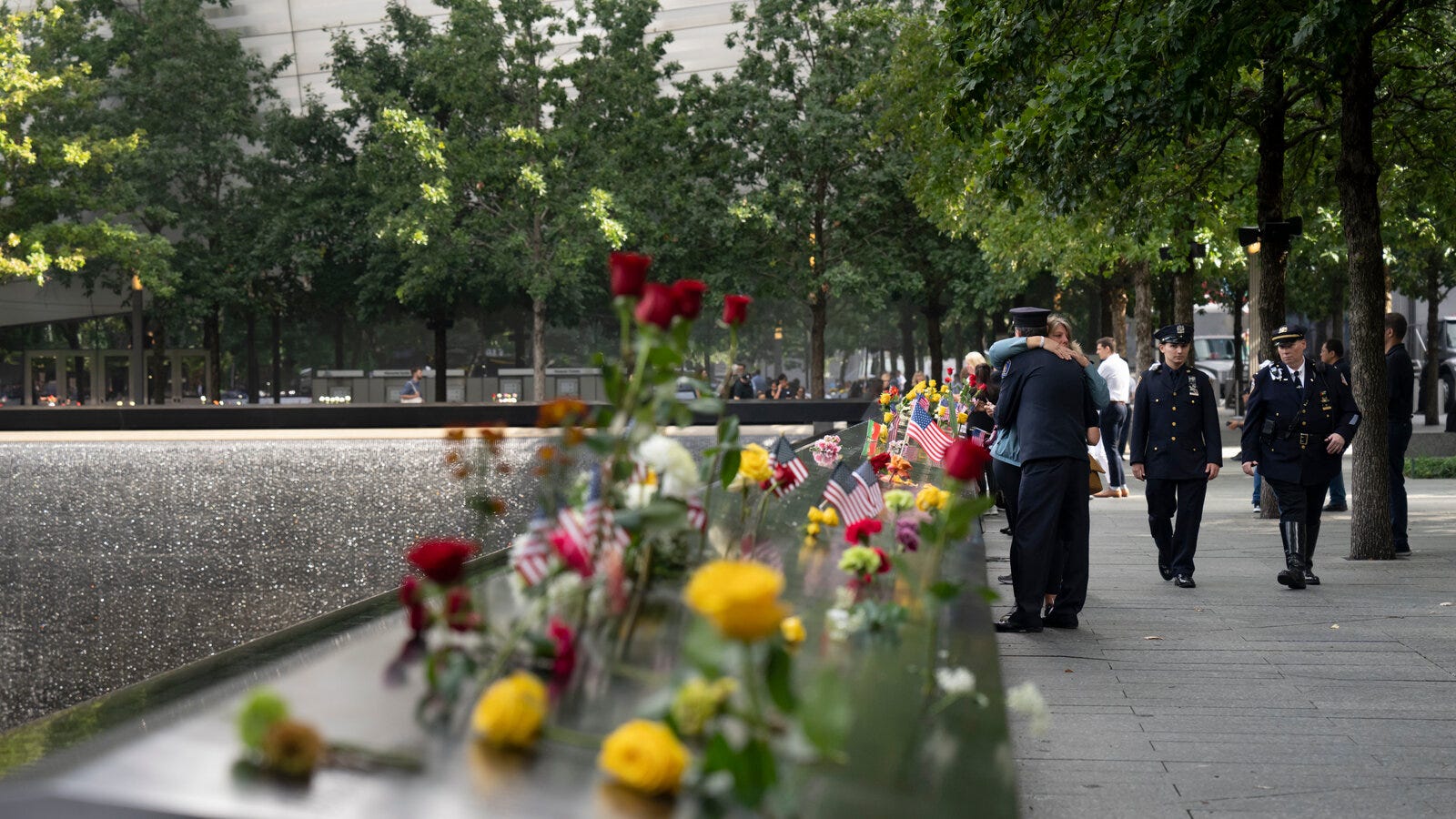
On Friday morning, the mayor of New York City will stand on the memorial plaza where the towers fell. He won’t give a speech. No politician does or should; the ceremony has excluded political remarks by design for nearly a quarter century. Families will read 2,983 names aloud, and at 8:46 a.m., the moment the first plane hit, the city will go quiet.
More than 95,000 people signed a petition asking to keep him away.
Zohran Mamdani is the first Muslim mayor of New York, a city that holds the largest and most diverse Muslim population in the United States. Those two facts are America’s most powerful living rebuttal to the attacks of 25 years ago. Who better? Who better than a New York City mayor who is Muslim to demonstrate that Islam is not al-Qaeda or the Taliban, any more than Christianity is the KKK or white nationalism?
It’s a uniquely American circumstance. It might just represent what America is all about.
The numbers
On the morning of September 11, 2001, al-Qaeda’s core numbered fewer than one hundred members, by the Council on Foreign Relations’ count. There are two billion Muslims on Earth. For every man in that terror cell, twenty million Muslims woke up that day, prayed or didn’t, dropped kids at school, went to work, and had nothing to do with any of it.
Run the same math on my faith. Christianity claims 2.3 billion people worldwide. The Ku Klux Klan, which burned crosses in Christ’s name for a century, counts roughly 3,000 members today. Nobody asks a Christian mayor to skip a memorial because the Klan exists. Nobody should.
The country has moved in the wrong direction on this arithmetic. In March 2002, six months after the attacks, 25 percent of Americans said Islam was more likely than other religions to encourage violence. Today, per a new Pew study, it’s 51 percent. A quarter century of knowing our Muslim neighbors, and the suspicion doubled. That number is a choice we keep making.
The record
The attacks killed nearly 3,000 innocent people. About 60 of them were Muslim.
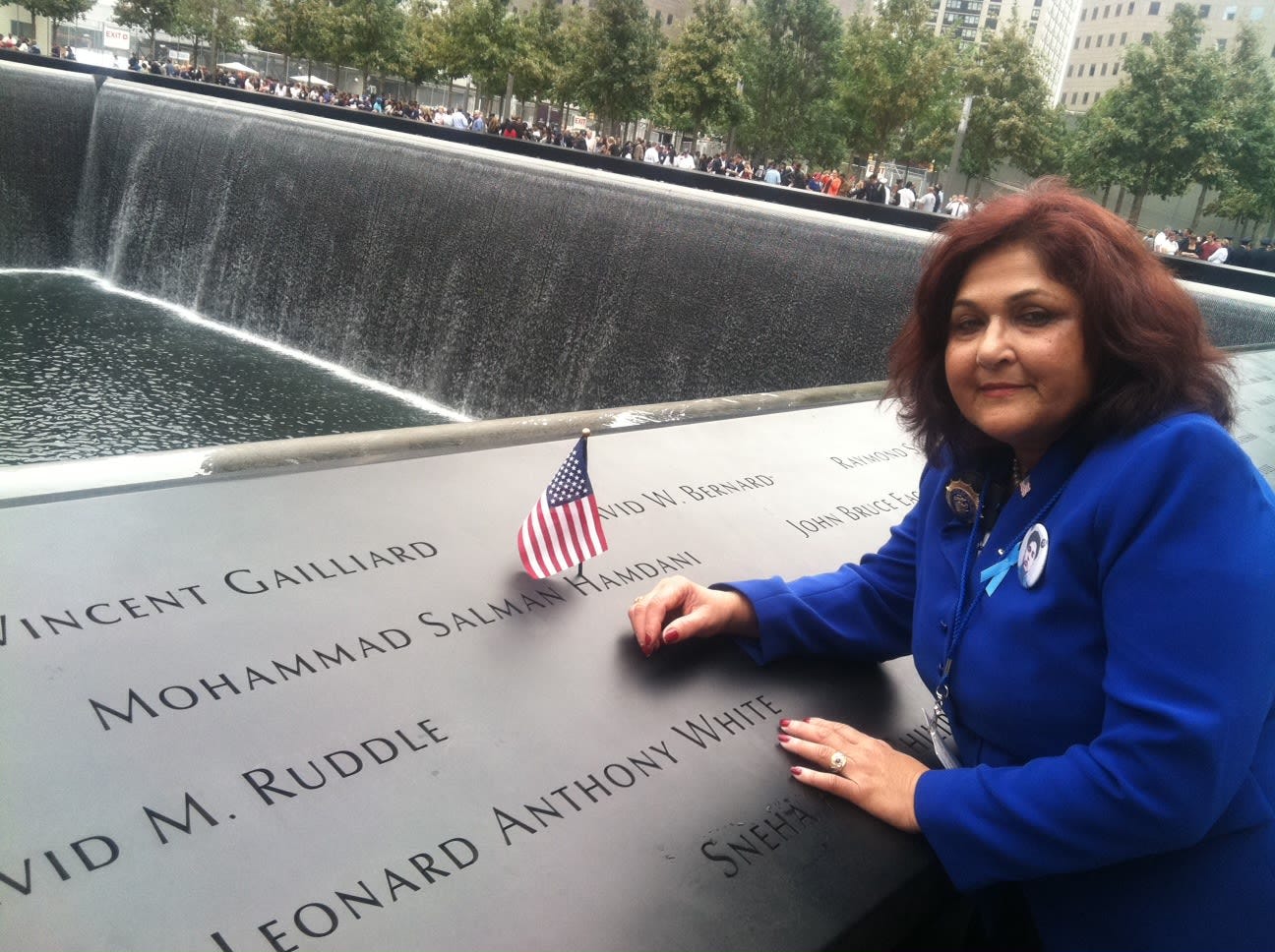
One was Mohammad Salman Hamdani, a 23-year-old from Queens. Pakistani-born, Star Wars fan, NYPD cadet, certified EMT. When the towers were hit, he drove toward them to help. For months his mother, Talat, searched hospitals and casualty lists, hoping he was among the injured who had lost their memory. Five months later, his remains were found near the North Tower, beside his medical bag. It was four months after the New York Post had cast him as a possible terrorist on the run, under the headline “Missing — or Hiding? Mystery of NYPD Cadet from Pakistan.”
The city buried him with full police honors. Congress wrote his name into law as an example of Muslim-American valor. His mother has spent years fighting to have him listed on the memorial among the first responders. “That’s where he belongs,” she said. “That’s why he went down there.”
One in nine New Yorkers is Muslim, more than 750,000 people. Roughly a thousand of them wear an NYPD badge. On September 11, they grieved as New Yorkers. By September 12, they grieved as suspects. A leader of the Council on American-Islamic Relations said it plainly that fall: the hijackers took one thing from American Muslims. “The only thing they took from us was the name of our faith. They stole it from us.”
America has run this experiment before, with other faiths and other names.
In 1928, New York Governor Al Smith became the first Catholic nominated for president. Millions of handbills warned he would take orders from the Pope. He lost in a landslide. Thirty-two years later, John F. Kennedy stood before Protestant ministers in Houston, declared himself the candidate “who happens also to be a Catholic,” and won.
After Pearl Harbor, we forced 120,000 Japanese Americans into camps. Some of their sons volunteered from behind the barbed wire and formed the 442nd Regimental Combat Team, one of the most decorated units in U.S. Army history. One of them, Daniel Inouye, lost his arm in Italy, earned the Medal of Honor, and rose to President pro tempore of the Senate, third in line to lead the country that once labeled him an enemy. His father’s words as he shipped out: “America has been good to us. Whatever you do, do not dishonor your country.”
On September 11, 2001, there were zero Muslims in Congress. In 2007, Keith Ellison took his oath on Thomas Jefferson’s personal Quran, a book the founder bought in 1765 and Congress has kept ever since. Today there are four. And this year, the city al-Qaeda wounded most deeply swore in a Muslim mayor.
It’s a repeating pattern: America scapegoats, then repents, then elevates. Slowly, imperfectly, at brutal cost to the scapegoated. But the arc is real, and it runs straight through New York.
The fabric
Six days after the attacks, President George W Bush walked into the Islamic Center of Washington and said, “The face of terror is not the true faith of Islam. Islam is peace.” Anti-Muslim hate crimes had spiked seventeen-fold that September. The following year, they fell by nearly two-thirds. Researchers credit W’s speech. Words from leaders matter.
So do hands.
A 30-foot American flag hung over Ground Zero during the site recovery; it was tattered and in pieces. Seven years later, volunteers carried the shredded flag to Greensburg, Kansas, a town a tornado had nearly wiped off the map. Survivors there began stitching it back together with fabric from their own storm-damaged flags. Over three years, the flag traveled to all 50 states, and 30,000 hands added stitches: wounded soldiers, Katrina survivors, Fort Hood families, students from Columbine, Pearl Harbor veterans aboard the USS Missouri. Restorers wove in blue wool from the flag that draped Lincoln’s box at Ford’s Theatre and thread from the original Star-Spangled Banner.
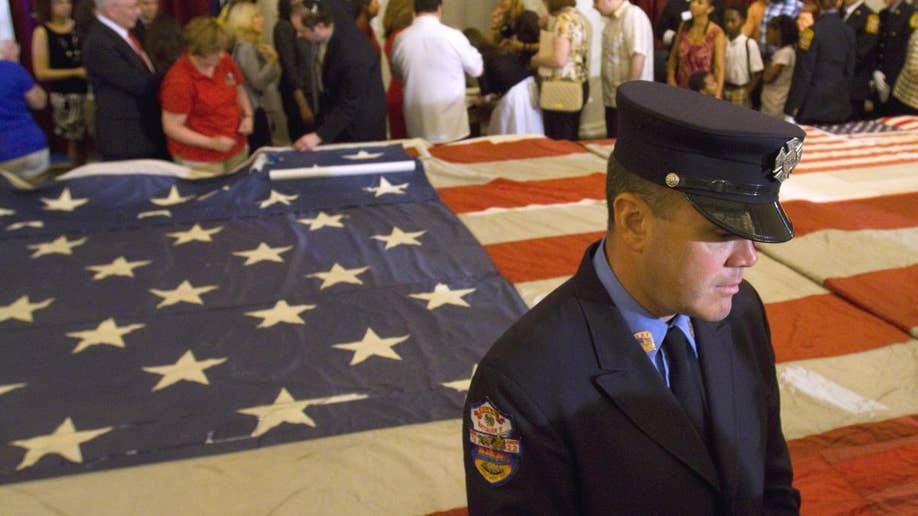
The man who led the project said a flag destroyed in New York, brought back to life by tornado survivors in a small Kansas town, is “what America’s all about.”
There’s a quilt, too. The United in Memory 9/11 Memorial Quilt, sewn by 3,600 volunteers from 18 countries. One block for every victim, 2,977 in all. Laid end to end, it would stretch five football fields. Nobody checked the religion of the hands holding the needles. A quilt is many fabrics refusing to come apart. That has always been the whole idea of this country. E pluribus unum is a sewing instruction.
The grief behind that petition is real, and it deserves to be named. Giovanni Galante lost his wife, Grace, in the towers. The Port Authority Police Department lost 37 officers that morning, the largest single-day loss in the history of American policing. Those families guard the plaza fiercely because they earned the right. And listen to what the petition’s organizer said about the mayor: “Not because he is Muslim. Because of who he supports.” Take him at his word. Americans can oppose a politician’s positions with everything they’ve got; that’s the country working. The ceremony settles the rest. No one gets a microphone. A mayor’s role on that plaza is to stand with the families of his city, head bowed, silent. Presence is not a speech. For the chief executive of New York, presence is the job.
On the question of who belongs, New York answered centuries ago. In 1657, about 30 settlers in Flushing, in what is now Queens, refused a colonial order to turn away Quakers. None of the signers were Quakers themselves. They wrote that they were “bounde by the law of God and man to doe good unto all men.” Historians call the Flushing Remonstrance a root of the First Amendment. It was written in the borough Zohran Mamdani represented before the city elected him mayor.
A young republic made the same promise in 1790, when George Washington wrote to the Jews of Newport, Rhode Island, a congregation unsure the new nation had room for them. The government of the United States, he told them, “gives to bigotry no sanction, to persecution no assistance.” Every citizen shall sit in safety under his own vine and fig tree, “and there shall be none to make him afraid.”
On Friday, the names will be read. Salman Hamdani’s is among them, right where he belongs. Sixty Muslim names woven through 2,977, one fabric, torn on the same morning by the same evil. Standing with the families will be a Muslim New Yorker the city chose to lead it.
Twenty-five years ago, thousands of strangers picked up needles and repaired a flag.
For America’s sake, let’s keep stitching.
Slade Wentworth | The Dad Briefs covers the civic, political, and quietly human stories shaping family life in America — with recipes along the way.
This is a beautiful piece, sir. I hope with all my heart that our country works its way back to sanity and acceptance; it's what made us great to begin with.
This, Slade, is eloquence. Thank you 💙