


A few weeks ago, I published a piece asking a straightforward question about Graham Platner, the Democrat running against Susan Collins in Maine’s 2026 Senate race.
The responses came fast.
“He’s not perfect, but he’s better than Susan Collins.”
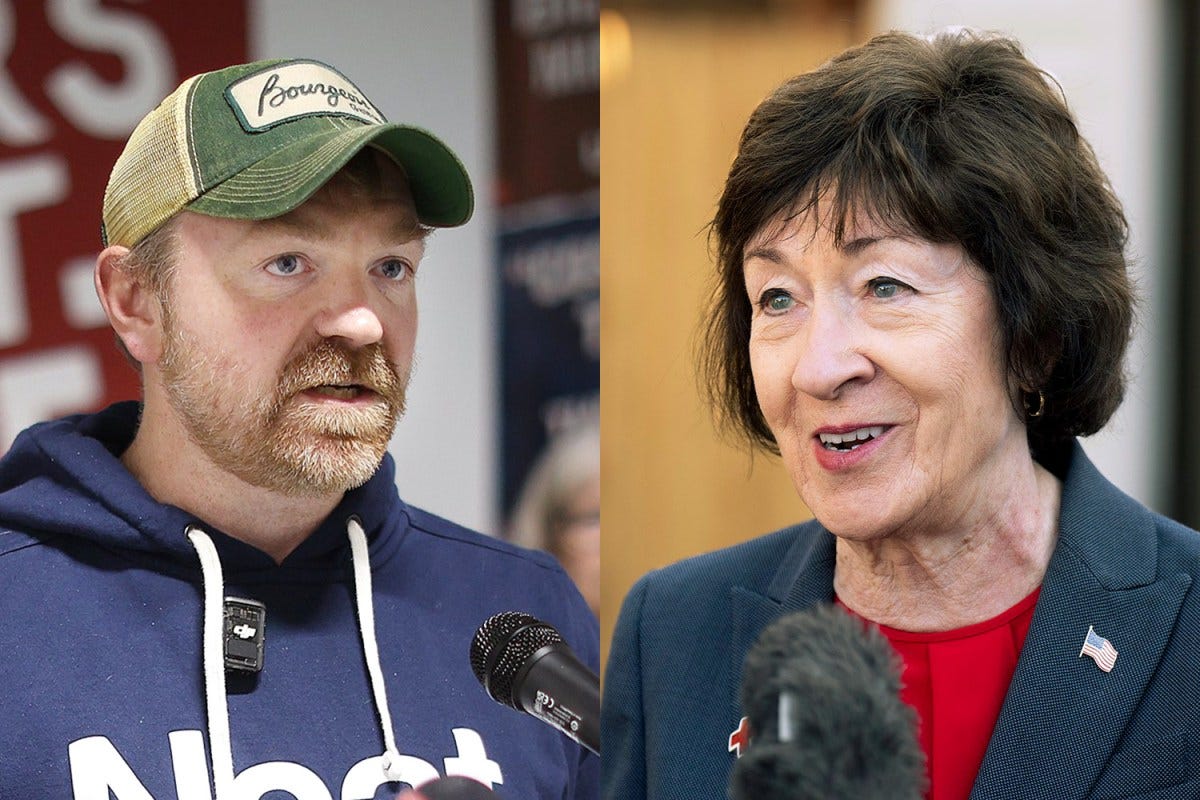
I hear that. Further, I want to meditate on the second half of that sentence for a moment — because “better than Collins” has become a kind of shorthand that lets her off the hook. And Susan Collins has been off the hook for a long time.
She has served in the United States Senate since 1997. That is 29 years. When she took her seat, a dozen eggs cost 99 cents, a gallon of gas ran about $1.24, and the median home price in Maine hovered around $87,000. Netflix was mailing DVDs. Titanic was number one at the box office. AOL had just launched instant messenger.
That was the world Susan Collins entered as a United States Senator.
Here is the world she has helped shape since:
The Brand and the Record
Collins has built her reputation on a single word: bipartisan. It appears more than 2,600 times on her official Senate website. She is routinely cited in Washington as one of the most independent Republicans in the chamber. The Lugar Center has ranked her among the most bipartisan senators for years running.
The numbers from the 119th Congress tell a more complicated story.
According to CQ Roll Call’s 2025 Vote Studies, Collins supported Donald Trump’s position 94.6 percent of the time last year. That is not a figure from a Democratic opposition research shop. CQ Roll Call is one of the most respected nonpartisan trackers in Washington. PolitiFact rated the “95 percent” characterization “Mostly True” in June 2026.
To be precise: she ranks as the third-least-Trump-aligned Republican in the Senate, behind only Rand Paul and Lisa Murkowski. In a body where most Republicans vote with Trump virtually every time, that distinction is real. But “least aligned” in that context still means voting with him roughly 19 out of every 20 times.
The honest question is not whether she breaks with Trump. She does, occasionally. The question is when, and whether it changes anything.
The Pattern
Collins has a consistent pattern in the 119th Congress. She registers concern. She announces opposition. She votes no — after the outcome is already determined, or after providing the procedural vote that made the outcome possible.
The clearest example: the One Big Beautiful Bill Act.
On June 28, 2025, Collins voted yes on the motion to proceed — the procedural step that brought the bill to the Senate floor for a final vote. That motion passed 51 to 49. Her vote was part of the majority that cleared the path. Three days later, on July 1, she voted no on final passage. The bill passed anyway, 51 to 50, on Vice President Vance’s tie-breaking vote.
She called the bill’s Medicaid cuts harmful. She said they were “not sufficient” protections for Maine’s rural hospitals. She was right about that. And she voted to open the door anyway.
This is the pattern. Not secret collaboration. Not cynical theater, exactly. Something more structurally frustrating: independence calibrated to be visible without being decisive.
What It Costs Maine
The One Big Beautiful Bill is not an abstraction for Maine families.
Approximately 400,000 Mainers — nearly a third of the state’s population — rely on Medicaid and MaineCare. That includes roughly 190,000 children, and about 75 percent of Maine nursing home residents. Maine’s own Department of Health and Human Services estimates the law will cost the state $5 billion in Medicaid funding over the next decade.
Four rural Maine hospitals have been identified as at risk of closure: Northern Light A.R. Gould in Presque Isle, Maine Coast Memorial in Ellsworth, Cary Medical Center in Caribou, and Calais Community Hospital. About 40 percent of Maine hospitals were already operating at a loss before these cuts.
More than 176,000 Mainers rely on SNAP. By 2028, Maine is projected to absorb $60 million per year in new food assistance costs, shifted from the federal government to the state. Between July 2025 and March 2026, more than 4,000 Maine children were dropped from SNAP rolls entirely, according to Maine DHHS data compiled by the Maine Center for Economic Policy.
A gallon of milk in Maine costs about $4.49 today. Eggs run between $2.39 and $3.03 depending on where you shop. Gas sits around $4.32. The median home price has climbed from roughly $87,000 in the late 1990s to more than $407,000 today.
These are not national statistics. These are Maine numbers. And they exist inside a policy environment that Collins has helped build over nearly three decades.
The Kavanaugh Question
No accounting of Susan Collins’s Senate tenure is complete without Brett Kavanaugh.
In 2018, Collins delivered a 44-minute floor speech defending Kavanaugh’s nomination in the wake of Christine Blasey Ford’s testimony. She voted to confirm him. She had previously voted to confirm Neil Gorsuch in 2017. Both times, she told constituents and reporters that she believed Roe v. Wade was settled precedent, that the nominees had assured her they respected established law.
In 2022, both Gorsuch and Kavanaugh joined the majority in Dobbs v. Jackson Women’s Health Organization, overturning Roe.
Collins said the ruling was “inconsistent” with what the justices had told her in private meetings. She called it “a sudden and radical jolt to the country.”
That may be true. It is also true that her votes made the majority possible. The consequences — for Maine women, for women across the country — are not abstract. They are ongoing.
What She Has Delivered
A fair accounting requires saying this plainly: Collins has delivered for Maine in ways that matter.
She has consistently fought for federal funding for Maine’s fishing industry, its rural healthcare infrastructure, and its military installations. She secured a $50 billion rural hospital relief fund in the OBBBA negotiations — less than she requested, and less than advocates say is needed, but a real concession extracted from a bill she ultimately opposed. She voted against Pete Hegseth and Kash Patel. She voted for a Democratic-led extension of ACA premium tax credits in December 2025, though the effort failed and the credits expired anyway.
They are also insufficient for a senator with 29 years of seniority, a seat on the Appropriations Committee, and the kind of institutional leverage that comes from being one of the last remaining Republican moderates in a closely divided Senate.
When your leverage is highest, the votes that matter most are the ones you cast — not the amendments you propose that get blocked, and not the final passage votes you cast after the procedural gate is already open.
Wider Implications
Maine is one state. But what happens in Maine’s Senate race in 2026 has implications well beyond its borders.
Democrats need to flip four seats to retake the Senate majority. Maine is their single best opportunity. A Collins loss does not just change one vote. It changes committee chairmanships, floor schedules, confirmation processes, and the basic architecture of what legislation can move.
That is the context in which “he’s not perfect, but he’s better than Collins” deserves to be heard. Not as a reluctant settling, but as a recognition that representation is structural. Who holds the seat shapes what is possible — not just for Maine, but for the country.
Who Is Paying to Define This Race
AIPAC — the American Israel Public Affairs Committee — bundled more than $538,000 from 315 individual donors for Collins in a recent filing period alone, according to the Bangor Daily News. Over the course of her career, cumulative AIPAC contributions to Collins total approximately $647,000, per OpenSecrets. In 2025, AIPAC-bundled money accounted for nearly 20 percent of everything she raised — more than she brought in from small donors.
Graham Platner does not take AIPAC money. His campaign has been explicit: no corporate PACs, no super PACs, no bundled special interest money.
Republican-aligned groups have already reserved roughly $99 million in advertising in this race, compared with about $44 million on the Democratic side, according to AdImpact. Pine Tree Results PAC — a Maine-focused outside group supporting Collins — has reserved $23.8 million in ads on her behalf. Two of its largest contributions came from Delaware-incorporated nonprofits with no public presence, no disclosed staff, and no identifiable donor base. A federal watchdog group has filed a complaint alleging what it describes as an illegal straw donor scheme.
The ads from these groups are not about policy. They are exclusively focused on personal attacks against Platner.
That is worth keeping in mind when you see what is coming at him between now and Election Day. The money attacking Graham Platner cannot tell you what Susan Collins has done for Maine families over 29 years, because that record does not make the case they need to make.
So they are going after the man instead.
What You Can Do
If you are a Mainer, vote. November determines it all, and turnout in Maine’s smaller communities has consistently shaped statewide outcomes. If you have neighbors, family members, or coworkers who are not yet planning to vote, that conversation matters more than almost anything else.
Senator Collins has offices in Washington, Portland, and Bangor. Her staff answers the phones. Constituent calls are logged.
Call her Washington office: (202) 224-2523
You do not need a script. You can say: “I’m a constituent. I’m concerned about Medicaid cuts and what they mean for Maine families. I want Senator Collins to know that her procedural vote on June 28th mattered, and her constituents are watching.”
That is enough.
This series will continue. There is more to cover — on tariffs, on environmental rollbacks, on what 29 years in the Senate looks like when you trace it across the lives of the people you were sent to represent.
The question I asked a few weeks ago still stands.
What are we going to do about Susan Collins?
That answer belongs to Maine. But the rest of us have a stake in it too.
Sources: CQ Roll Call Vote Studies Feb. 2026 | Senate.gov Roll Call Vote #329, June 28 2025 | Maine DHHS | MECEP/Maine DHHS SNAP data | Bangor Daily News | Zeteo | Read Sludge
The Dad Briefs covers the civic, political, and quietly human stories that shape family life in America — with recipes along the way. Food, Fun and Fatherly Wisdom. Recipes for Resistance.
Based on her actions and allegiances Susan Collins is asking to be Platnered.
Simple- vote her out of office.