


On May 7, the Tennessee legislature passed a new congressional map. It carved up the 9th Congressional District, anchored in Memphis, and split its predominantly Black voters into three rural, white, Republican-leaning districts stretching hundreds of miles east. The state’s only majority-Black congressional district was gone.
Five days later, Speaker Cameron Sexton stripped all 24 House Democrats of their committee assignments.
Because every Black member of the Tennessee House caucuses as a Democrat, the result was complete: every Black state representative was removed from every committee at once. Roughly 1.7 million Tennesseans now have legislators who can vote on the floor but cannot shape legislation in committee, where bills are written, amended, and killed before most people know they exist.
These two actions are connected. They are also worth understanding with precision, because the full story is more damning than the version circulating online.On May 7, the Tennessee legislature passed a new congressional map. It carved up the 9th Congressional District, anchored in Memphis, and split its predominantly Black voters into three rural, white, Republican-leaning districts stretching hundreds of miles east. The state’s only majority-Black congressional district was gone.
The Race to be Partisan
Most of the outrage online calls this partisan gerrymandering. Republicans, to their credit in one narrow sense, said the quiet part out loud: Sen. John Stevens described the new map as “Tennessee’s attempt to maximize our partisan advantage.”
That framing is understandable. It is also a legal trap.
In 2019, the Supreme Court ruled in Rucho v. Common Cause that federal courts have no authority to strike down partisan gerrymanders. The majority held that partisan gerrymandering claims present political questions beyond the reach of federal courts. In plain terms: if Republicans draw a map to crush Democrats, and do nothing else, federal judges cannot touch it. The Court acknowledged that extreme partisan gerrymandering may be “unjust” and “incompatible with democratic principles,” but held that the Constitution does not provide a judicial remedy. Rucho closed the federal courthouse door on partisan claims.
It left open the door on racial ones.
The Equal Protection Clause of the 14th Amendment prohibits racial discrimination in the drawing of legislative districts. Section 2 of the Voting Rights Act, until recently, required that minority voters have an equal opportunity to participate in the political process and to elect representatives of their choice. These are the tools that remain available to challengers of the Tennessee map, and they are the tools the lawsuits are using.
Three suits are now pending. The NAACP’s Tennessee chapter filed in Davidson County Chancery Court. The ACLU and ACLU of Tennessee filed in federal court. Both allege intentional racial discrimination and First Amendment retaliation. A third suit is in progress. The maps remain in effect while litigation proceeds.
The racial case against the Tennessee map is not abstract. Memphis is a majority-Black city. The 9th Congressional District was drawn around it, specifically because of that demographic reality, and had returned Black Democratic representation to Congress for decades. The new map splits those voters into three separate districts, each anchored in rural, white, Republican-leaning communities to which Memphis has no geographic, cultural, or political connection. The effect is to take a concentrated bloc of Black voters and render them a minority in three places rather than a majority in one.
Republicans have tried to insulate the map from racial challenge by building the partisan record themselves. If Stevens goes on the record calling it a partisan move, the argument runs, then the racial argument becomes harder to prove. Courts are required to ask whether race or partisanship was the predominant factor in drawing a district. Since Black voters in Memphis vote overwhelmingly Democratic, the two motivations are difficult to untangle. This is a known legal strategy. It has been deployed in redistricting fights in North Carolina, Alabama, and Louisiana.
It does not always work. In Allen v. Milligan (2023), the Supreme Court upheld Section 2’s application to Alabama’s congressional map, holding that a court-drawn map was needed to give Black voters a fair opportunity to elect a second representative. That ruling is now in tension with the Court’s 2026 decision in Louisiana v. Callais, which significantly narrowed Section 2’s reach, making it harder for plaintiffs to prove that a map dilutes minority voting power. Callais is the ruling that opened the door for Tennessee’s special session. It had been handed down one day before Gov. Lee called the legislature back to work.
The lawsuits challenging Tennessee’s map will have to navigate a legal landscape that was reshaped to make challenges like this harder. That is part of what makes the timeline significant.
The distinction between racial and partisan framing is the legal terrain on which this fight will be won or lost.
How We Got Here
Gov. Bill Lee called the special session on April 30, one day after the Supreme Court’s ruling in Louisiana v. Callais gutted Section 2 of the Voting Rights Act. The session came at the request of President Trump, as part of a coordinated multi-state push to redraw congressional maps before the 2026 midterms. Tennessee was the ninth state to act.
The coordination matters. This is not a state acting on its own political instincts. Across the country, Republican-controlled legislatures in Texas, Missouri, North Carolina, Ohio, Florida, and elsewhere have moved to redraw maps mid-decade, between the normal redistricting cycles that follow each census. The goal, stated or implied, is to lock in Republican seats in the U.S. House before November 2026. Estimates suggest Republicans could gain as many as 14 seats nationally through this cycle of mid-decade maps, offsetting potential losses from policy backlash and establishing structural advantages that persist regardless of electoral conditions.
Before Tennessee Republicans could draw a single line, they first had to repeal a state law prohibiting mid-decade redistricting. They did so with no apparent hesitation. The law existed for a reason: to provide stability in the representative relationship between voters and their elected officials between census cycles. Its repeal was a precondition for the map, and the map was a precondition for the punishment.
The Protest, and the Punishment
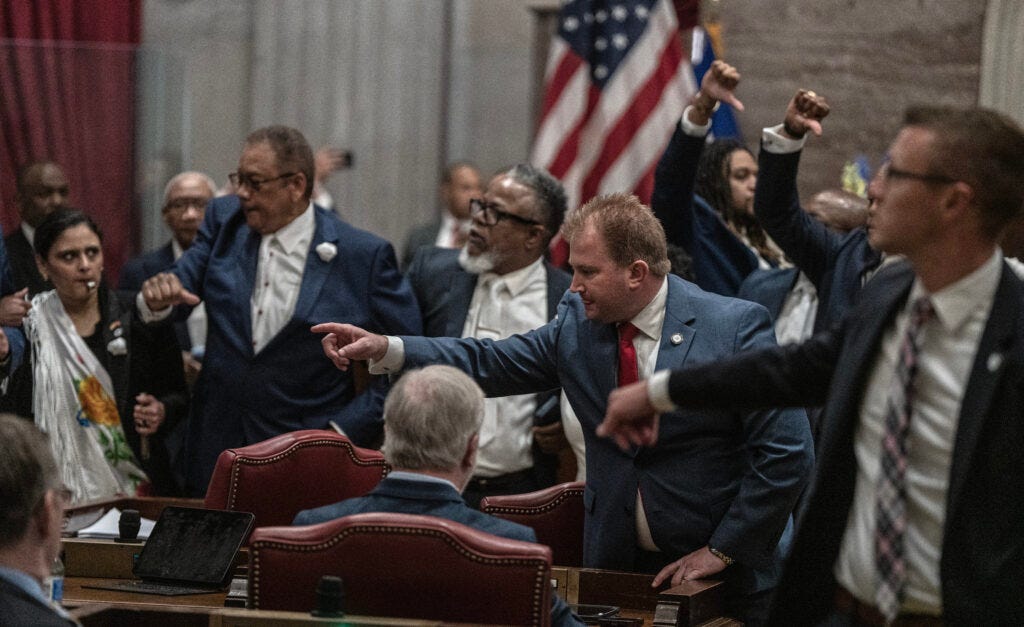
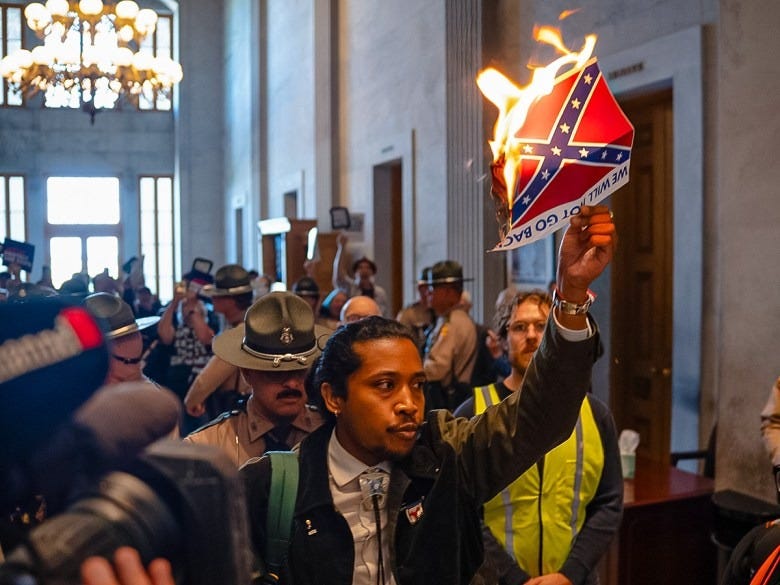
During the May 7 vote, Black Democratic lawmakers linked arms at the front of the chamber. Activists in the gallery sounded air horns and chanted “Our house.” Rep. Justin Jones burned a photograph of a Confederate flag in the hallway. Sen. Charlane Oliver stood on her desk holding a banner: “No Jim Crow 2.0, Stop the TN Steal.”
Speaker Sexton’s response, five days later, cited “decorum violations”: linking arms, blocking aisles, distributing earplugs, using noisemakers. The letter called it a procedural matter. Every Democrat received one.
The procedural framing is worth examining. Sexton did not write that Democrats were being punished for opposing the redistricting, or for holding incorrect political views, or for representing constituencies that voted the wrong way. He wrote that they violated House decorum. This framing insulates the action from a First Amendment retaliation claim, at least on paper, by characterizing the punishment as a response to conduct rather than speech. It is the same logic that frames the redistricting as partisan rather than racial: if the official record says one thing, the legal argument runs through a different door.
What the official record cannot change is the sequence of events. Democrats protested a map drawn to eliminate Black political representation. Five days later, Republicans eliminated Black political representation from every committee in the state House.
The Pattern is Repeating
In April 2023, the Tennessee House expelled Reps. Justin Jones and Justin Pearson for protesting gun violence on the floor after the Covenant School shooting that killed six people, including three children. Both are Black. Rep. Gloria Johnson, who participated in the same protest, survived expulsion by a single vote. She is white. Jones and Pearson were reinstated by their local governments and returned to the chamber.
Sexton’s 2026 letter cited 2023 as precedent. The new action is broader in scope (the entire caucus rather than two members) but the logic is the same. Dissent gets punished. Black lawmakers bear the cost first and most severely. Johnson’s survival in 2023 was not incidental. The vote was 65-30 to expel Jones, 69-26 to expel Pearson, and 65-30 to retain Johnson. Those numbers did not reflect differences in conduct. They reflected differences in identity.
The 2026 action is harder to frame as targeted in the same way, because it sweeps in all 24 Democrats. But the effect remains racially specific, because the caucus and the Black caucus are the same body. A rule that applies equally to everyone can still fall unequally when the underlying demographics are what they are.
Tennessee Republicans hold a 75-24 supermajority. That margin is not incidental to how this power is used. A supermajority does not need opposition votes to pass legislation, does not need minority participation in committee to move bills, and does not face meaningful electoral risk from the districts it controls. What it retains is the ability to make the minority’s presence symbolic. The committee removals accomplish that.
What to Watch Next
Three lawsuits are pending. The courts will determine whether the maps stand. That process will take months, possibly years, and will move through a federal judiciary that the same political coalition has spent a decade reshaping. The Callais ruling that enabled the map came from a Supreme Court with three Trump appointees. The lower courts that will hear the initial challenges sit in a federal judiciary where Republican-appointed judges now hold a majority. This does not predetermine outcomes, but it shapes the terrain.
In the meantime, Tennessee Republicans dismantled the state’s only majority-Black congressional district at the president’s request, hours after a Supreme Court gave them the opening to do it. When the opposition protested, it lost its seats at every table where legislation is made. The stated reason was decorum. The mechanism was a supermajority that answers to no one in the room it just emptied.
The map and the punishment carry the same message. One targets Black voters in November. The other targets their representatives in May.
Stay vigilant. Keep receipts.
The Dad Briefs is produced independently, without party affiliation or partisan funding, and covers the civic, political, and quietly human stories that shape family life in America — with recipes along the way. Food, Fun, and Fatherly Wisdom. Recipes for Resistance.
Be kind, and … you know.
Wow!!! I am stunned. What a bunch of a**holes! It’s like it’s 1956 - not 2026.
This is what we reap as a people because we put a racist, misogynistic, criminal, bully back in the White House.
Full non stop bullying, harassment, and law breaking is apparently ok now.
For all the brown skin people who voted for the orange clown - jokes on you. He is only for the top white male 1% - the end.
Blatant. They dare because no one stops them in the small acts, so they dare larger and larger.