
Golden Diner Pancakes for Our Golden Hours
A speech from 2008, a question for 2026, and a recipe that's worth the wait
First, the recipe: Sam Yoo’s legendary pancakes, as published in The New York Times. These are not quick; they require a pre-ferment, patience, a hot skillet, and a 350-degree oven. They are worth it. Golden Diner, located near the Manhattan Bridge in New York City’s Chinatown, is known for these towering, cloud-like pancakes served with maple-honey butter, maple-honey syrup, and berry compote. The secret ingredient in the syrup is a teaspoon of soy sauce. Don’t skip it.
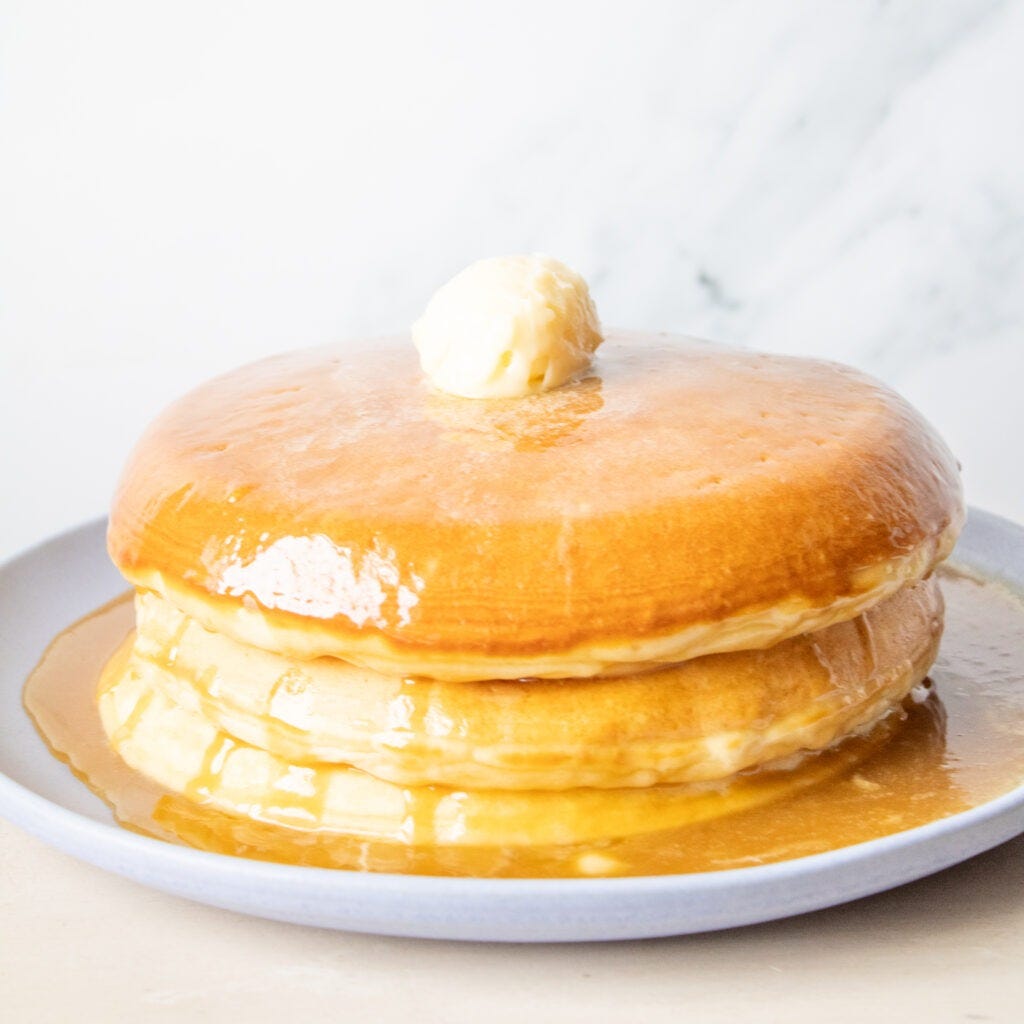
Golden Diner Pancakes
Makes 4 Servings
Ingredients:
For the Pancake Batter
2 ¼ teaspoons/7 grams active dry yeast (one ¼-ounce packet)
2 cups/260 grams all-purpose flour, divided
1 ¼ cups/300 grams buttermilk
2 tablespoons sugar
¾ teaspoon baking soda
½ teaspoon fine salt
2 large eggs
¼ cup/60 grams canola oil or other neutral-tasting oil
For the Maple-honey Butter
½ cup/113 grams unsalted butter, softened
3 tablespoons honey
2 tablespoons pure maple syrup
¾ teaspoon fine salt
For the Maple-honey Syrup
½ cup/113 grams unsalted butter
⅓ cup/100 grams honey
1½ tablespoons maple syrup
1 teaspoon soy sauce
½ teaspoon fine salt
For the Berry Compote
14 ounces/400 grams mixed berries, such as blueberries, raspberries and stemmed strawberries, cut to the same size as the small berries
⅓ cup/67 grams sugar
1 ½ teaspoons cornstarch
1 lemon
Instructions
Start the pancake batter: In a small bowl, whisk the yeast with 1 cup flour. In a small saucepan, heat the buttermilk with ¼ cup/60 grams water over medium-low heat, stirring often, until lukewarm (about 100 degrees), about 5 minutes. Pour the buttermilk into the flour and whisk until smooth. Cover with plastic wrap and let sit for 1 hour to create a pre-ferment. This will give the pancakes a deeper flavor and some additional rise.
Meanwhile, make the maple-honey butter: In a medium bowl, whisk the butter, honey, syrup and salt until smooth. Keep at room temperature if using within a few hours. Otherwise, refrigerate in an airtight container for up to 1 week. Soften the butter and whisk it again before serving.
Make the maple-honey syrup: Combine the butter, honey, syrup, soy sauce and salt in a small saucepan. Heat over medium-low, whisking often, until the butter melts completely. While whisking, add 1 ½ tablespoons water. Keep whisking until emulsified, then reduce the heat to the lowest setting to keep warm.
Make the berry compote: In a large bowl, gently mix the berries, sugar and cornstarch until the berries are evenly coated. Heat a large, deep skillet over high until very hot. A drop of water sprinkled on the pan should immediately sizzle away. Add the berry mixture and cook, stirring once in a while, until the blueberries look like they’re about to pop, about 2 minutes. Remove from the heat.
Finish the pancakes: Heat the oven to 350 degrees with a rack in the center. Set a metal rack in a sheet pan and place on the center oven rack.
After the pre-ferment has proofed for an hour, whisk the remaining 1 cup flour with the sugar, baking soda and salt in a small bowl. In a large bowl, whisk the eggs and oil until smooth. Scrape the pre-ferment into the egg mixture, then add the dry ingredients. Gently stir with the whisk until no traces of dry ingredients remain. It’s OK if the batter is lumpy.
Heat one or two 7- to 8-inch nonstick skillets (5- to 6- inches across the bottom) or extremely well-seasoned cast-iron pans over medium until very hot. Nonstick works best because you won’t be greasing the pans at all. Fill each pan with batter to about ⅓-inch depth. Smooth the top to ensure the batter reaches the edges of the pan and forms a nice round. Cook until the bottom is crisp and evenly golden brown, 2 to 4 minutes, turning down the heat if the bottom browns too quickly. Flip and cook until the other side crisps and browns evenly, 1 to 3 minutes, tucking in the edges to give the pancake a nice dome.
Transfer the pancake from the skillet to the rack-lined pan in the oven for the centers to cook through, 2 to 5 minutes. To check, poke a paring knife in the middle and peek to see if any wet batter remains. Repeat with the remaining batter, reheating the pan between pancakes. You can serve the pancakes as they’re done or keep the earlier batches in the oven until all of the pancakes are ready.
To serve, center one or two hot pancakes on serving plates and evenly drench with the maple-honey syrup right away. Spoon the berry compote on top, then scoop maple-honey butter over the berries (see Tip). Zest the lemon over everything. Serve immediately.
Notes:
At Golden Diner, the butter is formed into the football shape known as quenelles. You can do the same if you want: Use one spoon to scoop a round of soft maple-honey butter along its long side, then run another spoon of the same size against the first spoon to shape the butter into a football.
Now … Don’t Forget to Cheer for Unity
I’ve been thinking about a speech from November 4th, 2008, delivered from a stage in Grant Park, Chicago, to a crowd of roughly 240,000 people, with millions more watching from living rooms and laptops around the world. It’s known as Barack Obama’s “Change Has Come to America” speech, and it is remarkable for many reasons. But one moment, against our contemporary backdrop, keeps pulling me back.
Early in the speech, Obama mentioned his opponent. Senator John McCain. The crowd cheered loudly in the way a crowd cheers when it recognizes a name it has reason to dislike. Before the cheering could calcify into something uglier, Obama spoke. He described a very gracious call he had just received from the senator. He called McCain brave. He called him selfless. He said America was better off for the service rendered by this leader, and that he looked forward to working with him.
That crowd, in that moment, cheered for their opponent’s humanity. And meant it.
A Campaign that Retained its Humanity
The 2008 campaign was not a genteel affair. It was long, exhausting, and frequently ugly, particularly in its final weeks. Sarah Palin’s rallies had grown incendiary. Crowds yelled things that had no place in a democracy. The whisper network questioning Obama’s faith, his birthplace, his very identity as an American, was fully operational.
Then, in October 2008, John McCain did something striking at a town hall in Lakeville, Minnesota,
A woman approached the microphone and told McCain she couldn’t trust Obama. “I have read about him,” she said, “and he’s not — he’s an Arab.” McCain shook his head before she finished the sentence. He took the microphone back. “No, ma’am,” he said. “He’s a decent family man, a citizen that I just happen to have disagreements with on fundamental issues, and that’s what this campaign is all about.” The crowd booed. He didn’t flinch. He defended Obama twice that night. When another supporter said he was “scared” of an Obama presidency, McCain replied that Obama was a decent person and someone no one should fear as president.
McCain’s framing contained its own blind spot. Assuring the crowd that Obama was not Arab implied that being Arab would have been disqualifying. You can be Arab and a citizen and a decent person. Those things are not in conflict. But within the context of a campaign trail actively on fire, what McCain did that night was still an act of political courage. He chose his opponent’s dignity over his own crowd’s energy. His campaign later condemned the comments from that event as inappropriate rhetoric.
When Election Night came, he did it again. In his concession speech in Phoenix, McCain told his supporters that Obama’s success commanded his respect, that Obama had inspired millions of Americans who had once wrongly believed they had little at stake or influence in a presidential election, and that he pledged to do all in his power to help him lead through the challenges ahead. He asked his supporters not just to congratulate the president-elect, but to offer him their goodwill and earnest effort to find common ground.
And then Obama, from that stage in Grant Park, completed the exchange. He described McCain’s call as gracious, said the senator had fought even longer and harder for the country he loves than he had for the presidency, and told the crowd that America was better off for the service rendered by this brave and selfless leader.
Two men who had spent nearly two years trying to defeat each other, publicly and consistently choosing to affirm each other’s humanity. That choice was available to both of them, and both of them made it.
The America I Know
We can disagree without dehumanizing each other. Dissent shouldn’t confused with disloyalty. A crowd can cheer for an opponent’s name and not feel like it’s a betrayal. This is the America I know.
Building that kind of unity has never been easy. It requires leaders who are willing to absorb political cost to preserve something larger than their own momentum. It requires resisting the incentive structures of big money and broken media ecosystems that thrive on disruption and outrage. Weak leaders take the path of least resistance. They cast enemies, grow division, and call it strength. They make hatred of the other side feel like love of country, and it isn’t. It never has been.
Right now, America is in a moment of profound fragility. There are serious questions about the integrity of our institutions, the separation of church and state, and whether the public trust is being held or sold. These are not small things. They are not things we can afford to treat casually or set aside for later.
But I believe that change will come to America again. It always has. The only question worth asking, and the one that keeps me up at night, is whether we will have forgotten, by the time it does, how to cheer for each other.
The Dad Briefs covers the civic, political, and quietly human stories that shape family life in America — with recipes along the way. Food, Fun and Fatherly Wisdom. Recipes for Resistance.


