


That guy selling the beef tallow has been very busy.
If you’ve been on any corner of health TikTok or Instagram in the last two years, you’ve encountered someone like him. He’s shirtless or in a flannel, often standing in a grocery store aisle. He has opinions about the seed oils in your cabinet. He calls them the “Hateful Eight.” He has an alternative to sell you.
And look — the algorithm has rewarded him generously. Because the seed oil panic has a lot going for it aesthetically: a villain (Big Canola, I guess), a hero (raw butter, beef tallow, the ancestral way), and a villain number you can put on a thumbnail. Eight! That’s a clean, scary number.
There is one problem: the science does not cooperate.
Here is what the evidence actually shows — and why the people screaming loudest about seed oils are almost always selling you something.
First: What Are the “Hateful Eight”?
The “Hateful Eight” framing was popularized by Dr. Paul Saladino and others in the carnivore and ancestral health space. The oils typically listed are: canola, corn, cottonseed, soy, sunflower, safflower, grapeseed, and rice bran oils.
The argument goes like this: these oils are high in omega-6 linoleic acid, which is inflammatory; they’re industrially processed and oxidize easily; our ancestors didn’t eat them; and the modern rise of chronic disease correlates with increased seed oil consumption.
Each part of this argument has a real-sounding logic to it. And each part of it falls apart under scrutiny.
The omega-6-causes-inflammation claim is the backbone of the whole movement — and it’s where the evidence goes most directly against the narrative. The theory assumes that because linoleic acid is a precursor to arachidonic acid (a compound involved in inflammatory pathways), eating more of it will increase inflammation in the body. But here’s what the research actually found when they tested this:
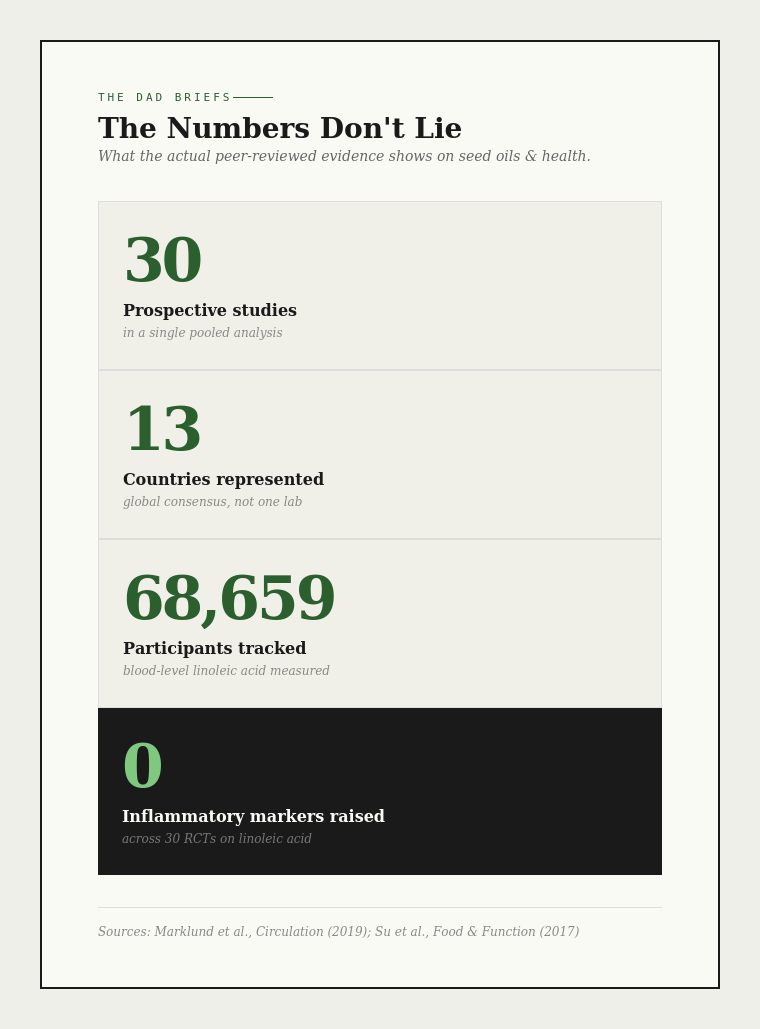
Thirty randomized controlled trials examined what happened to inflammatory markers when linoleic acid intake was increased. The result: no significant effect on TNF-alpha, IL-6, CRP, fibrinogen, or any other inflammatory marker measured.
Not a slight effect. Not a mixed effect. No significant effect. The chain-of-logic that seed oil advocates rely on — LA → AA → inflammation → disease — does not hold up when you feed it to actual humans and measure what happens.
As for the cardiovascular claim: the evidence runs in the opposite direction from what the influencers suggest.
What the Science Actually Says
A landmark 2019 study published in Circulation — the flagship journal of the American Heart Association — pooled individual-level data from 30 prospective observational studies across 13 countries, with nearly 70,000 participants. It measured actual linoleic acid levels in participants’ blood and tissue (not self-reported diet) and tracked cardiovascular outcomes over years.
The result: higher levels of linoleic acid were associated with a 7% lower risk of total cardiovascular disease. CVD mortality risk was lower by 22%. There was no signal suggesting harm.
There is also a separate meta-analysis of 13 cohort studies — over 310,000 people — finding that each 5% increase in energy from linoleic acid (replacing saturated fat) was associated with a 9% lower risk of coronary heart disease events and a 13% lower risk of CHD deaths.
And if the inflammation angle were driving cardiovascular disease through seed oils, we’d expect to see it in the inflammatory marker data — but we’ve already seen that those trials show nothing.
Now: does this mean you should chug canola oil by the glass? No. The nuance that actually holds up is about context, not the oil itself.
Seed oils in ultra-processed junk food — chips, fast food, commercial baked goods — are associated with worse health outcomes. But that’s the ultra-processing, the refined carbohydrates, the excess calories. Not the oil. Cooking a real meal at home using seed oil is not the same thing as eating fast food, and the data does not treat them as equivalent.
About That Canola Oil in Your Cabinet
Canola oil specifically tends to take the most heat (no pun intended), so it’s worth a direct look at the numbers.
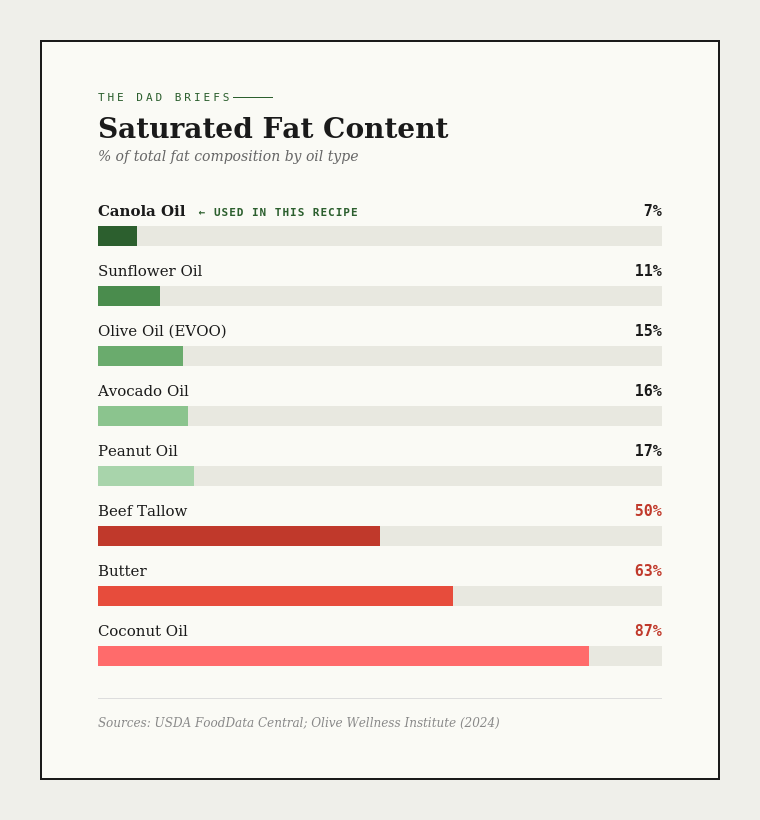
Among common everyday cooking oils, canola oil has one of the lowest saturated fat profiles — around 7%, compared to olive oil’s 14-15% and butter’s 63%. It also contains omega-3 fatty acids (9-11%), which most seed oils don’t.
The FDA has issued a qualified health claim for canola oil — meaning the evidence is real but not yet definitive enough to be called conclusive. The specific language on the label reads: “Limited and not conclusive scientific evidence suggests that eating about 1½ tablespoons of canola oil daily may reduce the risk of coronary heart disease due to the unsaturated fat content in canola oil.”
Important word there: “qualified.” The FDA isn’t hiding anything. They’re putting the nuance on the label. The point is that a federal health agency reviewed the evidence and put a heart health claim on a seed oil — and that doesn’t fit the narrative, so the influencers skip over it.
Is canola oil the pinnacle of human nutrition? No. Extra virgin olive oil has a more favorable antioxidant profile and a longer track record in the literature. For dressings or finishing dishes, EVOO is still a great choice. But for high-heat cooking — a stir-fry, a wok dish, fried rice — canola oil is a solid, well-studied option with a high smoke point and heart health support behind it.
Who Is Selling You the Panic?
As always, follow the money.
Paul Saladino, one of the loudest voices against seed oils, sells supplements, beef-based products, and books. He’s built an entire brand on the idea that ancestral eating requires rejecting vegetable oils. His income is tied to the narrative.
The beef tallow influencer community at large has financial relationships with grass-fed beef suppliers, tallow skincare brands, and carnivore diet product lines. A 2023 analysis by the Center for Science in the Public Interest found that a significant portion of the most-shared “seed oil” content online came from accounts with direct product tie-ins.
None of this means everyone who avoids seed oils is a grifter, or that skepticism of processed food is wrong. But when you notice that virtually every high-profile “seed oils are poison” account is selling something — a supplement, a tallow candle, a carnivore meal kit — it’s worth applying the same skepticism you’d apply to a study funded by the corn oil industry.
The irony is that the standard they demand from food scientists — disclose funding, show your work — they rarely meet themselves.
Practical Guidance: When to Use What
None of this means all oils are identical. Here’s a clear-eyed breakdown:
High-heat cooking (wok, stir-fry, searing): Canola oil, avocado oil, or refined olive oil. Good smoke points, stable under heat.
Medium-heat sauteing: Extra virgin olive oil is fine here, and brings additional polyphenol benefits.
Dressings and finishing: Extra virgin olive oil is the gold standard. Flavor, antioxidants, and strong cardiovascular evidence.
Baking: Canola oil or a neutral vegetable oil works well for most applications.
Butter: Not a villain. Use it where it adds flavor. Just don’t let anyone tell you it’s the health food and canola oil is the poison.
Ultra-processed packaged food: The real issue isn’t which oil is in the chip. It’s the chip. Cooking real food at home with any reasonable oil is categorically different.
The single most predictable driver of diet-related disease in the U.S. is ultra-processed food consumption — not the type of oil a home cook uses on Tuesday night.
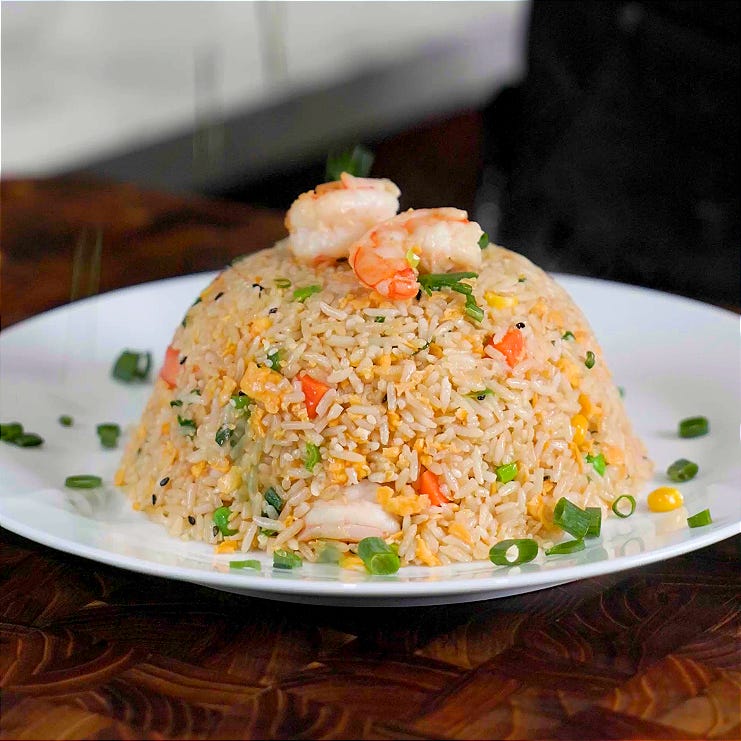
Shrimp Fried Rice
INGREDIENTS
3 tbsp vegetable oil (divided)
3 eggs
3 tbsp butter
8–10 medium shrimp, peeled & deveined
3–4 medium cloves fresh garlic, minced or pressed
4 cups cooked rice (day-old rice works best)
⅓ cup spring onions, chopped (reserve some green pieces for garnish)
½ cup mixed vegetables (carrots, peas, corn) — frozen is fine
1 tsp sesame oil
4 tbsp soy sauce
1 tbsp sesame seeds, toasted 5 min at 350°F
DIRECTIONS
1. Heat 2 tbsp canola oil in a wok or large pan on high. Cook eggs to a runny scramble, remove, and set aside.
2. Add the remaining 1 tbsp oil as the pan comes back up to temp. Add shrimp and cook until almost done.
3. Push shrimp to the side. Add onions and garlic and let them cook separately for a moment before combining. Add mixed vegetables and cook through.
4. Add rice and butter, stirring until butter melts. Add the cooked eggs, sesame oil, and 2 tbsp soy sauce. Stir and flip continuously, letting the underside cook and all the rice turn light brown.
5. Turn off heat. Add sesame seeds and stir to combine. Taste and add salt or more soy sauce as needed. Garnish with reserved green onion.
Sources
1. Marklund M, et al. (2019). Biomarkers of Dietary Omega-6 Fatty Acids and Incident Cardiovascular Disease and Mortality. Circulation, 139(21), 2422–2436.
2. Su H, et al. (2017). Dietary linoleic acid intake and blood inflammatory markers: a systematic review and meta-analysis of 30 RCTs. Food & Function, 8, 3091–3103.
3. Johnson GH, Fritsche K. (2012). Effect of dietary linoleic acid on markers of inflammation in healthy persons: a systematic review of RCTs. Journal of the Academy of Nutrition and Dietetics.
4. Farvid MS, et al. (2014). Dietary Linoleic Acid and Risk of Coronary Heart Disease. Circulation, 130(18), 1568–1578.
5. U.S. FDA. (2006). Qualified Health Claim for Canola Oil and Reduced Risk of Coronary Heart Disease.
6. U.S. FDA. (2018). Qualified Health Claim for Oleic Acid in Edible Oils and Reduced Risk of Coronary Heart Disease.
7. Olive Wellness Institute. (2024). Extra Virgin Olive Oil vs Canola Oil — Which Is Healthier?
8. Harvard T.H. Chan School of Public Health. (2015). Ask the Expert: Concerns about canola oil.
Keep on cooking. The science has this one covered. 🍳


