


In December 2025, the University of Alabama pulled the plug on two student magazines. One was Nineteen Fifty-Six — named for the year the first Black student enrolled at UA. The other was Alice, focused on women students. The university’s justification: a non-binding memo from Attorney General Pam Bondi about DEI compliance.
Not a court order. Just a memo from an administration that decided, preemptively, that student journalism by Black students and women was a DEI problem.
That’s where we are.
The assault on American higher education isn’t one policy. It’s a campaign running on every front simultaneously: DEI programs dismantled, research grants threatened or canceled, international students discouraged, curriculum policed, and faculty quietly rewriting their own work to avoid getting flagged.
The federal government has moved, in a single year, to reshape what universities teach, who they admit, what researchers can study, and whether institutions can operate independently of political pressure at all.
To understand what is actually being lost — and what it will cost — I spoke with Dr. Zakiya Smith Ellis. She’s a principal at Education Counsel and the former Secretary of Higher Education for the state of New Jersey. She has spent her career at the intersection of federal policy and campus life, and she has seen, up close, what inclusive higher education actually produces in people’s lives.
What she described is a system under siege. And a generation that will pay for it.
What ‘DEI’ Actually Means (And What Disappears When It Goes)
The anti-DEI movement has done something tactically clever: it turned three words into a slur. Say “DEI hire” with enough contempt, and people stop asking what the words mean. Ellis wouldn’t let that slide.
“Diversity is the idea that you want to bring talent from wherever it may be,” she said. “If you have all the same kinds of people together, you’re actually not being excellent. The idea that diversity is somehow at odds with excellence is a total farce.”
Equity, she explained, is simpler than it sounds. It just means making sure everyone has what they need to succeed. Women in STEM support programs. Cultural spaces for students navigating predominantly white institutions. Publications where students who have historically been invisible can see themselves.
Which brings us back to Alabama. The university shut down Nineteen Fifty-Six — a magazine whose entire premise was that Black students’ stories are worth telling. The Student Press Law Center called it “a more straightforward example” of unconstitutional viewpoint discrimination than they had ever seen.
Note: Dr. Ellis referred to Nineteen Fifty-Six as a “newspaper” in our conversation, but it’s generally regarded as a student magazine. A second magazine, Alice, which focused on women students, was also suspended. Both suspensions were confirmed across multiple outlets.
“Why can’t we have a magazine that’s about reporting on Black issues?” Ellis asked. “It doesn’t mean that you can’t read it if you’re not Black.”
The university shut it down, even though nobody argued that the magazine excluded white readers.
The Research Crisis: What the Relief Headlines Missed
Here are the numbers.
The Trump administration proposed cutting the NIH budget by more than 40 percent. The National Science Foundation, nearly in half. It moved to cap the indirect cost reimbursements that universities use to run labs, maintain equipment, and keep the lights on.
Congress pushed back and passed a spending bill with a $415 million NIH increase. That’s the version of the story that got the relief headlines.
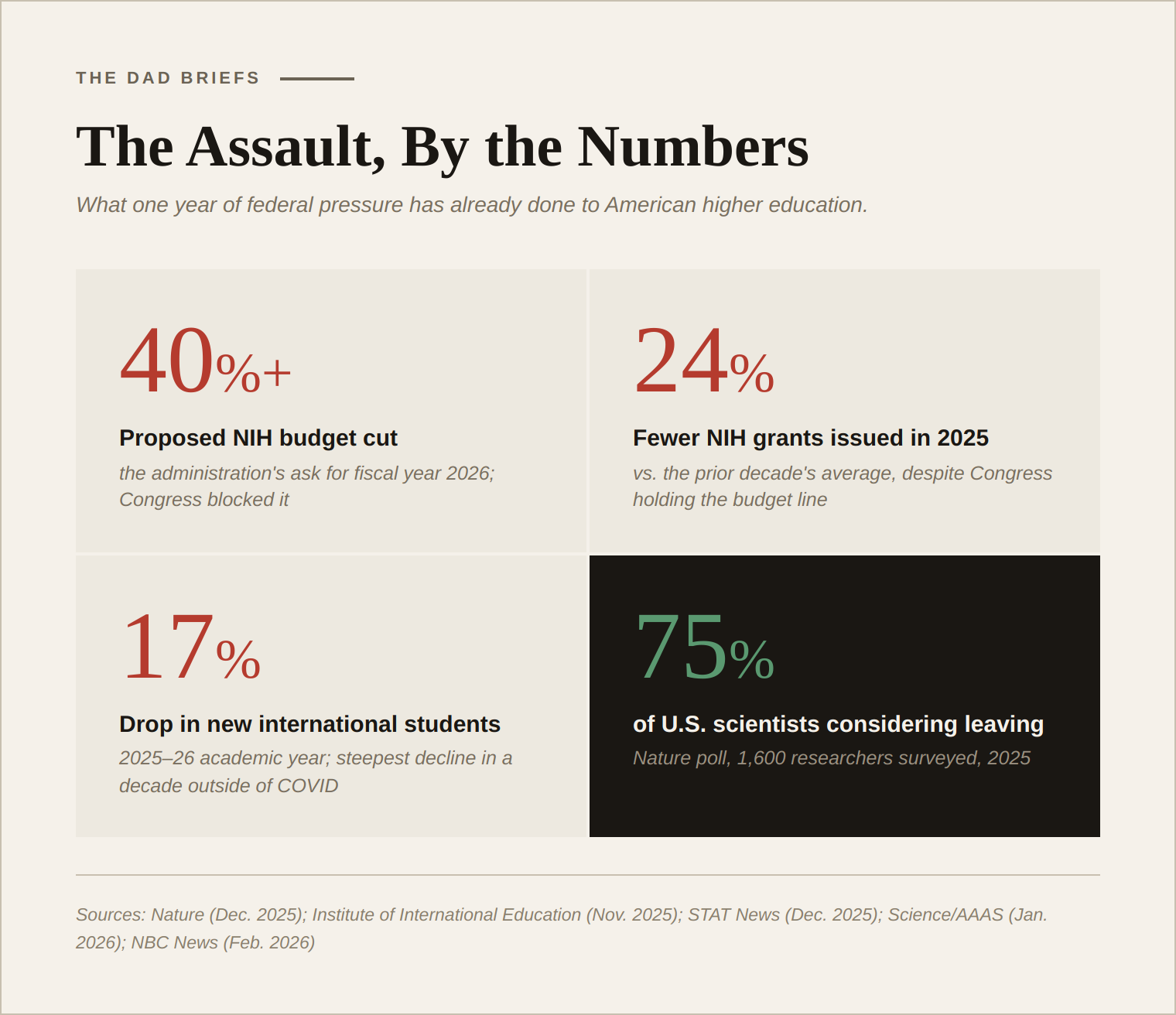
Still, the NIH issued roughly 24 percent fewer grants in 2025 compared to its decade-long average, according to analysis published in Nature. Hiring froze. PhD program enrollments flatlined. Clinical trials paused. Some institutions rescinded offers to incoming graduate students. A year of uncertainty doesn’t reverse when the budget number normalizes.
Ellis pointed to something even harder to quantify: what happens to research that technically still gets funded.
“If you can get people to censor themselves without you having to do it, you’ve changed the trajectory of things forever.” — Dr. Zakiya Smith Ellis
Researchers are quietly scrubbing their grant applications of flagged language — not because a law requires it, but because they’re afraid. And the chilling effect is reaching places that have nothing to do with race or politics.
“A florist studying agriculture may describe the diversity of flowers in their research,” Ellis said. “And they’re thinking: ‘I don’t want to get flagged by your AI diversity reader.’ That’s just stupid. We’ve got really smart people spending time doing stuff like that.”
She invoked Orwell — 1984, Animal Farm — not as hyperbole but as instruction. The point of controlling language isn’t to ban every word. It’s to get people to police themselves. Once that happens, you’ve already won.
Who’s Holding the Line, and How
Not every institution has bent. Ellis recently attended higher education conferences where the conversation was dominated by a single question: what separates the schools pushing back from the ones that aren’t?
She had just heard former U.S. Ambassador to Hungary David Pressman speak about what he witnessed in Budapest. Pressman served there from 2022 to 2025, and watched the Orban government bring Hungarian universities to heel — institution by institution, compromise by compromise, until they became, as Ellis put it, “wholly owned subsidiaries of the government.”
Each capitulation came with a justification. I’m protecting my students. I’m protecting the research funding. I’m protecting the people who work here.
“Once you start to compromise your values, it’s like being a little bit pregnant,” Ellis said. “You either have these values, and you stand for them, or you don’t.”
She’s not naive about the pressures on university presidents. The funding threats are real. The legal exposure is real. But she has a hard line — and she thinks smaller institutions, the ones without Harvard’s endowment or Yale’s legal team, can still hold it.
“I have a hard line about whether the government can extort money from you that you were already due,” she said. “That feels like a principled stance that we have to be able to take.”
Some schools are taking that stand. Most are not. The ones that aren’t are betting that compliance now will protect them later.
Hungary suggests that bet doesn’t pay off.
The Generation That Will Pay for This
Ellis ran higher education for one of the most diverse states in the country. She watched what happened when genuine diversity — of background, geography, income, experience — was brought into a room and asked to build knowledge together.
She worries that what is being dismantled now is not just a set of programs. It’s a decades-long project of deciding whose stories belong in the American account. And the thing about that project is how long it takes.
“I worry that’s actually the point — to change the way we think about what is true, what matters, whose stories matter. It takes a long time to undo.” — Dr. Zakiya Smith Ellis
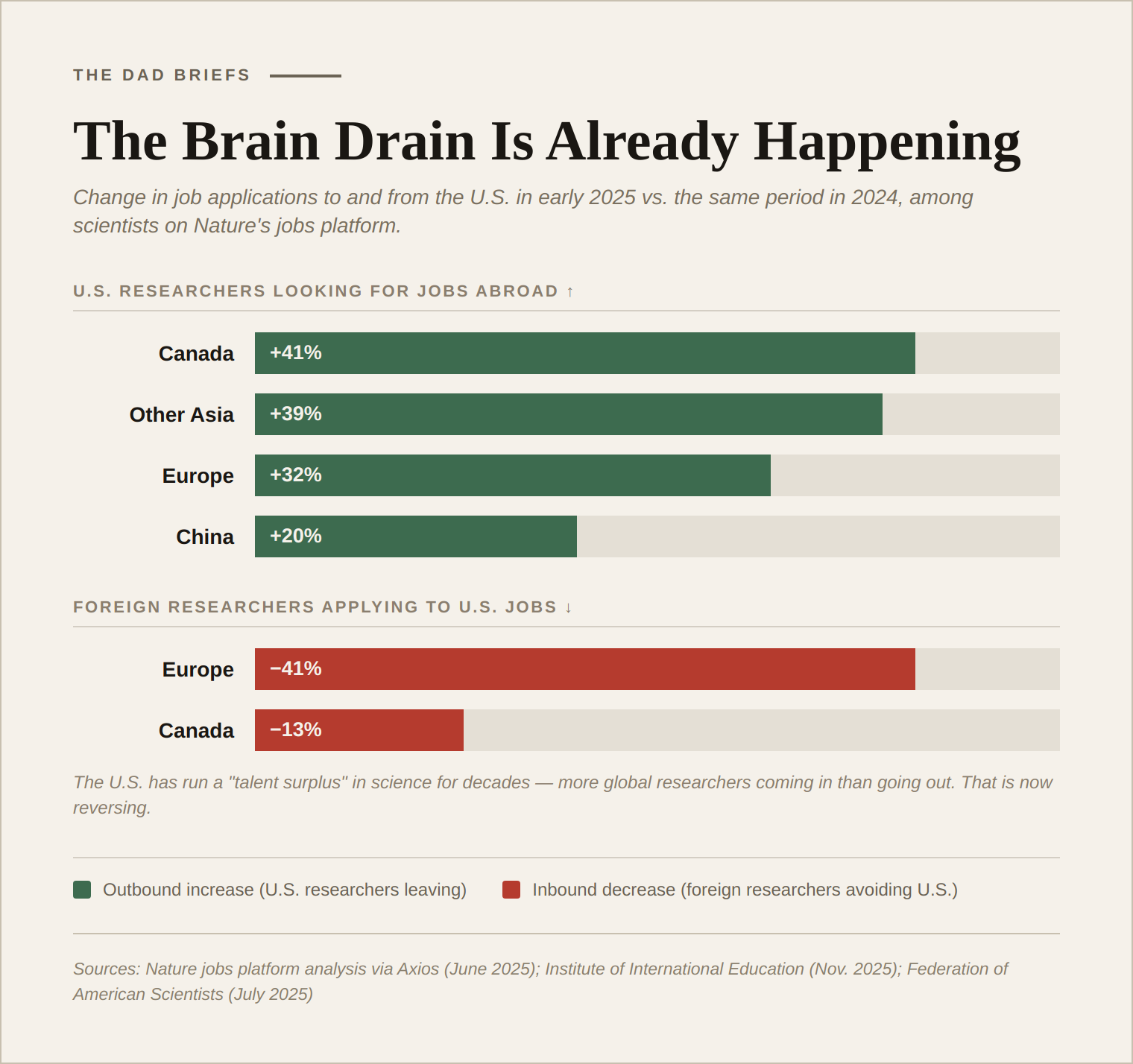
The brain drain data backs her up. A 2025 Nature poll of 1,600 scientists found 75 percent were considering leaving the U.S. New international student enrollment fell 17 percent in the 2025-26 academic year — the steepest drop in a decade outside of COVID. Applications from U.S.-based researchers to European funding bodies nearly tripled. France, Canada, Australia, and China have all launched campaigns to recruit American scientists.
Ellis doesn’t think this is a side effect.
“I actually think that’s a feature, not a bug,” she said. “The current administration has said: we don’t want international students, we don’t think they have as much to add. And that is a real loss for us in the long term.”
She ended with what she believes universities are actually for.
“There is something special about colleges,” she said. “They’re meant to be a place where people of differences come together, debate ideas, test them, and produce new knowledge for the world. We’re going to see a generation of research that is lessened because it doesn’t include the perspectives we need.”
The University of Alabama shut down a magazine called Nineteen Fifty-Six so it could comply with a non-binding memo. A student who wanted to tell stories about her campus no longer has a place to do it.
That’s not a bureaucratic dispute.
That’s a generational one.
Sources & Notes
University of Alabama student magazine suspensions:
Alabama Reflector (Dec. 2, 2025); NPR (Dec. 20, 2025); Student Press Law Center (Dec. 23, 2025); Essence (Dec. 10, 2025). Both Nineteen Fifty-Six and Alice magazines were suspended; university officials cited the AG Pam Bondi DOJ memo on DEI compliance. The Student Press Law Center characterized the move as unconstitutional viewpoint discrimination.
Federal research funding cuts and Congressional response:
STAT News (Dec. 4, 2025); NBC News (Feb. 6, 2026); Science/AAAS (Jan. 2026); Nature (Dec. 2025); Inside Higher Ed (Feb. 9, 2026). The Trump administration proposed a 40%+ NIH cut and a ~57% NSF cut. Congress passed a bill with a $415M NIH increase. The NIH issued approximately 24% fewer grants in 2025 vs. the prior decade average.
Brain drain and international student enrollment:
Institute of International Education (Nov. 2025): 17% drop in new international student enrollment. Nature poll (2025): 75% of 1,600 scientists considering leaving the U.S. STAT News (Dec. 17, 2025); Axios (June 7, 2025); The Week (March 28, 2025); Federation of American Scientists (July 2025). European Research Council applications from U.S.-based researchers nearly tripled.
David Pressman:
U.S. Embassy Budapest; Center for American Progress; Wikipedia. Pressman served as U.S. Ambassador to Hungary under the Biden administration from 2022 to 2025. He is now a senior fellow at the Center for American Progress focused on countering authoritarianism.
Vanderbilt University integration history:
Vanderbilt University Black Cultural Center; Vanderbilt University Timeline; Tennessee Encyclopedia. The first Black student, Joseph Johnson, enrolled in the Divinity School in 1953. The first class of Black undergraduates was admitted in 1964. A quota limiting women to one-third of Arts and Sciences enrollment was lifted in 1969. Dr. Ellis’s description of Vanderbilt not acknowledging women or Black students “until almost the seventies” is a simplification — both groups faced formal institutional restrictions through the 1960s, which is the spirit of the point she was making.
Dr. Zakiya Smith Ellis is a principal at Education Counsel, former Secretary of Higher Education for the state of New Jersey, and former senior policy advisor to the NJ governor.


