


Actions you can take are at the bottom of this article!
The House of Representatives passed a bill this spring called the Farm, Food, and National Security Act of 2026. Tucked inside it is a provision called the Save Our Bacon Act. It has nothing to do with saving bacon.
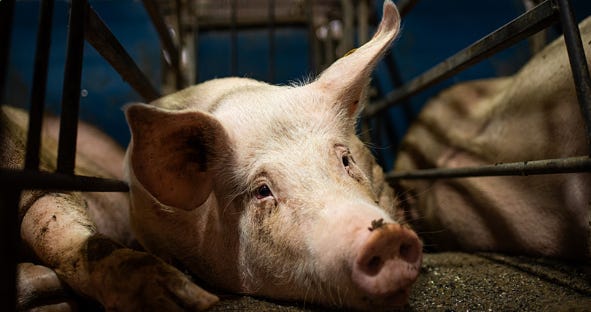
What it would do is let the biggest meat companies in the country ignore state laws about how farm animals are raised. The main target is California Proposition 12, a law that requires pork, eggs, and veal sold in the state to come only from animals given enough room to stand up, lie down, and turn around. For breeding pigs, that means no more gestation crates, the metal stalls barely wider than the animal locked inside them.
California voters approved Prop 12 at the ballot box. Roughly sixty-three percent said yes. The pork industry sued to overturn it, fought all the way up, and in 2023 the Supreme Court upheld it. Having lost with the voters and lost in court, the industry’s allies went looking for the last door left open. They asked Congress to do what the judges would not.
This wasn’t the first try. The same idea has traveled under other names before, the King Amendment and the EATS Act among them, and each version died after bipartisan pushback. Save Our Bacon is the latest coat of paint on an old car.
Who and what it protects
They sell this act like it is a lifeline for small farmers. The small farmers say the opposite.
Ask a hog farmer like Russ Kremer in Missouri, who says the share of farms qualifying for the higher standard has climbed from under ten percent to around forty, with young farmers entering the business and conservative bankers backing the barns. Ask a Pennsylvania farmer named Brent Hershey, who converted his operation, watched his herd get healthier, and now calls the split inside his own industry a civil war in the pig business.
The farmers on his side of that war did the slow, expensive work of meeting the new standard. They built the barns. They earned the market. This bill would devalue every dollar of that investment and hand the advantage back to the largest producers, several of them owned by foreign conglomerates. As one rancher put it plainly, the legislation would pull the rug out from family farms that played by the rules. The people it claims to save are the people it leaves behind.
Bigger than bacon
The reach does not stop at pork. Lawyers at Harvard Law School read the language and found it vague enough to put more than six hundred state and local laws into question. Not every one of them would fall. The trouble is that no farmer, regulator, or shopper would know which ones survive until courts spend years untangling it.
Inside that fog are rules states use to fight animal disease outbreaks like bird flu, food safety standards families count on without thinking about them, and even longstanding bans on horse slaughter. A bill marketed as a fix for one California pork rule turns out to reach into the parts of the food system most of us assume are settled.
An unlikely coalition of resistance
Spend ten minutes on this issue, and you find the strangest table in American politics.
Animal welfare groups oppose the bill. So do independent farmers. So do conservative voices like Tomi Lahren (god help us), along with libertarians and a wing of the MAHA movement that sees it as exactly the kind of corporate carve-out it organized to stop. And then there are everyday voters, the people who actually passed these laws. Polls have long shown that around eighty percent of Americans, nearly even across both parties, want laws like Prop 12 in their own states.
This is one of those rare fights where the line does not run left against right. It runs corporation against citizen.
The pressure is working
The provision cleared the House inside the larger Farm Bill. Then something shifted. As the Senate wrote its own version, the Agricultural Act of 2026, the committee left the Save Our Bacon language out. One of the provision’s own Senate sponsors backed away from it. Sponsors do not abandon their own bills by accident. They do it when enough farmers, voters, and unlikely allies make enough noise that a quiet giveaway stops being quiet.
It is also far from dead. The language can be added back during the Senate’s markup in the weeks ahead, or slipped in later when the House and Senate sit down to reconcile their two bills into one. A provision that is out today can be back tomorrow.
The win is both real and fragile at the same time, and the only thing that keeps it real is steady attention.
What you can do
Stand against the giant meat companies who wrote this bill for their own benefit. The only bacon they are saving is their own profits.
GO TO https://act.link/gi-hllsw782 RIGHT NOW and add your name to the growing list of people supporting American family farmers who have already invested in a better system.
Be kind, feed your mind, and wash your behind.
The Dad Briefs covers the civic, political, and quietly human stories that shape family life in America, with recipes along the way. Food, Fun and Fatherly Wisdom. Recipes for Resistance.
Sources
The legislation and the law
Congress.gov, H.R. 7567, the Farm, Food, and National Security Act of 2026. The House Farm Bill that carries the Save Our Bacon provision.
Congress.gov, H.R. 4673, the Save Our Bacon Act. The provision’s standalone text and sponsors.
U.S. Senate Committee on Agriculture, the Agricultural Act of 2026 (Farm Bill 2.0). The Senate draft that left the provision out.
U.S. Supreme Court, National Pork Producers Council v. Ross (2023). The decision upholding Proposition 12.
Legal and policy analysis
Brooks McCormick Jr. Animal Law & Policy Program, Harvard Law School, Legislative Analysis of H.R. 4673. The source of the finding that more than 600 state and local laws could be affected.
SCOTUSblog, National Pork Producers Council v. Ross. A plain-language summary of the ruling.
Reporting and commentary
Russ Kremer, The Farm Bill Is No Place for Big Pork’s Save Our Bacon Act, Civil Eats. A farmer’s op-ed, with a June 11 update noting a Senate sponsor’s withdrawal.
KRCU, Missouri farmer says Save Our Bacon Act threatens emerging pork markets. On the growing market for higher-welfare pork.
Sentient, Senate Ag Committee Set to Spare This Animal Welfare Law. Brent Hershey and the “civil war in the pig industry.”
Stateline, Animal welfare rules might be rolled back by Congress. The family-farm impact and the House vote.
The New Lede, Senate Farm Bill draft leaves out industry-backed provision. The Senate committee’s omission of the provision.
The New Lede, Hog farmers reject push to undo state animal welfare standards. The independent-farmer coalition opposing the bill.
The Hill, Republicans roll out farm bill without Democratic priorities. The Senate draft text and its omission of the provision.
The Hill, How the Save Our Bacon Act threatens a horse slaughter ban. The reach of the bill beyond pork.
Washington Examiner, Warning for Senate Republicans: MAHA voters oppose Save Our Bacon Act. The conservative and MAHA opposition.
Advocacy organizations
Humane World for Animals, Save Our Bacon Act excluded from US Senate Farm Bill draft. The Senate exclusion, the 63% vote, and the sponsor’s withdrawal.
Humane World for Animals, What’s happening with Prop 12 and the Save Our Bacon Act. Background, the lineage of prior attempts, and polling.
ASPCA, Senate Agriculture Committee commended for excluding Save Our Bacon language. The animal-welfare response to the Senate draft.
Thanks for this! The farm bill is something I've supported because of the nutritional assistance piece ... I worked for a non-profit food bank for 8 years. Putting this sort of nonsense in the farm bill will just delay needed resources for people who need it :-( I signed the thingy too.
Thank you. Signed